Ivrea Castle
Ivrea Castle, located in the town of Ivrea in the Piemonte region of Italy, stands as a remarkable example of late medieval military architecture combined with noble residential functions. Constructed beginning in 1358 under the direction of Amadeus VI, Count of Savoy, also known as the "Green Count," the castle symbolized the dominance and authority of the House of Savoy over the strategic Canavese area. Its commanding position near the Bishop's Palace, the Cathedral of Ivrea, and the Municipal Palace underscored its dual role as a military stronghold and a center of political power.
Historical background and construction
The construction of Castello di Ivrea was initiated to reinforce control over the town and the main road leading from the Aosta Valley. The project was overseen by architect Ambrogio Cognon and involved a large workforce, sometimes exceeding a thousand workers, reflecting the scale and importance of the endeavor. The castle's completion is estimated between 1393 and 1395, marking a significant addition to the defensive network of the Savoy territories.
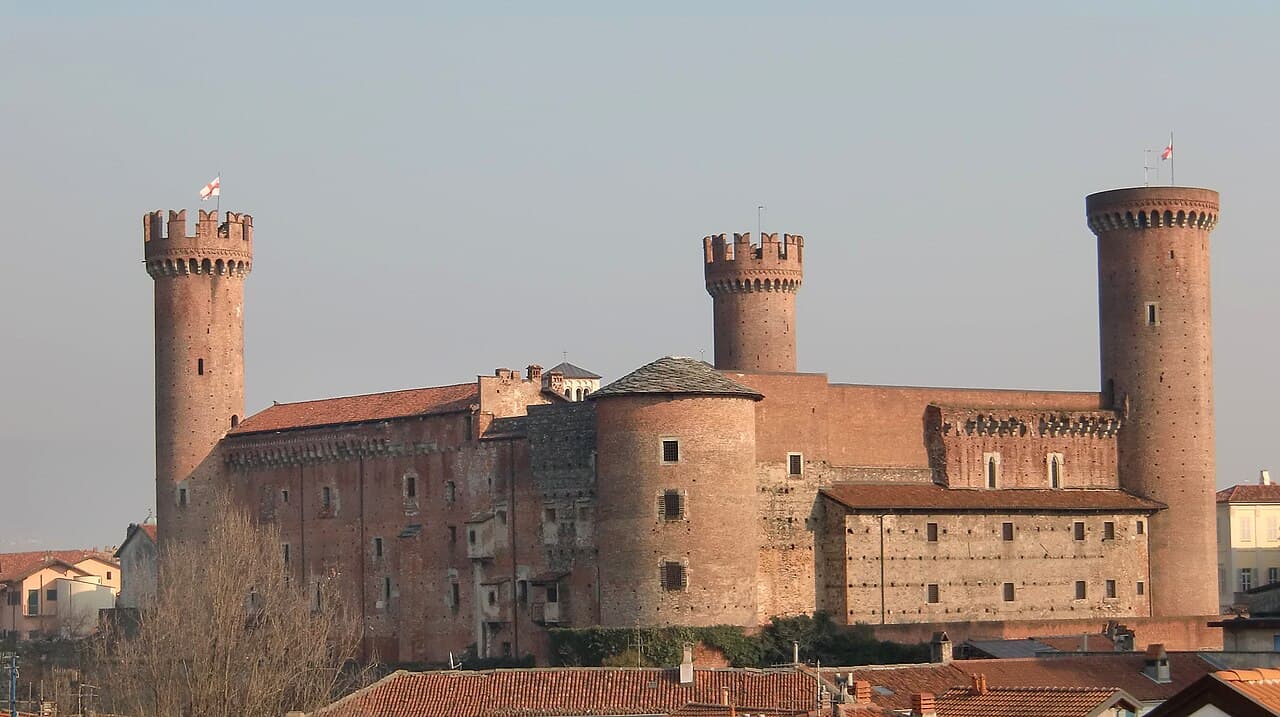
The fortress was strategically designed with a trapezoidal rectangular plan featuring four robust round towers at each corner. These cylindrical towers originally rose directly from ground level and were integral to the castle's defensive capabilities. The castle was originally three stories tall, with living quarters and service rooms arranged around an internal courtyard that served as the heart of the complex.
Architectural features and layout
Defensive structures
Ivrea Castle was fortified with swallowtail battlements, a distinctive V-shaped crenellation characteristic of Savoyard military architecture, providing defensive positions for guards and archers. The perimeter walls included a patrol walkway supported by stone corbels, allowing defenders to move along the walls safely. The main entrance was protected by a barbican and a drawbridge spanning a now-lost moat, whose foundations were uncovered during restoration excavations in 1979.
Residential and decorative elements
The castle's southern façade features a notable stone window with a trilobed arch, known as a bifora triglobata, a refined architectural detail that adds elegance to the fortress. Above this window is the coat of arms of the House of Savoy, asserting the castle's dynastic affiliation. Nearby are two smaller single-arched windows fitted with wrought iron grilles, exemplifying traditional Savoyard style. Inside the courtyard, visitors can find a well and a subterranean icehouse (glacière) measuring approximately six meters in diameter and four meters deep, used historically for food preservation.
Historical roles and transformations
Initially built as a military fortress, Ivrea Castle evolved over time to serve as a noble residence, particularly during the late 15th century. It housed prominent members of the Savoy family, including Duchess Jolanda of Valois, daughter of King Charles VII of France. The castle was the venue for important court events, such as the 1522 christening of Duke Charles III's son.
In the 16th and 17th centuries, the castle resumed a military function during the turbulent conflicts between French and Spanish forces in the region. A significant event occurred in 1676 when a lightning strike hit the main tower on the northwest corner, which was used as a powder magazine. The explosion destroyed the tower's upper sections, killed 51 people, and damaged nearby homes. The tower was subsequently capped with a conical slate roof and never rebuilt to its original height.
From the 18th century until 1970, the castle was repurposed as a prison. This period saw major structural changes, including the addition of a fourth floor and subdivision of rooms to create prison cells. These modifications resulted in the loss of much of the castle's original interior features and furnishings. The prison function divided the courtyard and enclosed the external spaces with high perimeter walls.
Restoration and current condition
After the prison was closed in 1970, ownership transferred to the Municipality of Ivrea. Restoration efforts began in the late 1970s, culminating in 1979 with the removal of 19th and 20th-century prison-era additions to reveal the castle's original structures, particularly in the courtyard and moat areas. Roofs were repaired, and the battlemented towers restored to reflect their medieval appearance.
Further restoration work started in January 2023, leading to the castle's reopening to the public in July 2024. Today, Ivrea Castle stands as partially preserved ruins, offering visitors a glimpse into its layered history through accessible ground-floor areas, including a circular isolation cell within one tower and several adjoining prison cells. A detailed scale model helps illustrate inaccessible parts of the fortress.
Cultural significance and visitor experience
The castle is prominently mentioned in the works of the Italian poet Giosuè Carducci, highlighting its cultural resonance beyond architecture and history. Its proximity to Ivrea's cathedral and bishop's palace situates it within a rich urban fabric of historical landmarks.
Visitors today can appreciate the castle's medieval military architecture, its transformation over centuries, and its role in the political and social history of the Savoy region. The combination of defensive features, noble residential elements, and later prison modifications makes Ivrea Castle a unique monument reflecting the complex history of northern Italy.
Frequently asked questions (FAQ)
- What is the historical significance of Ivrea Castle?
- Ivrea Castle, dating back to the 10th century, played a crucial role in the defense of the region against invasions. It served as a royal residence and a strategic military stronghold throughout the Middle Ages, reflecting the turbulent history of the area.
- When was Ivrea Castle built?
- The construction of Ivrea Castle began in the late 10th century, with significant modifications and expansions occurring over the following centuries. Its architecture showcases a blend of styles that evolved as the castle adapted to changing military needs and tastes.
- Is it possible to visit Ivrea Castle?
- Yes, Ivrea Castle is open to visitors who wish to explore its historic grounds and impressive architecture. Guided tours are often available, allowing guests to learn more about its rich history and the stories behind its walls.
- What are the opening hours for Ivrea Castle?
- Ivrea Castle typically opens its doors to visitors from Tuesday to Sunday, with varying hours depending on the season. It is advisable to check the official website or local tourist information for the most current opening times before planning your visit.
- Can I purchase tickets in advance for Ivrea Castle?
- Yes, tickets for Ivrea Castle can often be purchased in advance through the official website or at local tourist offices. This can help ensure your entry, especially during peak tourist seasons when the castle is particularly popular.
- What is the best time to visit Ivrea Castle?
- The best time to visit Ivrea Castle is during the spring and fall when the weather is mild and the tourist crowds are smaller. This allows for a more enjoyable experience as you explore the castle and its stunning surroundings.
- Are there any nearby attractions to Ivrea Castle?
- Yes, nearby attractions include the charming old town of Ivrea, known for its beautiful architecture and vibrant streets. Additionally, visitors can explore the surrounding natural landscapes, including the picturesque Canavese region.
- How accessible is Ivrea Castle for visitors with mobility challenges?
- Ivrea Castle has made efforts to improve accessibility for visitors with mobility challenges, although some areas may still present difficulties due to the historical nature of the site. It is recommended to contact the castle administration in advance to inquire about specific accessibility options and assistance available during your visit.
Photo gallery

Information
Website
Visit websiteSources & official resources
Verify the information above using these authoritative references.
Loading map...
Visitor reviews
No reviews yet. Been here? Write the first review and help other travelers!
Write the first reviewVisited this castle? Share your experience
Your review helps other travelers and adds first-hand knowledge to our encyclopedia.