Ivangorod Fortress
Ivangorod fortress is a significant Russian medieval castle founded in 1492 by the Moscovian Grand Prince Ivan III. Strategically positioned on the eastern bank of the Narva River, opposite the Estonian city of Narva, the fortress was constructed to serve as a powerful bulwark against the expansion of the Livonian Order. Its establishment marked a crucial moment in the territorial conflicts between the emerging Russian state and the Livonian Confederation during the late medieval period.
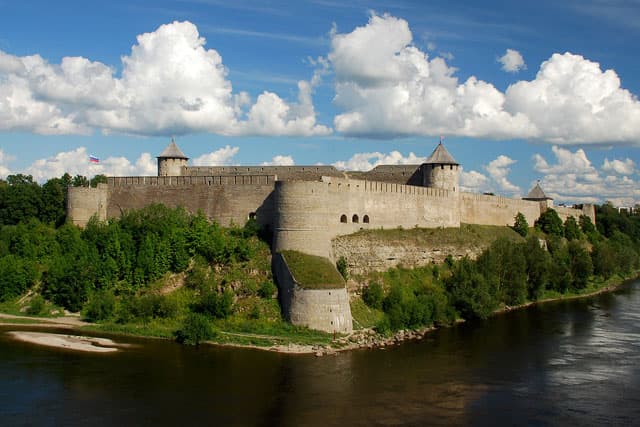
The fortress is characterized by a strictly quadrilateral layout, with imposing walls rising approximately 14 meters tall. Remarkably, the original castle was constructed within a single summer, reflecting the urgency and military importance of the project. The design focused on robust defense, featuring thick curtain walls and corner towers that provided overlapping fields of fire. This architectural approach was typical of late medieval fortifications aiming to withstand sieges and artillery attacks.
Construction and architectural features
The initial construction of Ivangorod fortress was a feat of rapid medieval military engineering. Its quadrangular plan enclosed a central courtyard and was fortified with massive stone walls, designed to repel the Knights of Livonia. The fortress included several defensive elements such as bastions and battlements to enhance its resilience against attacks. Over time, the fortress expanded into a sprawling complex with multiple defensive lines, reflecting its evolving military role.
Fortress layout and defensive structures
The fortress's walls formed a nearly perfect square, a common design in the late medieval period to maximize defensive coverage and minimize blind spots. The walls were constructed from locally sourced limestone and brick, materials chosen for their durability. The corner towers provided vantage points for lookouts and archers, while the gatehouse was heavily fortified to control access. Inside, the fortress housed essential facilities including barracks, armories, and two notable churches.
Churches within the fortress
Two churches stand within the fortress walls, underscoring the religious significance intertwined with its military purpose. The first, dedicated to the Virgin's Assumption, was constructed shortly after the fortress's founding in 1496. The second, dedicated to St. Nicholas, was built in the late 16th century and later reconstructed. These churches served both the garrison stationed at the fortress and the local community, reflecting the integration of spiritual life within a military stronghold.
Historical conflicts and strategic importance
Throughout its history, Ivangorod fortress was a focal point of military conflict and territorial struggle. Shortly after its construction, the fortress was contested fiercely during the wars between the Grand Duchy of Moscow and the Livonian Order. Commanders such as Prince Ivan Gundar and Mikhail Klyapin played pivotal roles in recapturing and reinforcing the fortress after initial Livonian occupation.
For nearly a decade, the lands surrounding the fortress were embroiled in continuous warfare, with control of the fortress changing hands multiple times. By the 16th century, it had become one of the strongest defensive positions in the region, undergoing numerous reconstructions and fortification enhancements to adapt to advances in siege warfare.
Treaties and territorial shifts
The Treaty of Teusina in 1595 returned the fortress to Russian control after a period of Swedish occupation. However, in 1612, the fortress was captured by Swedish forces during the Ingrian War, valiantly defended by the voivode Fyodor Aminev and his sons. The Treaty of Stolbova later ceded Ingria, including Ivangorod, to Sweden under King Gustav II Adolf.
In 1704, during the Great Northern War, Peter the Great recaptured the fortress, reinstating Russian sovereignty. This marked a significant turning point, as the fortress became part of the expanding Russian Empire's western defenses.
Decline of military significance and later history
Following the early 18th century, the fortress's military importance declined due to advances in artillery and changes in warfare tactics. A 1728 review criticized the fortress for neglect and low combat readiness. Despite orders for restoration, by 1738 it was deemed inadequate for modern defense needs.
Throughout the 19th and early 20th centuries, the fortress underwent various renovations, including roof replacements in 1840, structural improvements in 1863, and further work between 1911 and 1914. These efforts were more about preservation than upgrading its defensive capabilities.
Role during world wars and 20th century
During World War I, the fortress was captured by German forces in February 1918. Post-war geopolitical changes placed the fortress under Estonian control from 1919 to 1940. Despite its strategic location, the fortress did not play a significant combat role during this period.
In World War II, the fortress was alternately controlled by the Soviet Union and Nazi Germany. The Germans established two prisoner-of-war camps within the fortress and caused considerable damage during their retreat. After the Soviet annexation of Estonia in 1940, the fortress became part of the Russian Soviet Federative Socialist Republic.
Modern status and cultural significance
Following the dissolution of the Soviet Union and Estonia's restoration of independence in 1990, the fortress and the adjacent town of Ivangorod remained within the Russian Federation. Today, Ivangorod fortress functions as a museum, attracting visitors interested in medieval military architecture and Russian history.
The fortress is recognized for its well-preserved late medieval fortifications and its role in the complex history of Russo-Baltic relations. It stands as a testament to the military ingenuity of the late 15th century and the turbulent history of the borderlands between Russia and the Baltic states.
Visitors to the fortress can explore its extensive walls, towers, and inner courtyards, as well as the historic churches. The site offers insights into the architectural evolution of military fortresses and the geopolitical struggles that shaped the region.
Frequently asked questions (FAQ)
- What is the historical significance of Ivangorod fortress?
- Ivangorod fortress is a key late medieval Russian stronghold built in 1492 to defend against the Livonian Knights and played a major role in Russo-Baltic conflicts.
- How can I visit Ivangorod fortress and what are the opening hours?
- The fortress is open daily from 10:00 to 18:00. Visitors can explore the walls, towers, churches, and museum exhibits.
- What architectural style is Ivangorod fortress built in?
- The fortress is built in the Gothic style, typical of late medieval military architecture, featuring quadrilateral walls and corner towers.
- Are there any churches inside the fortress worth seeing?
- Yes, the fortress houses two historic churches: one dedicated to the Virgin's Assumption (1496) and another to St. Nicholas, built in the late 16th century.
- Did Ivangorod fortress play a role in the world wars?
- During both World Wars, the fortress changed hands multiple times and was used as a military site and POW camp, though it saw limited combat.
- Is the fortress accessible for visitors with limited mobility?
- While some areas of the fortress involve uneven surfaces and stairs, efforts have been made to improve accessibility; visitors with mobility concerns should check with the museum in advance.
- What is the best time of year to visit Ivangorod fortress?
- The fortress is best visited in late spring through early autumn when weather conditions are favorable for exploring the outdoor structures.
Photo gallery

Information
Opening hours
10:00-18:00, daily
Ticket prices
€5 adult, €3 child
Current owner
State museum
Website
Visit websiteSources & official resources
Verify the information above using these authoritative references.
Loading map...
Visitor reviews
No reviews yet. Been here? Write the first review and help other travelers!
Write the first reviewVisited this castle? Share your experience
Your review helps other travelers and adds first-hand knowledge to our encyclopedia.