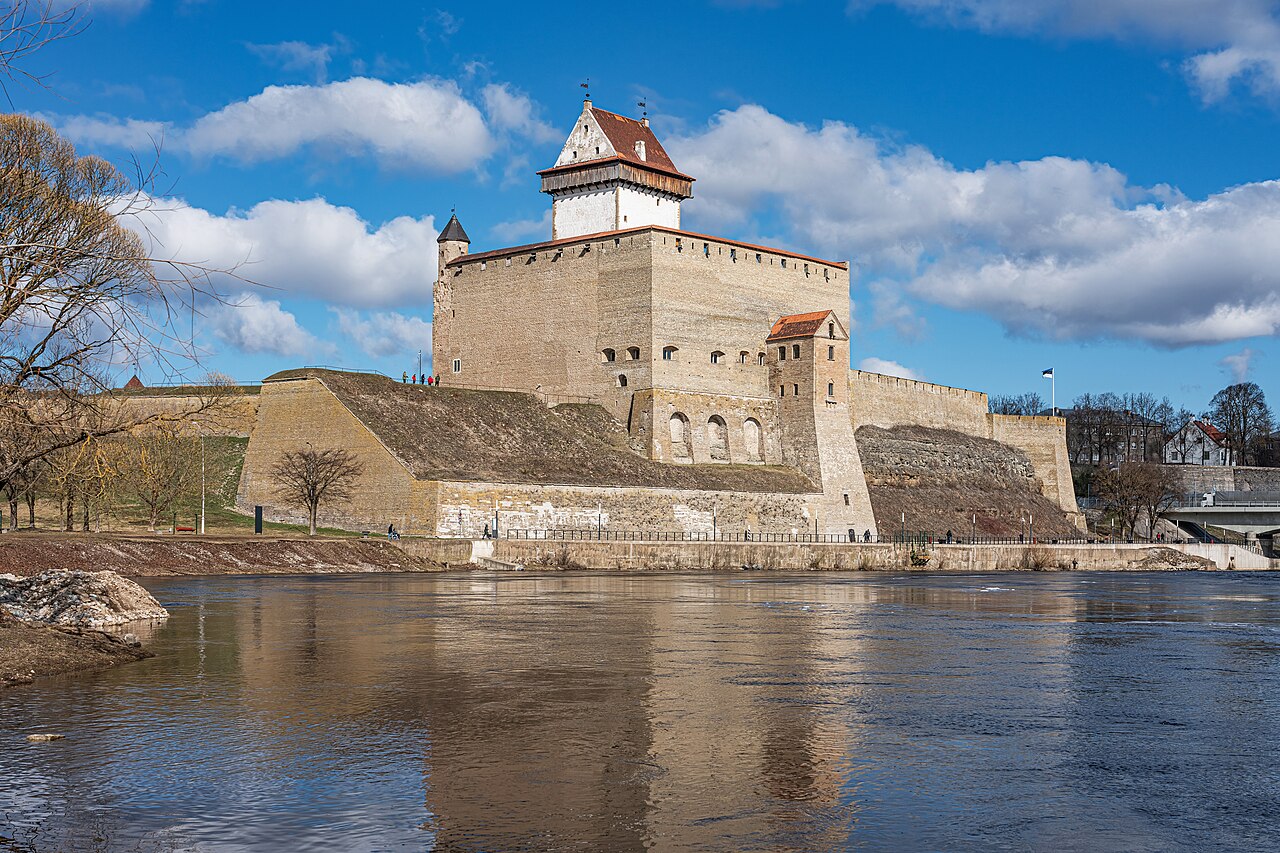
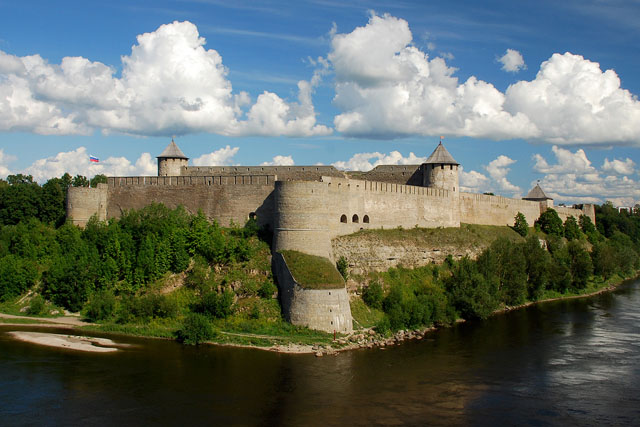
Vasknarva Castle stands as a significant medieval fortress located near the village of Vasknarva in northeastern Estonia, close to the border with Russia. Established by the Livonian Order, a military and religious order active in the Baltic region during the Middle Ages, the castle served as a critical stronghold controlling the Narva River and adjacent trade routes. Its strategic position made it a focal point in numerous conflicts shaping the history of northeastern Europe.
The earliest fortification at the site was a wooden castle built in 1349 under the leadership of Goswin von Herike, then master of the Livonian Order. This initial structure was intended as a border fortress and administrative center along the Narva River near Lake Peipus. However, this wooden fortification was short-lived, destroyed within the same year during attacks by forces from the Pskov Republic or possibly local fishermen from across the river, reflecting the volatile nature of the frontier.
Construction of the stone fortress
Recognizing the need for a more durable defense, the Livonian Order initiated the construction of a stone castle between 1427 and 1442. A master builder from Tallinn was commissioned to oversee the project, resulting in a fortress that embodied the military architectural principles of the 15th century. The castle was built on a regular quadrangular plan, typical for the period, allowing defenders to maintain clear lines of fire for archers and early firearms.
The stone walls, made from locally sourced limestone, were robust, with thicknesses ranging from approximately 2.6 to 3.6 meters, designed to withstand artillery attacks. The castle's footprint measured about 75 meters in length and 32 meters in width, enclosing a courtyard surrounded by a curtain wall and fortified with corner towers. Two prominent diagonal towers stood at the northwest and southeast corners. The southeast tower was partly rounded and projected beyond the curtain wall, likely intended to house artillery and protect the main entrance.
The main residential building
The castle's core was the main residential building, or "majalinnus," rising approximately three stories tall. It measured 23 by 15 meters, with a floor area exceeding 330 square meters. Large windows on the main floor illuminated the interior, which included a chapel and living quarters for the vogt (bailiff), the castle's administrative head. Ingeniously, staircases, including a spiral staircase, were embedded within the thick walls, facilitating discreet and secure movement between floors.
The basement and attic spaces served both economic and defensive functions. The roof was covered with copper sheets, a feature indicating the castle's status and the importance placed on durability. The castle’s design reflected a blend of military necessity and residential needs, emphasizing its role as both a fortress and an administrative center.
Historical significance and military engagements
Throughout the 16th and 17th centuries, Vasknarva Castle was embroiled in the turbulent conflicts that swept across northeastern Europe. During the Livonian War, Moscow’s forces captured the fortress in 1558, underscoring its strategic value. The Swedes recaptured it in 1581 and undertook restorative efforts following the cessation of hostilities in 1583.
The castle's military importance persisted into the Russo-Swedish War (1656–1658), during which Russian troops briefly occupied it. In the early 18th century, the campaigns of Peter the Great brought the fortress under Russian control in 1704. However, repeated destruction, including a deliberate demolition by Peter I’s forces in 1699, diminished its military role.
Subsequent damage from fires in 1832 and 1901 further contributed to the castle's decline. Since then, it has remained a ruin, though it was recognized as a national cultural monument in Estonia in 1964 and included in the country's heritage registry in 1998.
Architectural features and archaeological findings
Vasknarva Castle's architecture exemplifies 15th-century military design adapted for the challenges of artillery warfare. The curtain walls and towers provided overlapping fields of fire, while the robust stone construction enhanced its defensive capabilities. Archaeological excavations conducted in 1983, 2019, and 2021 have uncovered cellars, shore fortifications, and the remains of outer defensive walls with at least three towers, though a fourth tower remains unlocated.
Today, only three walls of the main residential building remain standing above ground, alongside scattered ruins. These remnants provide valuable insight into the castle's layout and defensive strategies, confirming its role as a fortified administrative center rather than a monastic complex. The absence of monastic buildings distinguishes Vasknarva from other Livonian Order castles that often included religious structures.
Defensive adaptations
The castle's thick walls, measuring up to 3.6 meters, and the design of the diagonal towers reflect adaptations to the evolving nature of warfare, particularly the introduction of artillery. The partly rounded southeast tower, projecting beyond the curtain wall, was likely designed to mount cannons and to provide flanking fire along the walls, a common feature in late medieval fortifications transitioning to early modern artillery defense.
Cultural heritage and preservation
Despite its ruinous state, Vasknarva Castle remains a symbol of Estonia's medieval heritage and its strategic importance in Baltic history. Its designation as a national cultural monument and inclusion in the heritage registry highlight ongoing efforts to preserve and study the site. The castle attracts historians, archaeologists, and visitors interested in medieval military architecture and the complex history of the Livonian Order's borderlands.
Interpretive efforts and archaeological research continue to enrich understanding of the castle's historical context and architectural evolution. The site offers a tangible connection to the dynamic geopolitical struggles that shaped the Baltic region from the Middle Ages through the early modern period.
Frequently asked questions (FAQ)
- What is Vasknarva Castle known for?
- Vasknarva Castle is renowned for its impressive medieval architecture and strategic significance in Estonia's history. Built in the 14th century, it served as a defensive stronghold and a residence for local nobility, reflecting the region's turbulent past.
- When was Vasknarva Castle built?
- Vasknarva Castle was constructed in the 14th century, specifically starting in 1346. It has undergone various renovations and restorations over the centuries, preserving its historical charm while adapting to changing times.
- Can I visit Vasknarva Castle year-round?
- Yes, Vasknarva Castle is open to visitors throughout the year, though accessibility may vary depending on the season. It’s best to check the official website for any seasonal events or maintenance updates that might affect your visit.
- What are the opening hours of Vasknarva Castle?
- The opening hours for Vasknarva Castle typically vary by season, with longer hours during the summer months. It is advisable to check the castle's official site for the most up-to-date information on visiting hours before planning your trip.
- Is there an entrance fee to visit Vasknarva Castle?
- Yes, there is a nominal entrance fee to explore Vasknarva Castle, which helps maintain the site and fund its preservation. Ticket prices may vary for adults, children, and families, so be sure to check the official site for current rates.
- What is the best time to visit Vasknarva Castle?
- The best time to visit Vasknarva Castle is during the late spring and summer months when the weather is pleasant and the grounds are vibrant. Additionally, numerous events and festivals are held in and around the castle during this time, enhancing the visitor experience.
- Are there any nearby attractions to Vasknarva Castle?
- Yes, Vasknarva Castle is located near several other historical sites and natural attractions, including the beautiful Narva River and the town of Narva itself. Visitors can also explore local museums and parks that showcase the rich cultural heritage of the region.
- Is Vasknarva Castle accessible for visitors with disabilities?
- Vasknarva Castle strives to be accessible to all visitors, including those with disabilities. However, some areas may have limitations due to the castle's historic structure, so it's recommended to contact the visitor center in advance for specific accessibility information.
Information
Loading map...
Visitor reviews
No reviews yet. Been here? Write the first review and help other travelers!
Write the first reviewVisited this castle? Share your experience
Your review helps other travelers and adds first-hand knowledge to our encyclopedia.