Issogne Castle
Issogne Castle stands as a remarkable example of Renaissance and Gothic architecture nestled in the Aosta Valley of Italy. Its origins trace back to the 12th century, with earlier evidence suggesting a Roman villa from the 1st century BC once occupied the site. This historic residence is renowned for its exquisite frescoes, antique furnishings, and the iconic pomegranate fountain that adorns its central courtyard. Visitors to Issogne Castle are treated not only to a rich architectural experience but also to a vivid glimpse into the daily life and noble culture of the late Middle Ages and Renaissance period in the Alpine region.
Historical evolution and significance
The earliest documented mention of Issogne Castle appears in a papal bull issued by Pope Eugene III in 1151, indicating its importance as a fortified episcopal residence. Initially controlled by the Bishop of Aosta, the castle endured significant turmoil during the 14th century, including a destructive attack around 1333 by the De Verrecio family of nearby Verrès. Despite such conflicts, the castle remained a symbol of ecclesiastical and noble power in the region.
By the late 14th century, jurisdiction passed to Yblet de Challant, lord of Verrès, who transformed the fortress into a refined Gothic residence featuring multiple towers and defensive walls. Subsequent generations of the Challant family, particularly in the 15th and early 16th centuries, undertook extensive renovations that reshaped Issogne Castle into a luxurious Renaissance palace. These enhancements were spearheaded by notable figures such as George of Challant and his cousin Margaret de La Chambre, who infused the castle with artistic and architectural sophistication.
The castle gained prominence as a noble residence, hosting distinguished guests including Emperor Sigismund of Luxemburg in 1414 and King Charles VIII of France in 1494. Ownership later passed through various noble families, including the Madruzzo and Lenoncourt lineages, reflecting the complex inheritance disputes and political dynamics of the region. By the 19th century, following a period of neglect, the castle was acquired and restored by the artist Vittorio Avondo, who preserved its Renaissance character and later donated it to the Italian state in 1907. Today, Issogne Castle is managed by the autonomous Region of Aosta Valley and remains a vital cultural and historical landmark.
Architectural features and layout
Exterior and defensive elements
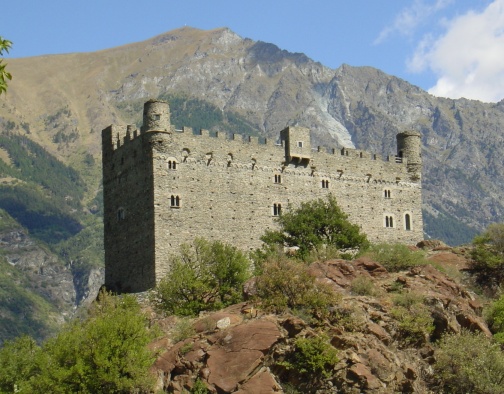
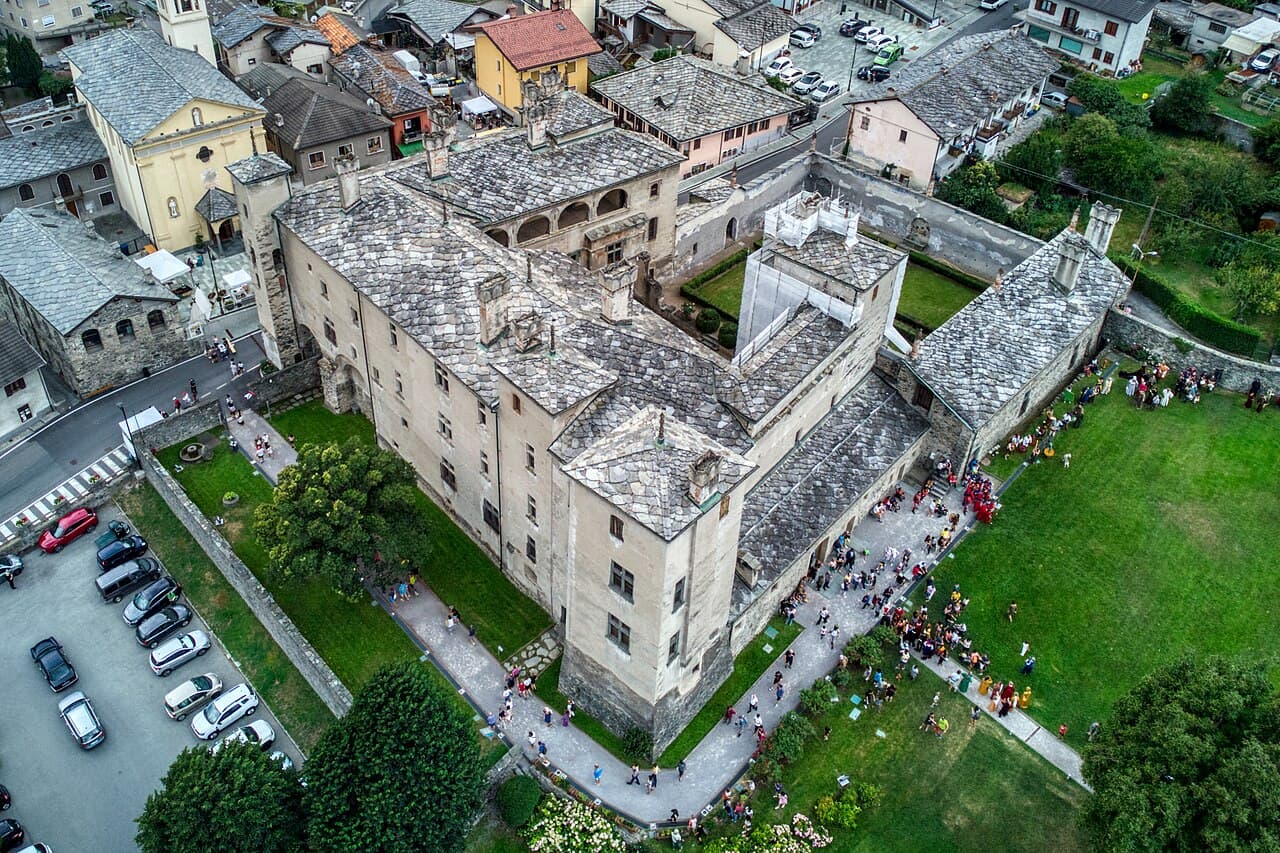
Issogne Castle is classified as a hill castle, strategically located on the right bank of the Dora Baltea river near the center of Issogne. Its quadrangular plan encloses an expansive courtyard, surrounded by living quarters and service buildings on three sides. The exterior presents a modest fortified appearance, characterized by corner turrets that rise slightly above the main structures. Unlike many medieval fortresses, Issogne’s walls lack elaborate external decoration, emphasizing a blend of defensive functionality and residential elegance.
The courtyard and pomegranate fountain
The castle’s courtyard is the heart of its architectural and artistic expression. It features a famous pomegranate fountain, an octagonal stone basin crowned by a wrought iron tree bearing symbolic pomegranates and oak-shaped leaves. These motifs represent fertility, family unity, strength, and longevity, while small iron dragons hidden among the branches add a touch of medieval mystique. Commissioned by George of Challant around 1502 as a wedding gift, this fountain is one of the castle’s most iconic elements.
Surrounding the courtyard, the walls are adorned with a remarkable series of frescoed heraldic shields known as the “Miroir pour les enfants de Challant”. These shields visually document the genealogical alliances of the Challant family, serving both as decoration and a historical record of noble lineage.
Portico and frescoes of daily life
One of the castle’s most celebrated features is its 15th-century portico along the east side of the courtyard. The portico’s rounded arches and cross vaults bear geometric rib patterns typical of the period. The lunettes above the vaults are decorated with an exceptional cycle of frescoes depicting vibrant scenes of daily life and various trades from the late Middle Ages. These include bakers, butchers, apothecaries, and soldiers engaged in leisure activities such as playing cards. Notably, this fresco cycle contains the earliest known visual representation of Fontina cheese.
Attributed to the enigmatic Master Colin, who also painted the castle chapel, these frescoes provide invaluable insight into the social and economic fabric of the time, blending humor and realism in their portrayal.
Interior spaces and artistic treasures
Ground floor halls and kitchens
The castle’s interior comprises about fifty rooms across three floors, though only a fraction are accessible to the public. The ground floor houses a vaulted dining room furnished with Renaissance-style pieces from the 19th century, connected directly to a two-part kitchen. The kitchen features a large fireplace and oven in one section and a smaller hearth with a sink in the other, illustrating the functional aspects of noble domestic life.
Another significant space on this level is the hall of justice or lower hall, a large reception room frescoed with a fictive loggia supported by marble-like columns. The frescoes depict hunting scenes, courtly activities, and northern landscapes, culminating in the Judgment of Paris, where George of Challant is portrayed as Paris. These works are attributed to the Master of Wuillerine, a Franco-Flemish artist active before 1509. The hall also features a wooden ceiling with exposed beams and carved seating stalls inspired by late Gothic originals.
Private chambers and oratories
The first floor contains the private chambers of the lords, refurbished in the 19th century by Vittorio Avondo. Access is via a distinctive stone spiral staircase with trapezoidal steps winding tightly around a central cylindrical column. Among these rooms is the chamber of Marguerite de la Chambre, notable for its wooden ceiling beams and her family’s coat of arms displayed in the frieze. Adjacent is her oratory, an intimate space with a cross-vaulted ceiling and frescoes depicting the Assumption of the Virgin and the martyrdom of Saints Catherine and Margaret. These frescoes were restored in 1936.
The chambre de Savoie, named for the Savoy family arms painted on its large stone fireplace, is furnished as a 19th-century armory with Gothic-style pieces reconstructed by Avondo. The castle chapel, located above the portico, is a narrow hall divided into five bays with a wooden railing separating the lords’ and servants’ areas. Its early 16th-century winged altar and frescoes depicting Nativity scenes and biblical figures are also credited to Master Colin.
Upper floors and notable rooms
The second floor includes rooms associated with George of Challant, such as the Chambre de Saint Maurice, adorned with ceiling decorations featuring the crosses of the order. This chamber houses a 16th-century canopied bed and 19th-century furniture designed by Avondo, along with a fireplace bearing George’s coat of arms supported by a griffin and lion.
George’s private oratory, located above Marguerite’s, contains frescoes of Christ’s Crucifixion, Pietà, and Entombment, showing him kneeling before the cross. These were repainted in 1936. Another distinguished room is the Hall of the King of France, named after King Charles VIII’s visit in 1494. It features a coffered wooden ceiling, a fireplace adorned with the royal lilies of France, and a canopied bed bearing the Challant-Aymavilles arms.
The Chamber of the Tower in the northwest offers views of nearby castles and served defensive and signaling purposes. The Chamber of the Emperor, named for Emperor Sigismund’s 1414 stay, contains a 16th-century Tyrolean bed and 19th-century furnishings by Avondo.
Unique cultural elements and legacy
Graffiti and inscriptions
One of Issogne Castle’s most intriguing features is its extensive collection of graffiti carved into walls, door frames, and window surrounds over centuries. These inscriptions, often in French, Latin, and Italian, include personal reflections, witty remarks, confessions of love, and responses to the frescoes nearby. Some graffiti commemorate significant events such as the death of Count René de Challant in 1565, offering a unique social dimension to the castle’s history.
Gardens and surroundings
The castle is complemented by an Italian-style garden enclosed by a simple wall on the south side, providing a serene setting that contrasts with the fortified appearance of the main buildings. Its location near the Dora Baltea river affords panoramic views of the surrounding Alpine valley, enhancing its appeal as both a historical monument and a scenic destination.
Modern stewardship and public access
Since its donation to the Italian state by Vittorio Avondo in 1907, and subsequent management by the autonomous Region of Aosta Valley from 1948, Issogne Castle has been preserved as a cultural treasure. It is open to the public, offering visitors a comprehensive experience of Renaissance art, architecture, and noble life in the Alpine region.
Frequently asked questions (FAQ)
- How do I get to Issogne Castle?
- Issogne Castle is located in the Aosta Valley region of Italy, easily accessible by car or public transport. The nearest major city is Aosta, from where you can take a bus or drive approximately 30 minutes to reach the castle.
- What is the historical significance of Issogne Castle?
- Issogne Castle, built in the 15th century, is a remarkable example of medieval architecture in the Aosta Valley. It served as a noble residence and reflects the wealth and power of the local aristocracy during the Renaissance period.
- When was Issogne Castle built?
- Construction of Issogne Castle began in 1470 under the direction of the nobleman Pierre Sarriod de la Tour. It was completed in the early 16th century, showcasing the transition of architectural styles from Gothic to Renaissance.
- Can I take guided tours of Issogne Castle?
- Yes, guided tours are available at Issogne Castle, providing visitors with in-depth knowledge about its history and architecture. These tours typically last around an hour and are offered in multiple languages, allowing for a richer experience.
- Why is the architecture of Issogne Castle unique?
- The architecture of Issogne Castle is unique due to its blend of Gothic and Renaissance styles, characterized by its intricate frescoes and decorative elements. The castle features a distinctive courtyard, elegant towers, and beautiful gardens that enhance its historical charm.
- Is it possible to access Issogne Castle with limited mobility?
- While Issogne Castle has made efforts to accommodate visitors with limited mobility, the historical nature of the site means that some areas may be challenging to navigate. It is advisable to contact the castle in advance to inquire about accessibility options and any available assistance.
- What are the opening hours for Issogne Castle?
- Issogne Castle is typically open to visitors from March to November, with varying hours depending on the season. It is recommended to check the official website for the most current opening hours before planning your visit.
- What are the ticket prices for visiting Issogne Castle?
- Ticket prices for Issogne Castle vary depending on age and special discounts for students or seniors. Generally, tickets are reasonably priced, and children under a certain age may enter for free, making it an affordable destination for families.
- When is the best time to visit Issogne Castle?
- The best time to visit Issogne Castle is during the spring and early autumn months, when the weather is pleasant and the gardens are in full bloom. Additionally, visiting during weekdays can help avoid larger crowds, allowing for a more enjoyable experience.
- What nearby attractions can I visit while at Issogne Castle?
- While visiting Issogne Castle, you can also explore other nearby attractions such as the charming town of Aosta and the stunning Gran Paradiso National Park. These sites offer a blend of natural beauty and cultural experiences, making for a perfect day trip.
Photo gallery

Information
Website
Visit websiteSources & official resources
Verify the information above using these authoritative references.
Loading map...
Visitor reviews
No reviews yet. Been here? Write the first review and help other travelers!
Write the first reviewVisited this castle? Share your experience
Your review helps other travelers and adds first-hand knowledge to our encyclopedia.