Ischia Castle
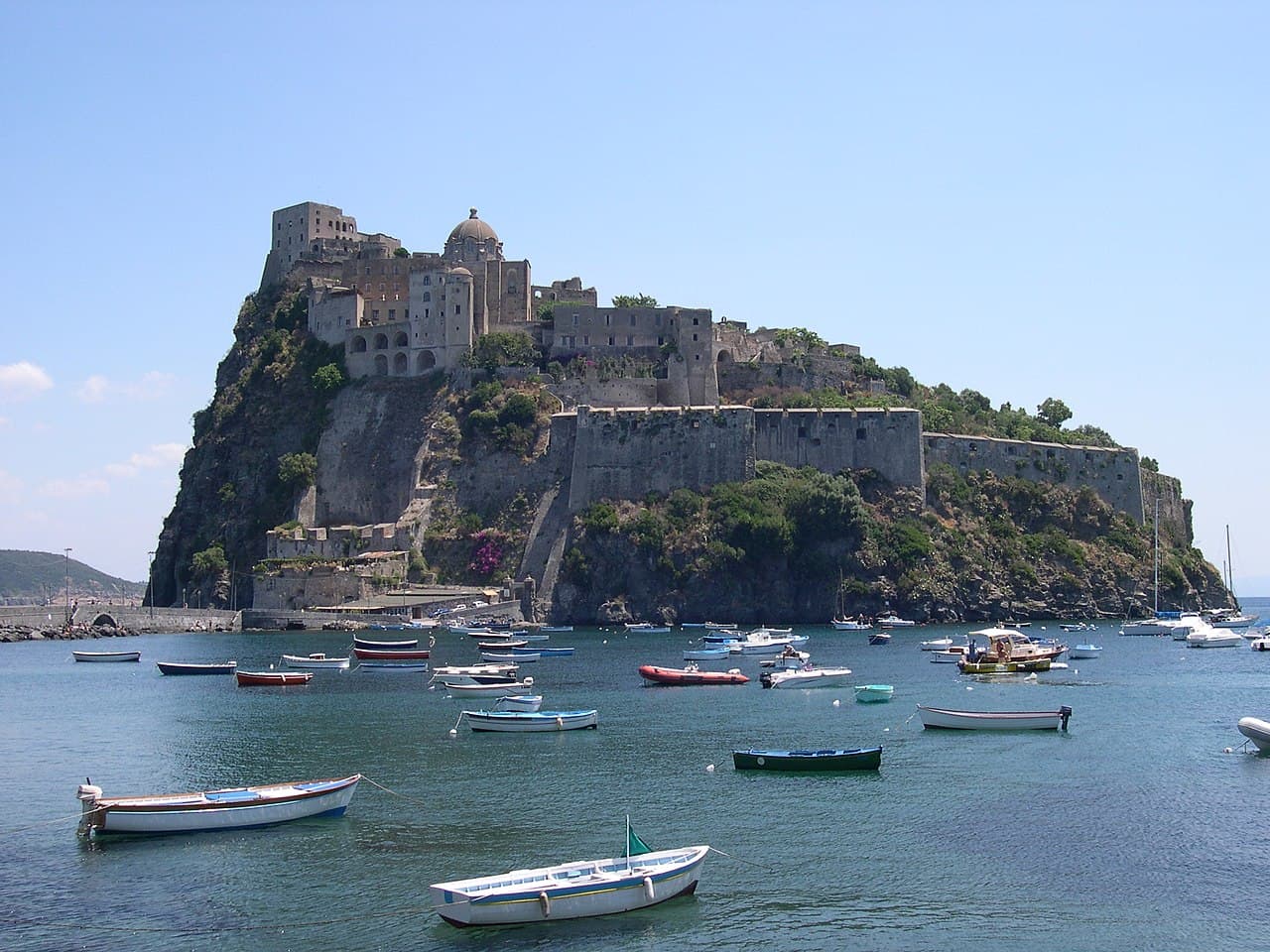
Aragonese Castle of Ischia stands as a monumental fortress on a volcanic rocky islet connected to the larger island of Ischia in the Campania region of Italy. It is renowned for its extraordinary beauty and historical significance, symbolizing the island's resilient spirit and cultural heritage. The castle's unique location, perched 113 meters above sea level on a tidal islet, offers commanding views of the surrounding sea and landscape, making it a prominent landmark celebrated by poets such as Ludovico Ariosto and once inhabited by the Renaissance poet Vittoria Colonna.
Originally constructed in 474 BCE by Hiero I of Syracuse, the fortress was built to control enemy fleets and protect the strategic Tyrrhenian Sea routes. Its initial name, Castrum Gironis, reflected its role as a defensive stronghold. Over the centuries, the castle evolved through various phases of occupation and reconstruction, reflecting the diverse cultural influences of the Greek, Roman, Norman, and Aragonese periods.
Historical development and significance
Ancient origins and early fortifications
The volcanic islet on which the castle stands was first fortified in 474 BCE by Hiero I, who was granted the island of Ischia—then called Aenaria—after aiding the Cumaeans against the Etruscans. The fortress served as a critical military outpost to monitor maritime activity and defend against enemy fleets. It was later controlled by the Parthenopaeans, the ancient inhabitants of Naples, before being conquered by the Romans in 326 BCE. The Romans established a colony here and enhanced the fortifications to secure the island from maritime threats.
Medieval transformations and aragonese enhancements
Throughout the Early and High Medieval periods, the castle underwent numerous modifications to withstand invasions by groups such as the Visigoths, Vandals, Ostrogoths, Arabs, Normans, Swabians, and Angevins. The castle's strategic importance persisted, serving as a refuge for local populations during times of conflict. In 1301, following a volcanic eruption that destroyed the nearby city of Geronda, survivors sought shelter within the castle, which then developed into a small urban settlement.
The castle's current quadrangular layout with four corner towers was established in 1441 by King Alfonso V of Aragon. He replaced the earlier wooden bridge with a durable stone causeway, connecting the islet to the main island of Ischia and allowing easier access and defense. Alfonso V also commissioned a tunnel carved through the rock, equipped with tall skylights that served both to illuminate the passage and to pour boiling substances on attackers during sieges.
Renaissance cultural hub and community life
By the late 16th century, the castle had transformed from a purely military fortress into a thriving community. It housed nearly 1,900 families, thirteen churches—including the Cathedral of the Assumption and the Church of the Immaculate Conception—a monastery of the Poor Clares, a Basilian abbey of the Greek Orthodox Church, a bishopric, and the prince’s residence with a military garrison. This period marked the castle’s peak as a fortified urban center and cultural hub.
Notably, the castle was home to the influential Renaissance poet Vittoria Colonna from 1501 to 1536. Her presence attracted prominent artists and intellectuals such as Michelangelo, Ludovico Ariosto, and Jacopo Sannazaro, who contributed to the castle's vibrant cultural life.
Architectural features and layout
Defensive structures and fortifications
The castle's architecture is characterized by its massive defensive walls with narrow vertical slits called piombatoi, designed for dropping molten lead, boiling water, stones, and other projectiles on attackers. The quadrangular plan includes four corner towers, each serving as lookout points and defensive bastions. The Maschio tower is a notable feature, representing the castle’s military strength.
Access to the fortress is via a 400-meter-long tunnel carved into the volcanic rock in the mid-15th century. This tunnel is illuminated by large skylights that also functioned as defensive openings. From the tunnel, a mule track ascends to the summit, branching into paths leading to various buildings and gardens. Since the 1970s, a rock-cut elevator provides more comfortable access to the upper levels.
Religious and residential buildings
The castle complex includes several churches and religious buildings, reflecting its role as a community center. The Cathedral of the Assumption, built in 1306 to replace an earlier cathedral destroyed by the 1301 eruption, is a three-nave basilica originally constructed in the Romanesque style and later modified with Renaissance and Baroque elements. Although heavily damaged during the 1809 British siege, it remains an important cultural venue.
The Church of the Immaculate Conception, begun in 1737 by the Poor Clares, features a Greek cross plan with a large dome dominating the skyline. Although unfinished, it was restored in 1980 and now serves as an exhibition space. The Poor Clares Monastery, founded in 1575, included an underground cemetery where deceased nuns were placed upright on stone seats to mummify naturally, a unique and macabre tradition.
Other religious structures include the Church of San Pietro a Pantaniello, attributed to Renaissance architect Jacopo Barozzi da Vignola, and the Church of Santa Maria delle Grazie from the 16th century. The Basilian Abbey reflects the presence of the Greek Orthodox tradition on the islet.
Historical events and later uses
Sieges, abandonment, and prison use
In 1809, British forces besieged the castle during the Napoleonic Wars, subjecting it to heavy bombardment that nearly destroyed much of the fortress and its community. Following this, King Ferdinand I of the Two Sicilies expelled the remaining inhabitants in 1823 and converted the castle into a prison. It housed life-sentenced inmates and political prisoners, including key figures in the Italian unification movement such as Carlo Poerio and Luigi Settembrini.
The prison was closed in 1860 after Ischia was annexed to the Kingdom of Italy by Giuseppe Garibaldi. Subsequently, the castle passed into private ownership in 1912, marking the beginning of restoration and preservation efforts.
Modern restoration and cultural significance
Since the 1970s, the Aragonese Castle has hosted exhibitions, cultural events, and concerts, continuing its long tradition as a place of significance on Ischia. Restoration work has rehabilitated many parts of the complex, preserving its architectural heritage and making it accessible to visitors. Today, it is the most visited monument on the island, open year-round from 9 am until sunset.
Visitor experience and access
Visitors can access the castle via the historic tunnel or a modern elevator that ascends 60 meters above sea level. The ascent reveals a transition from the fortress's austere exterior to sunny gardens, olive groves, vineyards, and panoramic sea views. The castle offers a rich historical atmosphere with its ancient walls, churches, frescoed catacombs, arches, vaults, and Bourbon-era prisons.
The castle's layout invites exploration of its various buildings, including royal apartments, military quarters, religious sites, and gardens. The peaceful environment, combined with the dramatic setting on a volcanic islet, provides a unique experience blending history, architecture, and natural beauty.
Frequently asked questions (FAQ)
- How do I get to the Aragonese Castle of Ischia?
- The castle is accessible by a stone causeway (Ponte Aragonese) connecting the volcanic islet to the main island of Ischia. Visitors can enter through a historic tunnel or use a modern elevator that ascends partway up the rock.
- What is the historical significance of the castle?
- Built in 474 BCE by Hiero I of Syracuse, the castle served as a strategic military stronghold through Greek, Roman, and Aragonese periods. It later became a cultural hub during the Renaissance and was used as a prison in the 19th century.
- When is the best time to visit the castle?
- The castle is open year-round from 9 am until sunset, making spring and autumn ideal for visiting due to mild weather and fewer crowds.
- Can I explore the religious buildings inside the castle?
- Yes, visitors can explore several churches, including the Cathedral of the Assumption and the Church of the Immaculate Conception, as well as the underground cemetery of the Poor Clares.
- Is the castle family-friendly and accessible?
- The castle offers a mix of walking paths and a modern elevator, making it accessible to many visitors. However, some steep and uneven areas may be challenging for those with mobility issues.
- Are there guided tours available at the castle?
- Guided tours are often available through local operators and provide detailed insights into the castle’s history, architecture, and cultural significance.

Information
Sources & official resources
Verify the information above using these authoritative references.
Loading map...
Visitor reviews
No reviews yet. Been here? Write the first review and help other travelers!
Write the first reviewVisited this castle? Share your experience
Your review helps other travelers and adds first-hand knowledge to our encyclopedia.