Castello Aragonese
The Castello Aragonese in Bacoli, Italy, stands as a remarkable example of Renaissance military architecture built upon ancient Roman foundations. This historic fortress occupies a commanding position on a promontory overlooking the Gulf of Baia, integrating remnants of a Roman villa once attributed to Julius Caesar. Its strategic location and robust design reflect the evolving defensive needs of the Kingdom of Naples from the late 15th century through the modern era.
Origins and early history
The origins of the Castello Aragonese date back to 1495, when the House of Aragon initiated its construction as part of a broader effort to fortify the Kingdom of Naples. The site was chosen for its natural defensive advantages, perched 51 meters above sea level on a tuff promontory. Beneath the fortress lie the remains of a Roman residential complex, believed to be a villa owned by Julius Caesar, as chronicled by the historian Tacitus. These ancient remains were incorporated into the fortress's walls and surrounding structures, linking the medieval and Renaissance fortification to its classical past.
Roman foundations
Archaeological excavations have uncovered significant portions of the Roman villa, including elements along the coastal perimeter and inland near modern sports fields. Restoration efforts in the 20th century revealed further villa components on the fortress's upper levels and coastal slopes. These finds provide a tangible connection to the Roman era, highlighting the site's long-standing importance and continuous occupation.
Transformation under Spanish rule
The fortress underwent major reconstruction following the 1538 eruption of Monte Nuovo, which dramatically altered the surrounding landscape. In response, the Spanish viceroy Pedro Álvarez de Toledo ordered extensive rebuilding and expansion between 1538 and 1550. The result was a striking star-shaped fortress design, characteristic of Renaissance military engineering, replacing the original 15th-century layout.
Architectural features
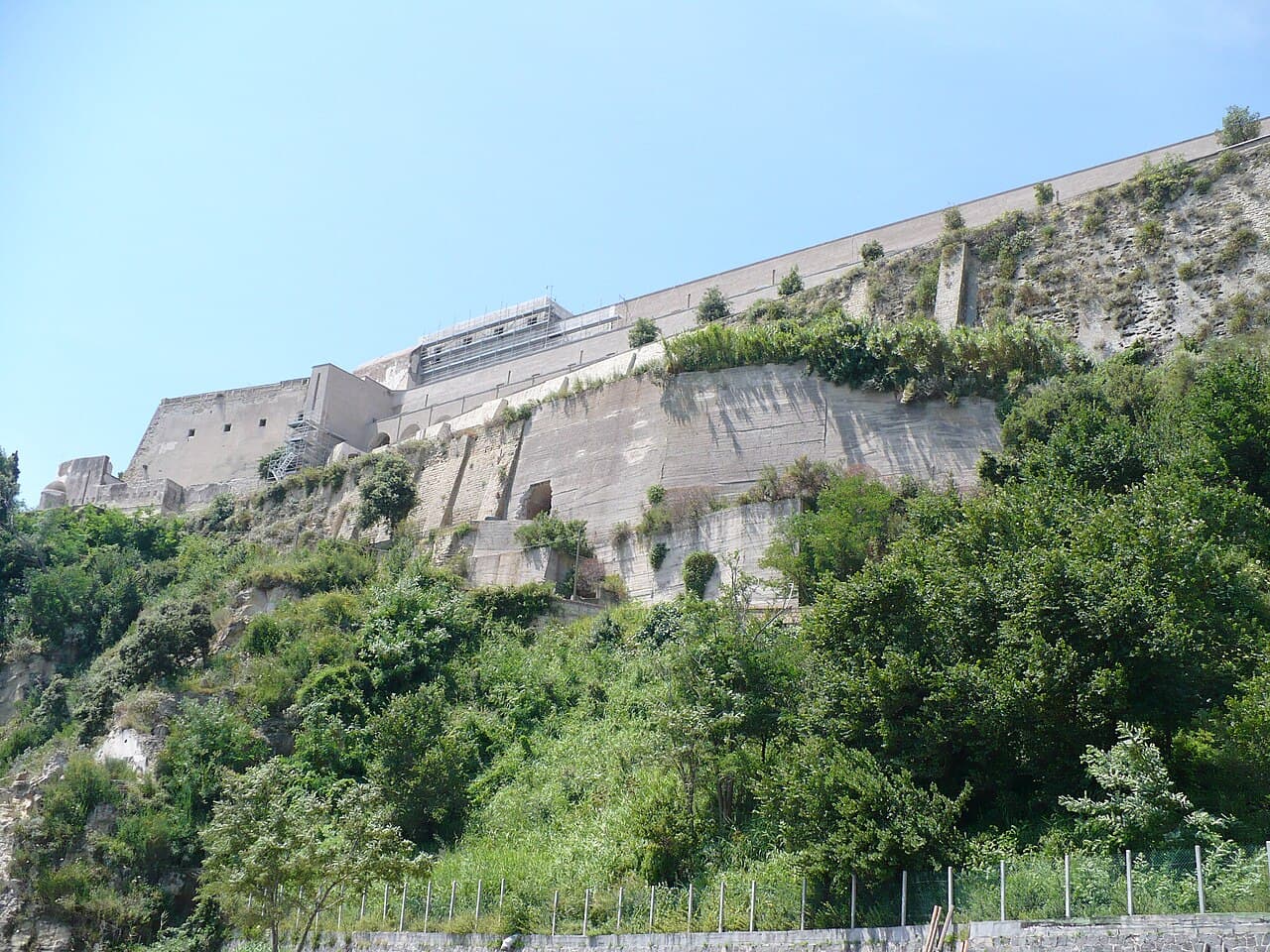
Constructed primarily from local Neapolitan tuff stone, the fortress features high defensive walls encircling the complex. Four corner towers and the prominent Torre Tenaglia lookout tower were built to enhance surveillance and defense capabilities. Access was controlled through three drawbridges, emphasizing the fortress's impregnable nature. Bastions and terraces provided elevated platforms for observation over the Gulf of Baia and the surrounding archaeological sites.
Military significance through the centuries
Throughout its history, Castello Aragonese served as a key military stronghold under various ruling powers. During the Spanish viceroyalty (1503–1707), the Habsburg administration (1707–1734), and the Bourbon kingdom (1734–1860), it was integral to the defense of the Kingdom of Naples. The fortress sustained heavy damage during the 1734 war between Austrian and Bourbon forces, after which King Charles III undertook significant restoration and fortification efforts.
Siege and later conflicts
In 1799, the fortress was occupied by French and Neapolitan republican troops during the brief existence of the Parthenopean Republic. It endured a siege by an English fleet, which ultimately failed to capture the stronghold, underscoring its strategic resilience. Following the unification of Italy in 1861, the fortress's military importance declined, leading to periods of neglect and varied uses.
20th-century adaptations and current use
Between 1927 and 1975, the castle was transformed into a military orphanage, a role that necessitated significant internal modifications. During World War II, it served as a military prison, with the Torre Tenaglia enclosed by fencing to function as a prison tower. Later, the fortress provided shelter to victims of the 1980 earthquake.
Archaeological museum and preservation
Since 1984, the Castello Aragonese has been managed by the Archaeological Superintendency of Naples and Caserta. It now houses the Museo archeologico dei Campi Flegrei, which exhibits artifacts uncovered in the surrounding archaeological area. Notable exhibits include the Sacellum of the Augustales from Miseno, plaster casts from the nearby Baia thermal baths, and portions of the nymphaeum at Punta Epitaffio. These displays offer visitors insight into the rich cultural and historical heritage of the Phlegraean Fields region.
Architectural and natural setting
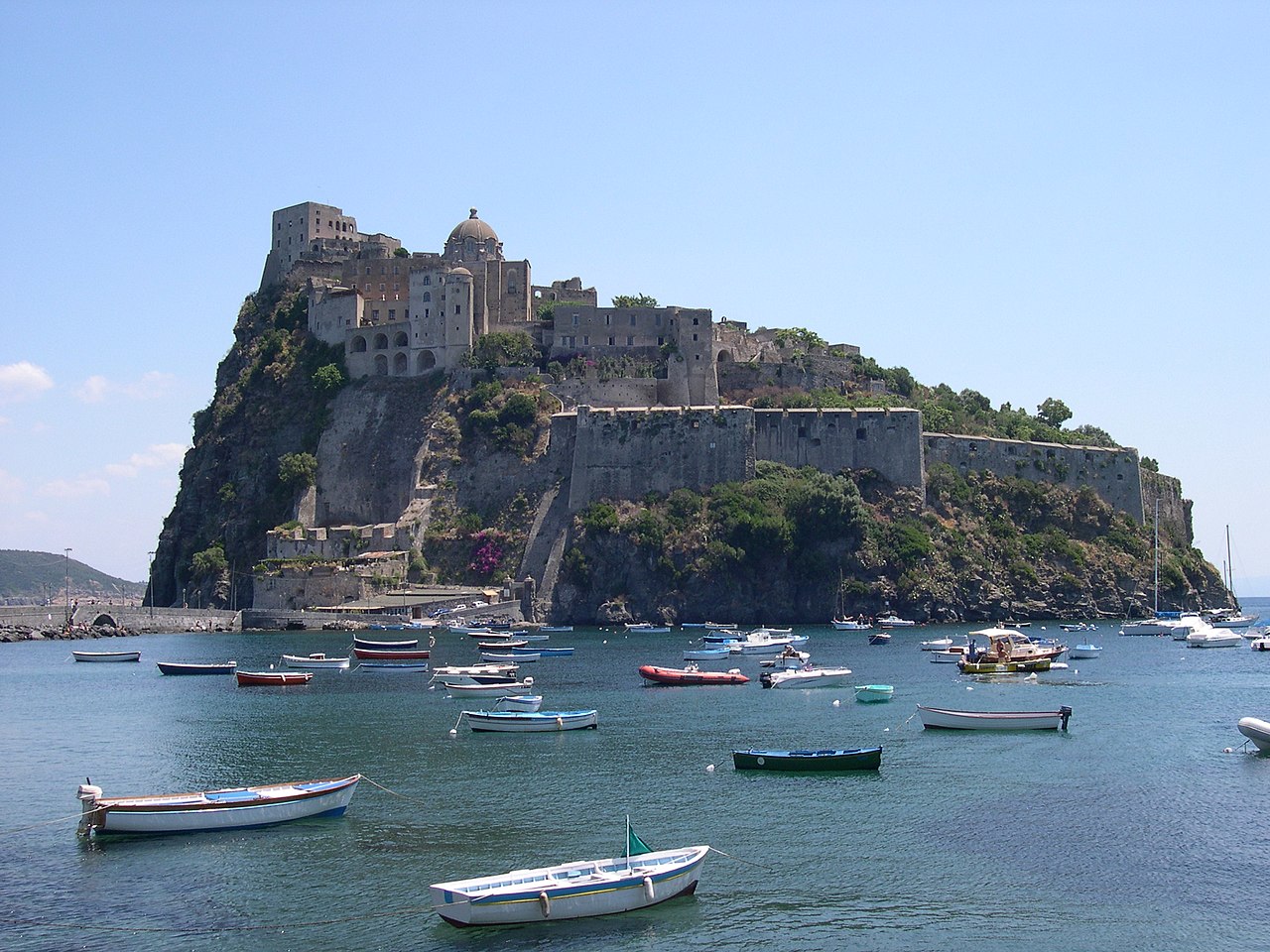
The fortress's location on a tuff promontory provides natural defenses, with a steep cliff on the eastern side and the deep volcanic basin known as the Fondi di Baia to the west, a remnant of a volcanic crater formed by the Yellow Neapolitan tuff eruption. The star-shaped design of the fortress, typical of mid-16th-century military architecture, maximizes defensive coverage and visibility.
Structural elements
The fortress is built mainly from local volcanic tuff stone, a material favored in Renaissance military constructions for its durability and availability. The high walls, bastions, and towers such as the Torre Tenaglia contribute to the site's formidable appearance. A chapel with a dome on the western side provides a religious space within the military complex, illuminated by natural light.
Modifications and preservation challenges
Various modifications during the 20th century, especially related to its use as an orphanage and prison, altered the internal layout and some external features. Despite these changes, ongoing restoration and archaeological work have preserved the fortress's essential character and historical significance.
Frequently asked questions (FAQ)
- How do I get to Castello Aragonese in Bacoli?
- Castello Aragonese is located in Bacoli, near Naples, Italy. Visitors can reach it by car or public transport from Naples, with local buses serving the area. The castle is situated on a promontory accessible via local roads leading to the Gulf of Baia.
- What are the opening hours of Castello Aragonese?
- Opening hours may vary seasonally and due to special events. It is recommended to check the official website or contact the Archaeological Superintendency of Naples and Caserta for the most current visiting times before planning your visit.
- Is there an entrance fee to visit the castle and museum?
- Ticket prices for Castello Aragonese and the Museo archeologico dei Campi Flegrei vary depending on exhibitions and events. Visitors should consult the official site or local tourist information for up-to-date pricing details.
- What can I see at the Museo archeologico dei Campi Flegrei?
- The museum exhibits artifacts from the Phlegraean Fields area, including the Sacellum of the Augustales from Miseno, plaster casts from Baia thermal baths, and parts of the nymphaeum at Punta Epitaffio. These displays provide insight into the region's rich Roman and Renaissance history.
- Why is the fortress star-shaped?
- The star-shaped design was implemented during the mid-16th century reconstruction ordered by Pedro Álvarez de Toledo. This layout enhanced defensive capabilities by allowing better coverage of the walls and reducing blind spots, a common feature in Renaissance military architecture.
Photo gallery

Photo by Dr.Conati at Italian Wikipedia•Public domain
Information
Sources & official resources
Verify the information above using these authoritative references.
Loading map...
Visitor reviews
No reviews yet. Been here? Write the first review and help other travelers!
Write the first reviewVisited this castle? Share your experience
Your review helps other travelers and adds first-hand knowledge to our encyclopedia.