Iscar Castle
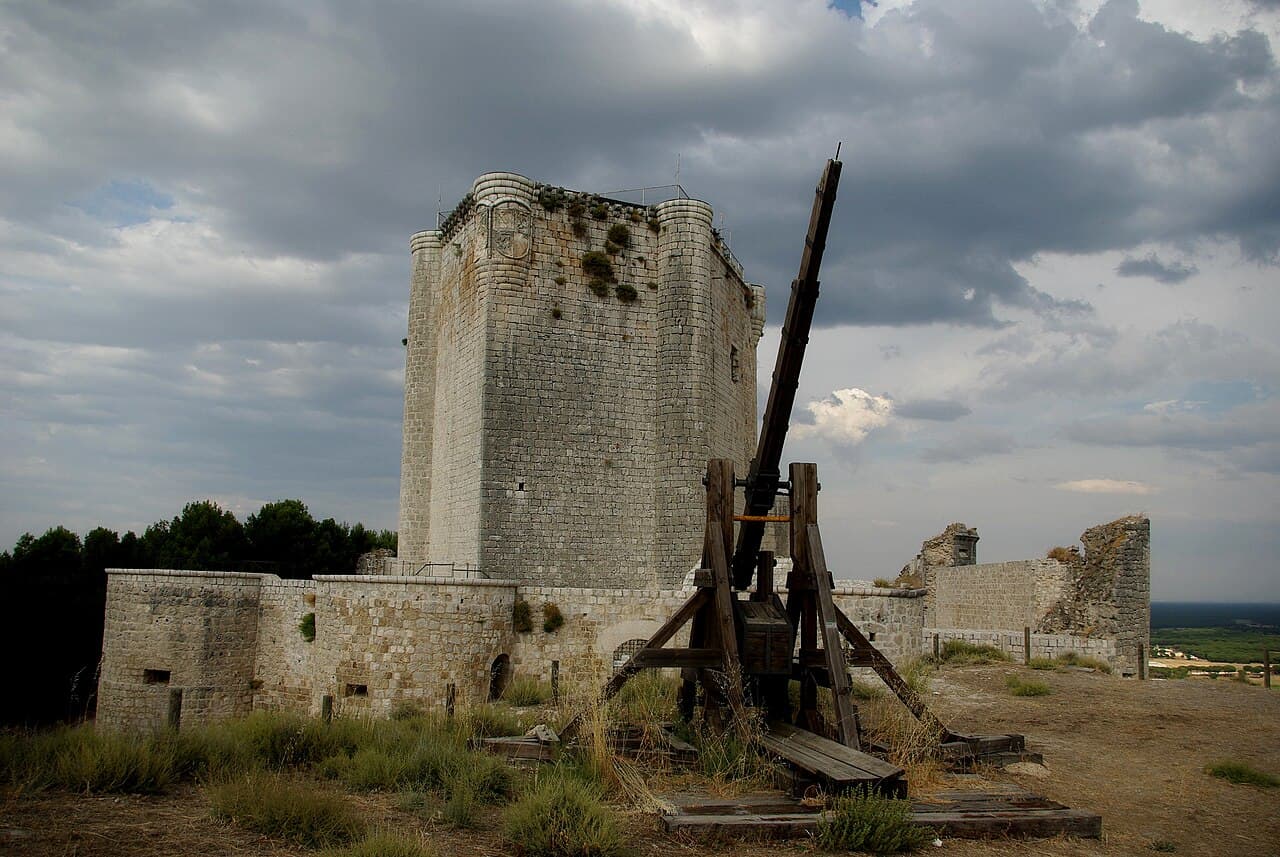
Iscar Castle stands prominently on a high hill overlooking the village of Iscar in the province of Valladolid, Spain. This late medieval fortress is renowned for its distinctive pentagonal keep built with excellent ashlar masonry, and its strategic location that commands expansive views over the surrounding plains known as Tierra de Pinares. The castle's history spans several centuries, reflecting the complex military and political changes in the region from the Moorish period through the Renaissance.
Historical background and early origins
The earliest mention of the site dates back to 939 AD in Muslim chronicles, which describe a fortress at Iscar used as a base for Moorish raids into Christian territories. This original castle was likely of Moorish origin, serving as a frontier post during the turbulent border conflicts between Muslim and Christian kingdoms in the Iberian Peninsula. The fortress was abandoned after attacks by forces under Abderramán III but remained an important strategic site.
In the 11th century, after the Christian reconquest of the region, the castle came under the control of Álvar Fáñez de Minaya, a lieutenant of the legendary El Cid. He is credited with repopulating the area and rebuilding the castle, establishing it as a Christian stronghold. This period marked the beginning of the castle's transformation from a Moorish fortress to a medieval castle with European military architecture influences.
Architectural evolution and defensive features
The pentagonal keep and towers
The castle's most remarkable feature is its pentagonal keep, constructed in the 15th century with finely cut ashlar stones. This keep was designed not only as a residence but also as a formidable defensive structure. A turret on one corner bears the coat of arms of Don Pedro Zuñiga de Avellaneda and Catherine Velasco de Mendoza, owners during the late 15th century, dating the construction between 1478 and 1493.
The elevated entrance to the keep was protected by a small defensive enclosure formed by three closely built towers. These towers guarded the stone steps and a now-lost wooden drawbridge, enhancing the keep's security. The castle walls surrounding the keep include multiple towers with small rectangular windows adapted for 16th-century artillery, reflecting the evolution of military technology.
Outer defenses and artillery adaptations
To strengthen the castle's defenses, a moat was dug into the limestone rock around the castle, accessible by a drawbridge. The second half of the 15th century saw the addition of a large pentagonal defensive spur flanked by two smaller turrets, creating a more complex defensive layout. A fortified barbican with three circular artillery turrets was also constructed to provide a small battery position, demonstrating adaptation to the increasing use of firearms in warfare.
The castle's curtain walls were reinforced with additional circular bastions featuring loopholes shaped like mailboxes, designed to protect defenders while allowing them to fire small arms or artillery. These enhancements reflect the castle's transition from medieval fortification methods to early modern military architecture.
Historical events and ownership
Throughout its history, Iscar Castle witnessed several significant events. In 1334, King Alfonso XI of Castile laid siege to the castle after its lord, Don Juan Martinez de Leyva, refused him entry. This event underscores the castle's importance as a power center and its role in regional conflicts.
The castle was owned by the Counts of Miranda, specifically Don Pedro de Zúñiga y Avellaneda and Doña Catalina de Velasco y Mendoza, who were responsible for major 15th-century fortifications. Over time, the Counts lost their legal privileges, and the castle passed into municipal hands by the late 20th century.
Later modifications and restoration efforts
In the early 16th century, the castle underwent structural reinforcements, including the installation of a central stone column inside the keep to support a ribbed vault and the reconstruction of the south wall. These changes ensured the longevity of the main tower and reflect Renaissance architectural influences.
Archaeological excavations in 1998 revealed remains of residential chambers and a late Gothic gallery with columns and arches dating from the early 1500s, indicating the castle's dual military and residential function. The courtyard spans over 3,000 square meters, providing a spacious interior protected by the robust fortifications.
Since 1991, the castle has been under the ownership of the Íscar Town Council, which has led extensive restoration projects to stabilize the ruins and adapt the site for cultural uses. A wooden pavilion was added to support exhibitions and events, ensuring the castle remains a vibrant part of the local heritage.
Present condition and visitor experience
Today, Iscar Castle stands as a partially preserved ruin, offering visitors a glimpse into the military architecture of the late medieval period and the evolution of fortifications in response to changing warfare technologies. The castle's elevated position provides spectacular views of the surrounding countryside.
The keep, although closed to the public at times, remains the focal point of the site. The rest of the castle, including the walls, towers, and courtyard, is freely accessible, allowing visitors to explore the complex defensive structures and appreciate the historical significance of this hill castle.
The cultural and historical significance of Iscar Castle
Iscar Castle is a testament to the layered history of the Castilian frontier, embodying architectural and military developments from the Moorish era through the Renaissance. Its preservation and restoration highlight the value placed on cultural heritage in Spain and the importance of maintaining such sites for educational and touristic purposes.
As a landmark in the province of Valladolid, the castle contributes to the understanding of regional history, medieval warfare, and noble lineage, particularly through its association with prominent figures like Álvar Fáñez de Minaya and the Counts of Miranda.
Frequently asked questions (FAQ)
- What are the visiting hours for Iscar Castle?
- Iscar Castle is generally open to visitors during daylight hours, but the keep may be closed at times for safety reasons. It is advisable to check with the local tourist office for current opening times before planning your visit.
- How do I get to Iscar Castle?
- Iscar Castle is located on Calle Castillo in the town of Íscar, Valladolid, Spain. It is accessible by car and local roads connecting to nearby towns such as Olmedo and Cuéllar.
- What is the historical significance of Iscar Castle?
- Iscar Castle played a key role as a frontier fortress between Muslim and Christian territories during the Middle Ages. It was owned by notable figures such as Álvar Fáñez de Minaya and the Counts of Miranda, reflecting its strategic and noble importance.
- Can visitors access the keep of Iscar Castle?
- The keep of Iscar Castle is sometimes closed to the public due to preservation and safety concerns. However, the surrounding walls, towers, and courtyard are freely accessible for exploration.
- Why is the pentagonal keep of Iscar Castle important?
- The pentagonal keep is a unique architectural feature that demonstrates advanced medieval military design. It was fortified with robust towers and adapted for artillery defense, reflecting changes in warfare during the 15th century.
Photo gallery

Information
Sources & official resources
Verify the information above using these authoritative references.
Loading map...
Visitor reviews
No reviews yet. Been here? Write the first review and help other travelers!
Write the first reviewVisited this castle? Share your experience
Your review helps other travelers and adds first-hand knowledge to our encyclopedia.