Coca Castle
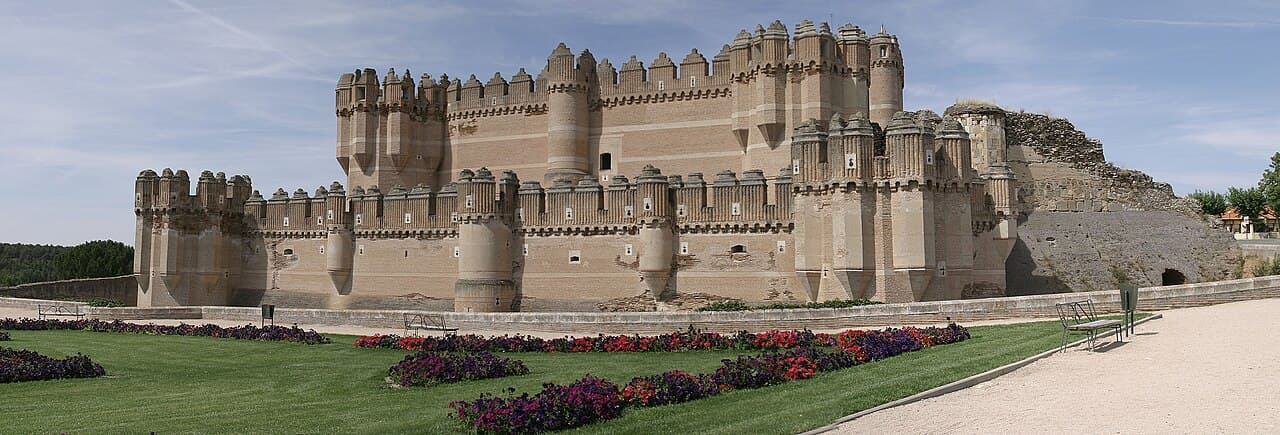
Coca Castle, known locally as Castillo de Coca, stands as one of the most remarkable examples of Spanish Mudéjar military architecture. Located in the town of Coca in the Segovia province of Castilla y León, Spain, this 15th-century fortress is unique for its construction on flat terrain rather than a hill, surrounded by a broad, deep dry moat. The castle's distinctive use of brick as both a structural and decorative material, combined with its polygonal towers and crenellated ramparts, marks it as a crowning achievement of the Late Medieval period and a prime representation of the fusion between Christian Gothic and Islamic Mudéjar styles.
Historical context and origins
The site of Coca Castle has a rich history of human occupation dating back to the Chalcolithic era around 2500 to 2300 BC. In the Iron Age, the area was inhabited by the Vacceans, a Celtiberian people who established the settlement known as Cauca. The Romans conquered the region in 151 AD, integrating it into their provincial system, and it later came under Visigothic and Muslim control.
In 1085, King Alfonso VI of Castile reconquered the area, restoring Christian rule. The current castle was constructed primarily during the 15th century, beginning shortly after 1453. Its construction was commissioned by Alonso de Fonseca y Avellaneda, the powerful Archbishop of Seville, under the reign of King Enrique IV of Castile. This project was part of a treaty exchange involving the Marquis of Santillana and the Fonseca family. Major construction was completed by 1493, with final additions finished by 1512.
Architectural design and features
Layout and defensive structures
Coca Castle is a rectangular fortress featuring two concentric square baileys separated by a passageway, each fortified with polygonal towers at the corners. The castle's walls are impressively thick, measuring approximately 2.5 meters, and are encircled by a deep dry moat that enhances its defensive capabilities. The outer curtain wall, though partially ruined, still shows the remains of rectangular towers, while the inner wall is reinforced with cylindrical towers at the center of each side and smaller turrets. A notable feature is the machicolated wall, allowing defenders to drop projectiles or boiling substances on attackers, combined with a sloping talus base extending to the moat.
Material and decorative elements
The castle's construction predominantly employs hardened brick, a hallmark of the Mudéjar style, which blends Islamic artistic influences with Christian Gothic architecture. The brickwork is meticulously laid with visible mortar lines creating geometric patterns that serve both structural and ornamental purposes. White limestone and plaster are used selectively for columns, embrasures (arrow slits), and balistraria (crossbow openings), adding contrast and refinement to the fortress's appearance.
The keep and interior spaces
The central keep, known as the Torre del Homenaje, rises approximately 25 meters tall on the northern side of the castle. It houses a narrow spiral staircase, a chapel, an armory, and various chambers. The armory is particularly noteworthy for preserving original metal armor and weapons dating from the 15th to 17th centuries, alongside walnut wood furniture adorned with intricate bone and ivory inlays.
Other significant towers include the Pedro Mata Tower, Torre de la Muralla, and Torre de los Peces, the latter famous for its hall decorated with murals depicting red and blue fish. The Patio de Armas (main courtyard) was added in the 16th century, and a gallery connecting the keep to Pedro Mata Tower was constructed in the 17th century, illustrating the castle's evolving use as both fortress and noble residence.
Artistic and cultural significance
The castle's interior reflects a luxurious aesthetic uncommon in purely military fortifications, highlighting its dual role as a palatial residence and defensive stronghold. The chapel ceiling, though damaged during the French occupation in the early 19th century, was carefully restored. It contains remarkable artworks, including a 14th-century Byzantine painting of Christ, Flemish paintings of the Crucifixion and Annunciation, Renaissance polychrome wood carvings of a tabernacle, and 15th-century Gothic and Romanesque paintings of the Virgin Mary.
The castle also features a unique acoustic circular room located in the Pedro Mata Tower, where whispered words can be heard clearly across the room due to its architectural design, a fascinating example of medieval acoustic engineering.
Historical events and changing roles
Throughout its history, Coca Castle has served multiple purposes beyond military defense. It was a noble residence for the Fonseca family and later the Dukes of Alba, who acquired it in the 16th century and maintained ownership for centuries. During the Revolt of the Comuneros in 1521, the castle was attacked, demonstrating its strategic importance in regional conflicts.
In 1645, the castle was repurposed as a prison, notably detaining Gaspar Alfonso Pérez de Guzmán, the 9th Duke of Medina Sidonia. The Peninsular War (1808–1812) saw the castle occupied by French troops, resulting in damage and neglect that lasted through the 18th and 19th centuries. Decorative elements such as marble columns were sold off during this period, although some were later recovered and restored.
Modern use and preservation efforts
In the mid-20th century, ownership transferred from the House of Alba to the Spanish Ministry of Agriculture in 1954. Between 1954 and 1958, extensive restoration work was undertaken to adapt the castle for its new role as a forestry training school, which opened in 1958 and remains operational today. The castle's interiors now house museum rooms displaying archaeological artifacts from the Celtiberian and Roman periods, underscoring the site's long and layered history.
Declared a National Monument in 1926 and recognized as a Cultural Heritage site in 1931, Coca Castle is protected as a significant cultural landmark. Guided tours offer visitors access to key areas such as the keep, battlements, chapel, and armory, although some passageways and the moat remain off-limits to preserve their condition.
The castle's exterior gained international recognition when it was used as the filming location for the Camelot castle in the 1967 Hollywood musical film Camelot, highlighting its iconic and picturesque qualities.
Architectural legacy and significance
Coca Castle stands as one of the finest examples of Gothic-Mudéjar architecture in Spain, embodying the cultural synthesis of Christian and Islamic influences during the Late Medieval period. Its innovative use of brickwork, combined with defensive features such as the dry moat, double curtain walls, and machicolations, illustrate advanced military engineering of its time. The castle's luxurious interiors and artistic decorations reflect the social status of its patrons and the blending of functional and aesthetic considerations in medieval fortress design.
Today, Coca Castle continues to attract scholars, tourists, and architecture enthusiasts eager to explore its rich history, architectural mastery, and cultural heritage. Its preservation and adaptive reuse as a forestry school demonstrate a successful balance between conservation and contemporary function.
Frequently asked questions (FAQ)
- How do I get to Coca Castle?
- Coca Castle is located in the town of Coca in the province of Segovia, Spain. You can reach it by car or public transport from nearby cities, with the nearest major city being Segovia. There are also local bus services that connect to Coca from major transport hubs.
- What is the historical significance of Coca Castle?
- Coca Castle is a 15th-century fortress known for its unique Mudejar architectural style, which blends Gothic and Islamic influences. It served as a defensive structure during the Reconquista and is a symbol of the region's rich history. The castle's well-preserved state allows visitors to explore its historical importance and architectural beauty.
- When was Coca Castle built?
- Coca Castle was constructed between the late 15th century and early 16th century, primarily commissioned by the Duke of Alburquerque. The castle's construction reflects the strategic military needs of the time, as well as the artistic styles that were prevalent during the Spanish Renaissance. Its completion represents a significant period in Spanish history.
- Can I visit Coca Castle year-round?
- Yes, Coca Castle is open to visitors throughout the year, but it's advisable to check specific opening hours as they may vary seasonally. Guided tours are available, which enhance the experience by providing historical context and insights about the architecture. Planning your visit in advance is recommended to ensure you don’t miss out on any special events.
- Why is Coca Castle known for its architecture?
- Coca Castle is renowned for its Mudejar style, characterized by intricate brickwork and decorative elements that showcase the blending of Christian and Islamic architectural traditions. Its impressive towers and exterior walls are a testament to the skilled craftsmanship of the period. This unique architectural style makes the castle a fascinating subject for both history buffs and architecture enthusiasts.
- Is it possible to take guided tours of Coca Castle?
- Yes, guided tours are available at Coca Castle, providing visitors with a more in-depth understanding of its history and architecture. These tours are led by knowledgeable guides who share fascinating stories and facts about the castle's significance. It's advisable to book your tour in advance, especially during peak tourist seasons.
- What are the ticket prices for Coca Castle?
- Ticket prices for Coca Castle are generally affordable, with discounts available for students, seniors, and groups. Children under a certain age may be admitted for free. It's best to check the castle’s official website or contact the visitor center for the most up-to-date pricing information.
- What are the opening hours for Coca Castle?
- Coca Castle typically opens from 10 AM to 6 PM, but hours may vary based on the season and local holidays. It is closed on certain public holidays, so checking the official website before your visit is recommended. Arriving early can help you avoid crowds and enjoy a more leisurely exploration of the castle.
- What nearby attractions can I visit while in Coca?
- While visiting Coca Castle, you can also explore the charming town of Coca, which features quaint streets and local eateries. Additionally, nearby attractions include the picturesque town of Cuéllar and natural parks in the region, offering opportunities for hiking and scenic views. This area is rich in cultural heritage, making it an ideal destination for history and nature lovers alike.
Photo gallery

Information
Website
Visit websiteSources & official resources
Verify the information above using these authoritative references.
Loading map...
Visitor reviews
No reviews yet. Been here? Write the first review and help other travelers!
Write the first reviewVisited this castle? Share your experience
Your review helps other travelers and adds first-hand knowledge to our encyclopedia.