Hutovo Castle
Hutovo fortress, also known locally as Hadžibegov Grad, is a significant Renaissance-era castle situated in the municipality of Neum, Bosnia and Herzegovina. This fortress commands a strategic position atop a hill overlooking the Prešjeci pass, an important route historically used by salt caravans from Ston traveling inland. Its location below Žaba mountain and southwest of the village of Hutovo highlights its role in controlling passage through this narrow corridor between the Adriatic coast and the Bosnian interior.
The fortress dates back to the 16th century, during the Renaissance period, when fortifications in this region were adapted to the evolving needs of warfare, particularly the introduction of firearms. The name Hadžibegov Grad derives from its last known lord, Hadžibeg Rizvanbegović, a notable local figure whose stewardship marked the final phase of the fortress's active use.
Architectural design and defensive features
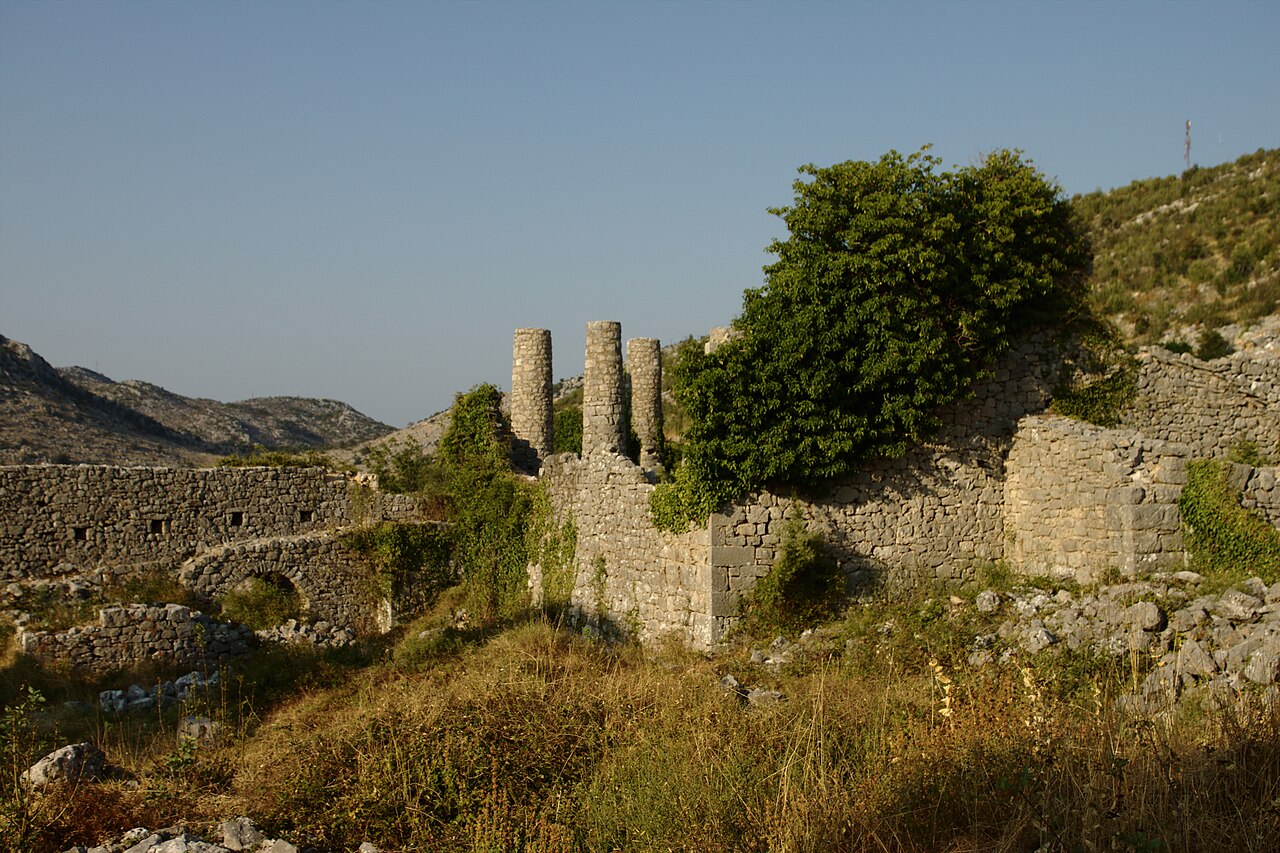
Hutovo fortress is distinguished by its irregular pentagonal layout, a design that maximizes defensive coverage. The fortress encompasses an enclosed area of relatively flat terrain, with walls stretching approximately 70 meters from east to west. The eastern section is about 50 meters wide, tapering to 30 meters in the west. This shape allowed defenders to cover every angle effectively, a crucial feature given the fortress's role in guarding a vital mountain pass.
The fortress is reinforced by nine towers, strategically positioned at each corner of the pentagon and at additional points along the walls. These towers are robust and tall, designed to provide vantage points for soldiers equipped with firearms. The walls themselves are thick and solid, constructed to resist artillery and small arms fire, reflecting the military architectural advancements of the Renaissance era.
Adaptations for firearm defense
Unlike earlier medieval castles designed primarily for defense against melee and siege engines, Hutovo fortress incorporates architectural features that accommodate firearms. The positioning of towers and the thickness of the walls were carefully planned so that defenders could cover all approaches with gunfire, eliminating blind spots and enhancing the fortress's defensive capabilities.
Historical context and significance
The fortress played a pivotal role in controlling the Prešjeci pass, a key transit route for valuable commodities such as salt. The salt caravans traveling from the coastal town of Ston to inland regions frequently passed beneath this stronghold, making it a critical point for monitoring and taxing trade during the Ottoman period in Bosnia and Herzegovina.
Hadžibeg Rizvanbegović, the last lord of the fortress, was a prominent figure in the region, and his name became synonymous with the castle itself. The fortress stands as a testament to the military and administrative organization of the area during the Renaissance and Ottoman periods.
Preservation and revitalization efforts
By the 20th century, Hutovo fortress had fallen into disuse and partial ruin. Recognizing its cultural and historical value, the National Museum of Bosnia and Herzegovina initiated revitalization efforts in 1969. These efforts aimed to stabilize the remaining structures and preserve the fortress as a heritage site.
Archaeological work at the site uncovered several important artifacts, including three inscribed slabs. These slabs are now housed in the Country House Museum's lapidary in Hutovo, providing valuable insights into the fortress's history and the people who inhabited it.
Visiting Hutovo fortress today
Visitors to Hutovo fortress can explore the remains of the imposing walls and towers, gaining a sense of the fortress's scale and strategic importance. Its location offers scenic views of the surrounding landscape, including the nearby Hutovo Blato nature reserve and the rugged terrain of Žaba mountain.
The fortress's accessibility along the narrow road connecting Hutovo Blato to Neum makes it a noteworthy destination for those interested in Renaissance military architecture and Bosnian heritage. While the fortress is partially preserved, it remains a compelling example of a Renaissance pentagonal fortress adapted for early firearm defense.
Frequently asked questions (FAQ)
- How do I get to Hutovo fortress from Neum?
- Hutovo fortress is accessible via a narrow road leading from Neum towards Hutovo Blato. The fortress is located near the village of Hutovo below Žaba mountain, making it reachable by car or local transport.
- What is the historical significance of Hutovo fortress?
- Hutovo fortress controlled the Prešjeci pass, a key route for salt caravans from Ston traveling inland. It played an important role in regional trade and defense during the Renaissance and Ottoman periods.
- Can I explore the towers and walls of Hutovo fortress?
- Yes, visitors can explore the remains of the fortress's nine towers and solid walls. While partially preserved, the site offers insight into Renaissance military architecture adapted for firearms.
- When was Hutovo fortress built?
- The fortress was constructed in the 16th century during the Renaissance period, reflecting advancements in fortification design to accommodate firearms.
- Are there any museums related to Hutovo fortress nearby?
- Yes, three inscribed slabs found at the fortress are displayed in the Country House Museum's lapidary in Hutovo, which provides additional historical context about the site.
Information
Current owner
National Museum of Bosnia and Herzegovina
Loading map...
Visitor reviews
No reviews yet. Been here? Write the first review and help other travelers!
Write the first reviewVisited this castle? Share your experience
Your review helps other travelers and adds first-hand knowledge to our encyclopedia.