Hurst Castle
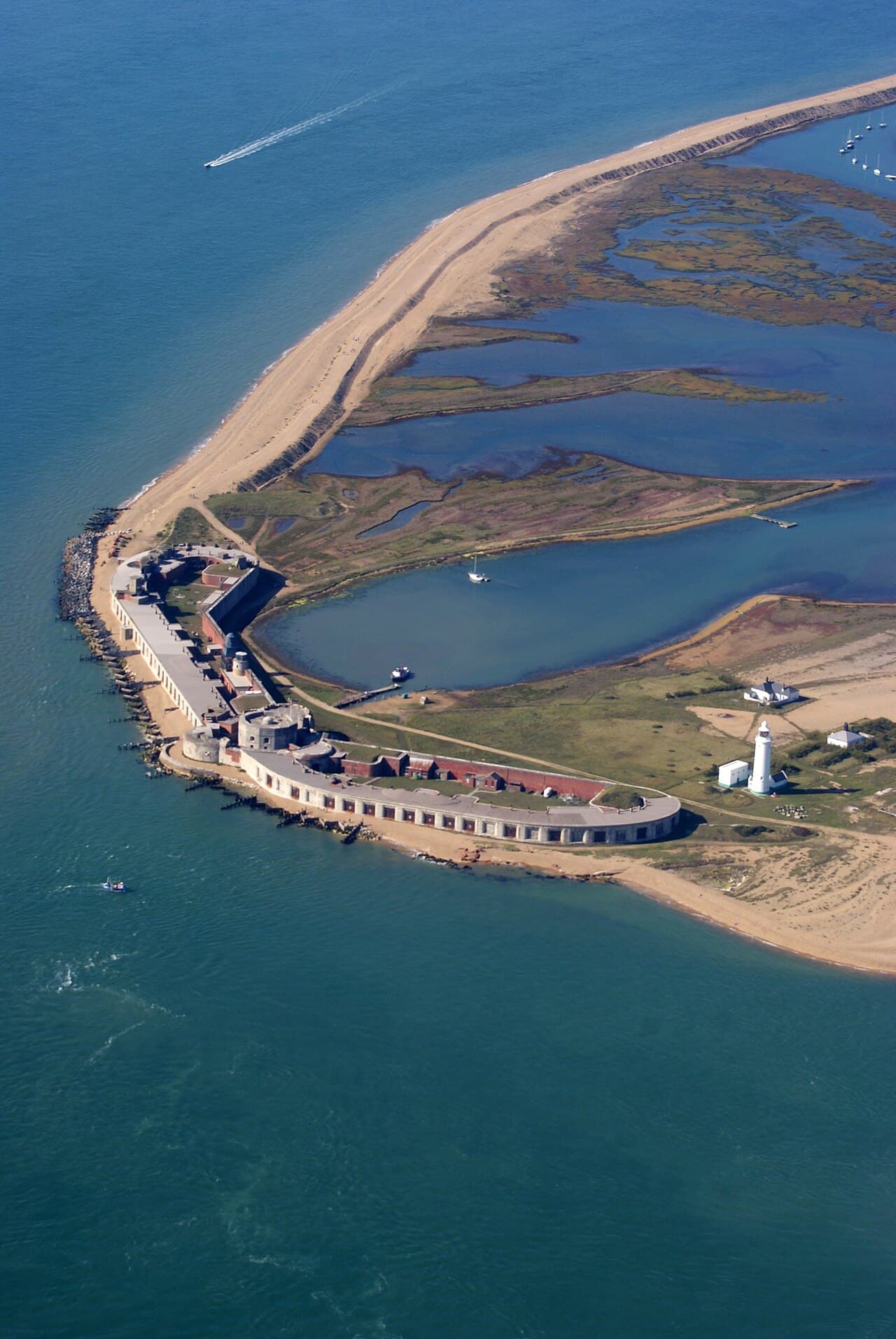
Hurst Castle is a significant artillery fort located on the Hurst Spit in Hampshire, England. Constructed between 1541 and 1544 during the reign of King Henry VIII, the castle was a crucial element of the King's Device programme, a series of coastal defences designed to protect England from invasions by France and the Holy Roman Empire. Its strategic position guarded the western entrance to the Solent waterway, a vital naval passage leading to the important naval base at Portsmouth and the city of Southampton.
The castle's design reflects the Renaissance military architectural principles of the time, emphasizing artillery defence. It features a distinctive concentric layout, with a central keep and multiple bastions equipped to mount heavy cannon. The thick stone walls and low, rounded bastions were specifically engineered to withstand cannon fire and provide overlapping fields of artillery fire against enemy ships attempting to enter the Solent.
Historical context and construction
The construction of Hurst Castle was part of Henry VIII's response to the breakdown of his alliance with the Holy Roman Empire and France, leading to fears of invasion in the early 1540s. The Device programme initiated a rapid building campaign of coastal forts along vulnerable points of the English coastline. Hurst Castle was one of several key forts including Calshot Castle and Southsea Castle, all designed to create a defensive network protecting the Solent and the English Channel.
The castle was built using local stone and brick, with a focus on durability and artillery placement. The central keep is surrounded by a curtain wall with angular bastions, allowing defenders to cover all approaches with cannon fire. The design was innovative for its time, blending traditional medieval fortification elements with new artillery fortification concepts inspired by Renaissance military engineering.
Architectural features and layout
Central keep and bastions
The heart of Hurst Castle is its central keep, a robust stone structure designed to serve both as a last line of defence and as a command centre. Surrounding the keep is a curtain wall with four large bastions positioned at the cardinal points. These bastions were equipped with gun embrasures to mount heavy cannons, enabling defenders to deliver enfilading fire along the walls and out to sea.
Defensive walls and moat
The castle's walls are notably thick and low, a design choice that helped absorb and deflect cannonballs. A shallow moat originally surrounded the castle, enhancing its defensive capabilities by making direct assaults more difficult. The moat was fed by the tidal waters of the Solent, adding a natural barrier against attackers.
Artillery and armaments
From its inception, Hurst Castle was equipped to function as an artillery fort rather than a traditional medieval castle. It housed a range of heavy guns, including culverins and demi-culverins, positioned to cover the sea approaches. The castle's design allowed for rapid reloading and firing, essential for repelling naval attacks.
Role in later conflicts
Throughout its history, Hurst Castle remained an active military installation. During the English Civil War, it was held by Royalist forces before falling to Parliamentarian troops. Its strategic importance continued through the 18th and 19th centuries, with upgrades to its artillery to keep pace with advances in military technology.
In the First World War, the castle formed part of a comprehensive network of defences protecting the Solent and the approaches to Portsmouth. It was re-armed again during the Second World War, serving as a coastal defence battery against potential German naval incursions. The fortifications were modernized with concrete gun emplacements and anti-aircraft positions, reflecting the evolution of military engineering.
Preservation and public access
Today, Hurst Castle is jointly managed by English Heritage and the Friends of Hurst Castle. It operates as a popular tourist destination, attracting around 40,000 visitors annually as of 2015. The castle's well-preserved walls, bastions, and artillery positions offer visitors a tangible connection to England's Tudor maritime defences and military history.
Visitors can explore the castle's extensive ramparts, gun platforms, and the central keep, gaining insight into the defensive strategies employed during the Renaissance and subsequent centuries. The site also provides stunning views across the Solent and towards the Isle of Wight, enhancing its appeal as both a historical monument and scenic location.
Access to the castle is typically via a ferry service from Keyhaven, with guided tours available during the tourist season. Educational programs and events are regularly held to promote awareness of the castle's historical significance and architectural uniqueness.
Frequently asked questions (FAQ)
- How do I get to Hurst Castle?
- Hurst Castle is accessible by a ferry service from Keyhaven, which operates during the tourist season. Visitors should check the ferry schedule in advance to plan their trip.
- What is the historical significance of Hurst Castle?
- Hurst Castle was built by Henry VIII as part of the Device programme to protect England from invasion. It played a key role in coastal defence from the 16th century through both World Wars.
- Can I explore the interior of Hurst Castle?
- Yes, visitors can explore the central keep, gun platforms, and ramparts. Guided tours are often available to provide detailed historical and architectural information.
- When is the best time to visit Hurst Castle?
- The best time to visit is during the warmer months when the ferry service is operational, typically from spring through early autumn. This allows for comfortable exploration and access to guided tours.
- Is Hurst Castle suitable for families?
- Yes, Hurst Castle is family-friendly with open spaces and educational programs. However, some areas may have uneven surfaces, so appropriate footwear is recommended.
Photo gallery

Information
Current owner
English Heritage and Friends of Hurst Castle
Website
Visit websiteSources & official resources
Verify the information above using these authoritative references.
Loading map...
Visitor reviews
No reviews yet. Been here? Write the first review and help other travelers!
Write the first reviewVisited this castle? Share your experience
Your review helps other travelers and adds first-hand knowledge to our encyclopedia.