Huntly Castle
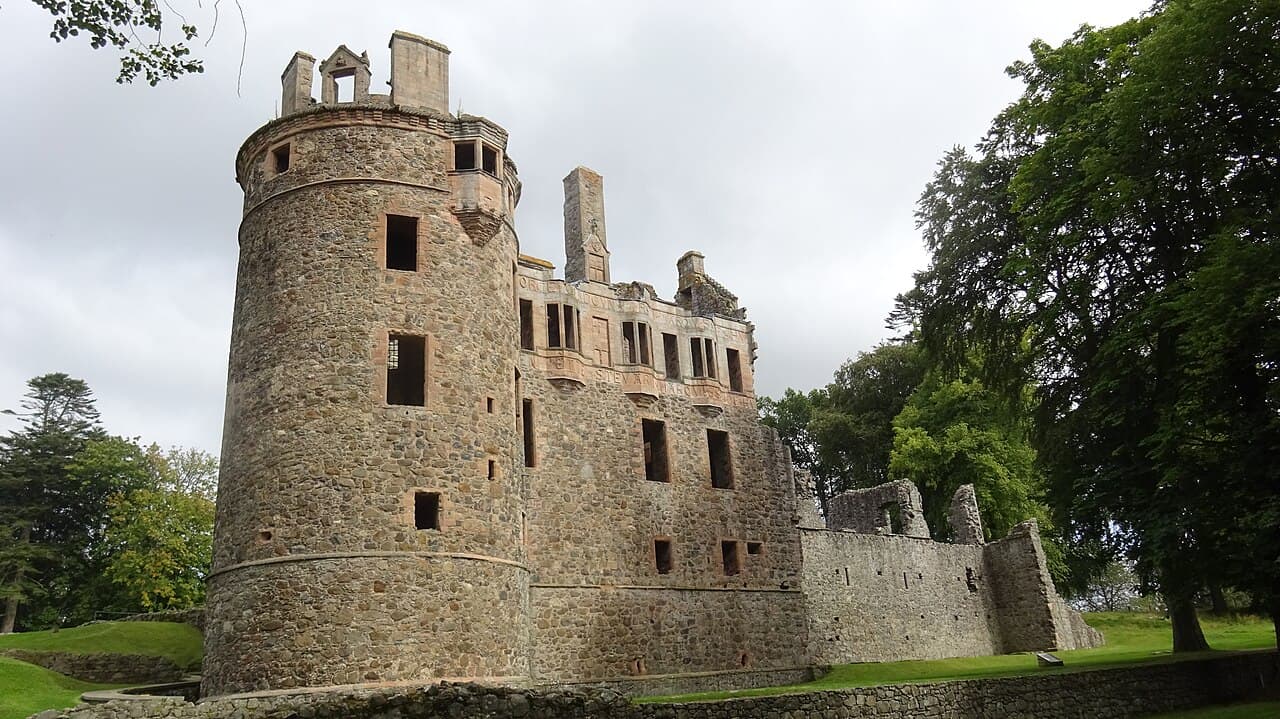
Huntly Castle stands as a significant historical monument in Aberdeenshire, Scotland, renowned as the ancestral home of the chief of Clan Gordon, the Earl of Huntly. This hill castle occupies a commanding position overlooking the confluence of the rivers Deveron and Bogie, controlling a vital route through northern Scotland. Its layered history spans from an early 12th-century wooden motte to a grand stone fortress that evolved over several centuries, reflecting the turbulent political and religious shifts of Scotland.
The site originally featured a wooden motte castle, constructed between 1180 and 1190 by Duncan II, Earl of Fife, known then as the Peel of Strathbogie. This initial fortification was typical of early medieval defensive architecture, consisting of a raised earthwork mound that supported a timber keep. The motte, approximately 24 meters across, remains visible today as a testament to the castle's earliest phase.
Medieval origins and the rise of the gordons
The castle's fortunes changed dramatically in the early 14th century during the Wars of Scottish Independence. Originally held by the Strathbogie family, who supported the English cause, the estate was confiscated by King Robert I of Scotland (Robert the Bruce) and granted to Sir Adam Gordon of Huntly in recognition of his loyalty. This transfer marked the beginning of a centuries-long association between the Gordons and Huntly Castle.
The Gordons transformed the site from a wooden motte into a stone fortress. The 15th century saw the construction of a substantial stone donjon and an L-shaped tower house, initiated by Alexander Seton, Lord Gordon. This period was marked by conflict; in 1452, the castle was burned by the Black Douglases during a power struggle involving the Gordons and the crown. The Gordons quickly rebuilt the castle, expanding its size and fortifications.
Architectural evolution and renaissance enhancements
By the late 15th and early 16th centuries, Huntly Castle had developed into a grand baronial residence. The castle's layout included a five-story tower with an adjoining great hall, supported by ancillary buildings such as a brewery and bakehouse. The castle was further extended with wings added in the 16th and 17th centuries, enhancing its residential and ceremonial functions.
One of the castle's most remarkable features is the ornate frontispiece above the main entrance, carved around 1602 by George Gordon, 1st Marquess of Huntly, and his wife Henrietta Stewart. This elaborate stonework includes heraldic symbols, grotesque animals, and religious iconography depicting scenes from the Passion and Resurrection of Christ. The carving of the archangel Michael crowns this display, symbolizing protection and divine favor.
Inside, the castle once housed richly decorated state rooms, including the Marchioness's lodging with two impressive heraldic fireplaces. Historical inventories from 1562 mention 45 tapestries and numerous portraits of monarchs and nobles, reflecting the castle's status as a cultural as well as military stronghold. A private chapel was maintained for Roman Catholic worship until 1640, when Covenanter forces removed many religious images during an iconoclastic campaign.
Political turmoil and military significance in the 17th century
The 17th century was a period of intense conflict for Huntly Castle, mirroring the broader struggles of Scotland during the Civil War and religious upheavals. In 1640, the castle was occupied by Covenanter forces under General Robert Monro, who preserved much of the castle's heraldic stonework while removing papist emblems. The castle changed hands multiple times during the 1640s, including brief control by James Graham against the Duke of Argyll and a siege by General David Leslie in 1647. The garrison, primarily Irish troops, endured starvation and brutal reprisals after surrendering.
Notably, Lord Charles Gordon defended the castle during these conflicts, and the castle was used as a prison for the captured Earl of Huntly, who was executed in Edinburgh. In 1650, Charles II visited Huntly Castle en route to the Battle of Worcester, underscoring the castle's continued strategic importance even as the Civil War concluded.
Decline, preservation, and modern status
Following the turmoil of the 17th century, Huntly Castle gradually fell into decline. By the early 18th century, the castle was already deteriorating, with local villagers scavenging stones for building materials. During the 1746 Jacobite Rebellion, British government troops occupied the castle, but it was soon abandoned and became a quarry for local construction.
Efforts to preserve the castle began in the 19th century when an antique dealer sought to save the remaining structures. The castle remained in the possession of the Gordon family until 1923, after which it was transferred to state care. Today, the ruins are managed by Historic Scotland, which protects the site as a scheduled monument and provides interpretation for visitors.
Visitors to Huntly Castle can explore the remains of the five-story tower, the great hall, and the extensive earthworks that include the original motte. The castle's rich heraldic stonework and inscribed friezes remain visible, offering insight into the artistic and cultural achievements of the Gordons. Although the castle is roofless and partially ruined, its imposing silhouette and detailed masonry continue to evoke its historical significance as a fortress, noble residence, and symbol of Clan Gordon's enduring legacy.
Archaeological and architectural highlights
- The wooden motte from the 12th century, one of the earliest defensive features on the site.
- The L-plan tower house and stone donjon from the 15th century, illustrating medieval castle design.
- The ornate frontispiece carved in 1602, featuring heraldic and religious motifs.
- The Marchioness's lodging with two heraldic fireplaces, showcasing Renaissance decorative arts.
- Foundations of a rare Scottish loggia, a covered exterior gallery added in the early 17th century.
- Military features including an ammunition house recorded in 1648 with muskets and cannons.
Historical events of note
- King Robert I's 1307 visit prior to defeating the Earl of Buchan.
- The 1452 burning by the Black Douglases during regional power struggles.
- Perkin Warbeck's 1496 marriage to Catherine Gordon at the castle, witnessed by King James IV.
- The 1640 Covenanter occupation and subsequent religious iconoclasm.
- The 1647 siege and brutal treatment of the Irish garrison by General Leslie's forces.
- Charles II's 1650 visit before the Battle of Worcester.
- 18th-century decline and use as a stone quarry, followed by 19th-century preservation efforts.
Frequently asked questions (FAQ)
- How do I get to Huntly Castle?
- Huntly Castle is located in the town of Huntly, Aberdeenshire, Scotland. It is accessible by car via the A96 road and is a short walk from the town center. Parking is available nearby.
- What are the opening hours for visiting Huntly Castle?
- Huntly Castle is managed by Historic Scotland and is typically open to visitors during daylight hours, often from 9:30 AM to 5:00 PM. It is advisable to check the official Historic Scotland website for seasonal variations and any closures.
- Is there an admission fee to enter Huntly Castle?
- There is no admission fee to view the exterior of Huntly Castle ruins, as the site is open to the public. However, some guided tours or special events may have associated costs.
- What is the historical significance of Huntly Castle?
- Huntly Castle was the ancestral seat of Clan Gordon and played a key role in Scottish history, including the Wars of Independence, civil wars, and religious conflicts. It showcases architectural evolution from a 12th-century motte to a Renaissance palace.
- Can I explore the interior of Huntly Castle?
- The castle is mostly in ruins with no roof, so interior access is limited and primarily for viewing from designated safe areas. Visitors can explore the grounds and see the remains of the great hall, tower, and other structures.
Photo gallery

Information
Sources & official resources
Verify the information above using these authoritative references.
Loading map...
Visitor reviews
No reviews yet. Been here? Write the first review and help other travelers!
Write the first reviewVisited this castle? Share your experience
Your review helps other travelers and adds first-hand knowledge to our encyclopedia.