Huntingtower Castle
Huntingtower Castle stands as a significant monument in Scottish history and architecture, located near the village of Ruthvenfield, just northwest of Perth. Originally known as the House of Ruthven, this late medieval hill castle was constructed primarily in the 15th century and evolved through several stages that reflect Scotland's turbulent political landscape and architectural trends from the medieval to the early modern period.
The castle's origins trace back to the Clan Ruthven family, who built the initial structures in the 15th century. This noble family played a pivotal role in Scottish history, especially during the reign of King James VI. The castle is famously associated with the Raid of Ruthven in 1582, a dramatic political event where the 4th Lord Ruthven and his allies abducted the young king in an attempt to control the monarchy. This episode underscored the castle's importance not only as a residence but also as a political stronghold.
Historical significance and political intrigue
The House of Ruthven was central to several key events in Scottish history. The family held the castle for centuries until the fallout from the Gowrie Conspiracy of 1600, when brothers John and Alexander Ruthven were accused of attempting to kidnap King James VI. Following their deaths, the king took a harsh stance by abolishing the Ruthven name and confiscating their estates, including the castle, which was subsequently renamed Huntingtower by royal proclamation.
Before these events, the castle had been a site of royal visits and noble residence. Mary, Queen of Scots visited in 1565, highlighting its status among Scotland's noble estates. After the Ruthvens' forfeiture, the property passed into the hands of the Murray family of Tullibardine in 1643, who later became the Dukes of Atholl and Mansfield. The castle remained in noble hands until the 18th century, after which it declined into agricultural use and partial abandonment.
Architectural development and features
Original structures and defensive design
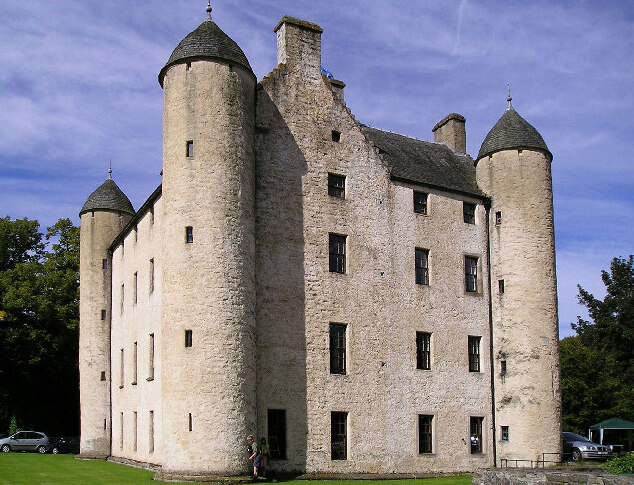
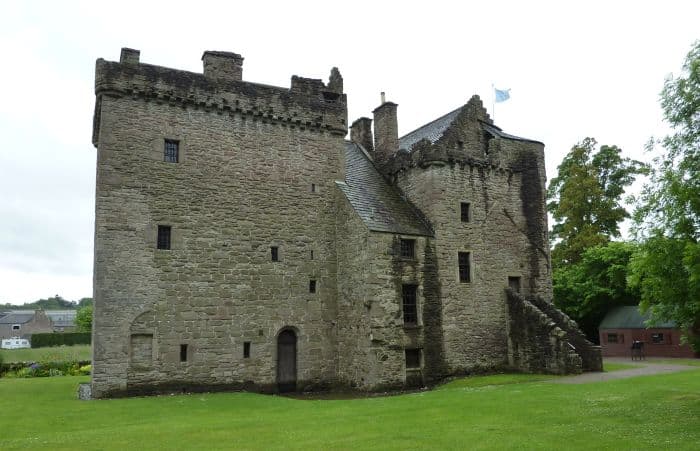
The earliest surviving part of Huntingtower Castle is the Eastern Tower, initially a free-standing gatehouse with three storeys and a garret beneath the roof. This tower exemplifies late medieval Scottish castle architecture, constructed primarily of stone and designed for both defense and residence.
Shortly after, around the end of the 15th century, a second structure known as the Western Tower was erected approximately three meters west of the Eastern Tower. This tower features an L-shaped floor plan and was connected to the Eastern Tower by a wooden bridge below the battlements. This design allowed defenders to retreat between towers if one was compromised, highlighting the strategic military thinking of the period.
Later modifications and domestic adaptations
By the late 17th century, the gap between the two towers was filled in, creating the castle's current footprint. This period also saw an increase in the size and number of windows, particularly in the Western Tower, signaling a shift from purely defensive architecture to more comfortable, light-filled living spaces.
A great hall was constructed against the north side of the Western Tower in the 16th century, though today only a raggle remains to indicate its former roofline. The castle was originally surrounded by defensive walls and subsidiary buildings, which have since been removed, reflecting changes in military technology and domestic needs.
Unique artistic heritage
One of Huntingtower Castle's most remarkable features is its early 16th-century wall paintings located in the Eastern Tower. These fragile artworks include floral motifs, animals, and biblical scenes that provide valuable insight into Renaissance art in Scotland.
Particularly notable is the painted wooden ceiling on the first floor of the Eastern Tower. This ceiling displays a complex decorative scheme featuring grotesque animals, including a version of the Green Man—a symbol of rebirth and nature—painted on the main beams. The overlying planks feature intricate Renaissance-style knotwork patterns. This ceiling is considered the earliest substantial example of its kind surviving in Scotland, underscoring the castle's cultural importance.
Minor fragments of wall paintings also survive in the Western Tower. In the early 20th century, conservation efforts led by chemist Arthur Pillans Laurie helped stabilize the painted ceiling using gelatin solutions, preserving this unique heritage for future generations.
Current status and public access
Today, Huntingtower Castle is managed by Historic Scotland and is open to the public year-round, with an entrance fee. The castle is not only a popular tourist destination but also serves as a venue for marriage ceremonies, blending its historical ambiance with contemporary use.
The castle's preservation allows visitors to explore a site that encapsulates centuries of Scottish history, from medieval fortifications and noble intrigue to Renaissance art and modern conservation efforts. Its layered architecture and rich historical associations make Huntingtower Castle a vital part of Scotland's cultural heritage.
Location and surrounding landscape
Situated near the village of Ruthvenfield, Huntingtower Castle overlooks the fertile plains near Perth in central Scotland. The castle's hilltop position provided strategic advantages in defense and surveillance during its active use, while its proximity to important medieval and early modern Scottish centers underscores its significance.
The surrounding landscape has evolved from a defensive frontier to a peaceful rural area, yet the castle remains a prominent landmark visible from miles around, symbolizing the enduring legacy of Scotland's feudal past.
Frequently asked questions (FAQ)
- What is the historical significance of Huntingtower Castle?
- Huntingtower Castle is historically significant for its connection to the Clan Ruthven and the 1582 Raid of Ruthven, where King James VI was kidnapped in a political plot. It also reflects Scotland's turbulent noble history and Renaissance art heritage.
- Can I visit Huntingtower Castle year-round?
- Yes, Huntingtower Castle is open to the public all year round and managed by Historic Scotland, offering visitors a chance to explore its rich history and architecture.
- What unique architectural features does Huntingtower Castle have?
- The castle features two original towers connected by a wooden bridge, a late 17th-century infill creating its current form, and early 16th-century Renaissance wall paintings and a painted wooden ceiling, the oldest substantial example in Scotland.
- Is Huntingtower Castle accessible for events like weddings?
- Yes, Huntingtower Castle is sometimes used as a venue for marriage ceremonies, providing a historic and atmospheric setting for special occasions.
- Who owns Huntingtower Castle today?
- The castle is currently owned and managed by Historic Scotland, which oversees its preservation and public access.
Photo gallery

Information
Opening hours
Open all year
Ticket prices
Entrance charge
Current owner
Historic Scotland
Website
Visit websiteSources & official resources
Verify the information above using these authoritative references.
Loading map...
Visitor reviews
No reviews yet. Been here? Write the first review and help other travelers!
Write the first reviewVisited this castle? Share your experience
Your review helps other travelers and adds first-hand knowledge to our encyclopedia.