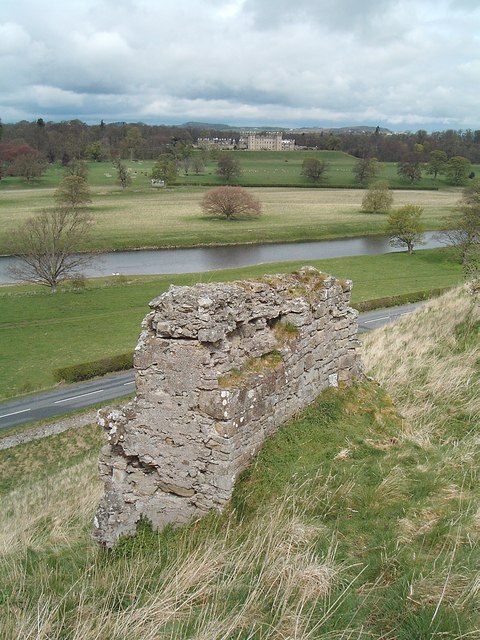
Hume Castle
Hume Castle stands as a striking example of a 13th-century hill castle perched atop a commanding height overlooking the village of Hume in the Scottish Borders. This fortress has played a pivotal role in the turbulent history of the Anglo-Scottish borderlands, serving both as a military stronghold and a symbol of the powerful Hume (Home) family, who were prominent wardens of the Eastern March. Its elevated position at approximately 750 meters above sea level provided exceptional views and strategic advantage across the Merse and towards the English border at Carter Bar.
Originally constructed in the late 12th or early 13th century, the castle was built upon a natural rocky outcrop, adopting a distinctive rectangular courtyard plan that was more typical of fortifications in the Scottish Highlands than in the Borders region. The castle's defensive design included a stone enceinte (curtain wall) enclosing the courtyard and a central keep or donjon, which formed the core of the medieval fortification. Over centuries of border warfare, Hume Castle was repeatedly besieged, captured, and destroyed, reflecting the region's volatile history.
Architectural features and medieval fortifications
The castle's original medieval fabric featured massive stone walls, towers, and outworks designed to withstand assaults. Archaeological investigations have revealed the foundations of the original enceinte and central keep, though these medieval structures no longer stand above ground. The castle's layout, with its irregular quadrilateral courtyard, was unusual for the Borders but aligned with defensive principles seen in Highland castles.
By the 18th century, the medieval walls had fallen into ruin, and significant restoration was undertaken by the Earls of Marchmont. This restoration involved rebuilding the curtain walls on their original foundations, resulting in the imposing high stone walls topped with large decorative crenellations visible today. These crenellations were primarily ornamental, reflecting the castle's transition from a military fortress to a picturesque folly. The reconstruction reused rubble from the original ruins, preserving the castle's historic footprint.
Historical significance and military role
The Hume family, who gave the castle its name, were influential figures in Scottish history, rising from wardens of the Eastern March to Lords and Earls of Home. The castle's strategic location made it a key defensive site during the frequent Anglo-Scottish conflicts. During the 16th century, it was heavily involved in the Rough Wooing wars, a series of violent clashes initiated by England to force a marriage alliance with Scotland.
In 1547, English forces under the Lord Protector Somerset captured Hume Castle after a determined siege, despite resistance led by Lady Mariotta Haliburton. The following year, the Scottish Lord Home recaptured the castle through a daring night-time assault aided by an insider, highlighting the castle's importance and the intensity of border warfare. Throughout this period, the castle was garrisoned by various commanders, including Regent Albany and Regent Arran, and equipped with artillery such as batard culverins, sakers, falconets, and fowlers, alongside numerous handguns.
In 1570, during the Marian Civil War, the castle was besieged by the Earl of Sussex and surrendered after a brief but intense bombardment. Subsequently, Regent Morton maintained the garrison to secure the castle for the young King James VI. The castle's military significance continued into the 17th century, when Oliver Cromwell's forces captured it in 1650 during the Wars of the Three Kingdoms. Following this, the castle was deliberately slighted to prevent its future military use.
Later history and restoration efforts
Ownership of Hume Castle passed to the Earls of Marchmont in the early 18th century, who undertook restoration works that transformed the ruins into a decorative folly. The reconstructed curtain walls, topped with large crenellations, were designed more for aesthetic appeal than defense. Despite this, the castle retained its symbolic military role, serving as a beacon site to warn of invasions.
The beacon function was notably revived during the Napoleonic Wars, when signal fires were lit to alert local militias of potential French invasion. In 1804, a false alarm known as the Great Alarm mobilized thousands of volunteers across the region. During the Second World War, Hume Castle again served a defensive purpose as a lookout post and potential resistance strongpoint against German invasion.
In 1929, the castle came under state ownership, and restoration efforts in the late 20th century by the Berwickshire Civic Society helped preserve the site. Since 2006, stewardship by a charitable trust under Historic Scotland has ensured ongoing protection and public access to this important heritage site.
Current condition and visitor experience
Today, Hume Castle stands as a Scheduled Ancient Monument and a Category A listed building, recognized for its national historical and architectural significance. Visitors can explore the castle's dramatic hilltop location, enjoy panoramic views of the Scottish Borders and into England, and appreciate the blend of medieval foundations and 18th-century restoration work.
The large curtain walls with their ornamental crenellations create a striking silhouette against the skyline, while the remnants of the central keep and archaeological traces offer insight into the castle's medieval origins. The site also features interpretive signage detailing its rich history, from its medieval military importance to its later roles in beacon signaling and wartime defense.
Architectural details
- The castle’s irregular quadrilateral courtyard plan is notable for its rarity in the Borders region.
- The 18th-century curtain walls are built on the original medieval foundations but serve a decorative purpose.
- Original medieval defensive features included towers, a central keep, and artillery placements.
- The battlements added during restoration are large and picturesque rather than functional.
- The castle’s elevated rocky outcrop enhances its defensive and signaling capabilities.
Historical highlights
- Founded by William de Home in the late 12th or early 13th century.
- Key site during the Rough Wooing wars and the Marian Civil War.
- Captured and recaptured multiple times during 16th-century border conflicts.
- Used as a beacon site during the Napoleonic Wars and WWII.
- Restored as a folly by the Earls of Marchmont in the 18th century.
Hume Castle remains a vivid testament to the complex and often violent history of the Anglo-Scottish border region. Its combination of medieval origins, military significance, and later picturesque restoration make it a fascinating destination for those interested in Scottish history, castle architecture, and heritage conservation.
Frequently asked questions (FAQ)
- How do I get to Hume Castle?
- Hume Castle is located in the village of Hume, Scotland. It is accessible by car and the nearest major city is Edinburgh, approximately an hour's drive away. Public transport options may be limited, so plan your journey in advance for the best experience.
- What is the historical significance of Hume Castle?
- Hume Castle dates back to the 12th century and has a rich history tied to the Hume family and the Scottish Borders. It played a strategic role during the various conflicts between Scotland and England. Today, it stands as a testament to the medieval architecture and history of the region.
- When was Hume Castle built?
- Hume Castle was originally constructed in the late 12th century, with significant alterations and expansions occurring over the centuries. The castle has seen various phases of construction, reflecting both its military importance and residential use throughout history. Its enduring structure is a reminder of its historical legacy.
- Can I visit Hume Castle?
- Yes, Hume Castle is open to visitors, allowing you to explore its historical grounds and enjoy the stunning views of the surrounding countryside. Guided tours may be available, providing deeper insights into the castle's history and architecture. Be sure to check the opening hours before your visit.
- Why is Hume Castle a popular tourist attraction?
- Hume Castle is popular due to its impressive medieval architecture and panoramic views of the Scottish Borders. Visitors are drawn by its historical significance and the opportunity to learn about the region's heritage. The blend of history, architecture, and natural beauty makes it a compelling destination.
- Is it possible to host events at Hume Castle?
- Yes, Hume Castle can be a unique venue for special events, such as weddings and private functions. The picturesque setting and historical ambiance provide a memorable backdrop for any occasion. It is advisable to contact the management for specific arrangements and availability.
- What are the best times to visit Hume Castle?
- The best times to visit Hume Castle are during the spring and summer months when the weather is generally milder and more conducive to outdoor exploration. Additionally, visiting during local festivals can enhance your experience, as you may encounter special events and activities. Always check the local calendar for events that might interest you.
- What are the ticket prices for Hume Castle?
- Ticket prices for Hume Castle vary depending on the type of tour and age group. Generally, there are discounts for children, students, and seniors. It is recommended to check the official website for the most current pricing and any special offers available.
- What are the opening hours for Hume Castle?
- Hume Castle typically opens to visitors from late morning until late afternoon, but hours may vary by season. During peak tourist season, the castle may offer extended hours to accommodate more visitors. Always check the official website for the most accurate and up-to-date information on opening hours before your visit.
Information
Website
Visit websiteSources & official resources
Verify the information above using these authoritative references.
Loading map...
Visitor reviews
No reviews yet. Been here? Write the first review and help other travelers!
Write the first reviewVisited this castle? Share your experience
Your review helps other travelers and adds first-hand knowledge to our encyclopedia.