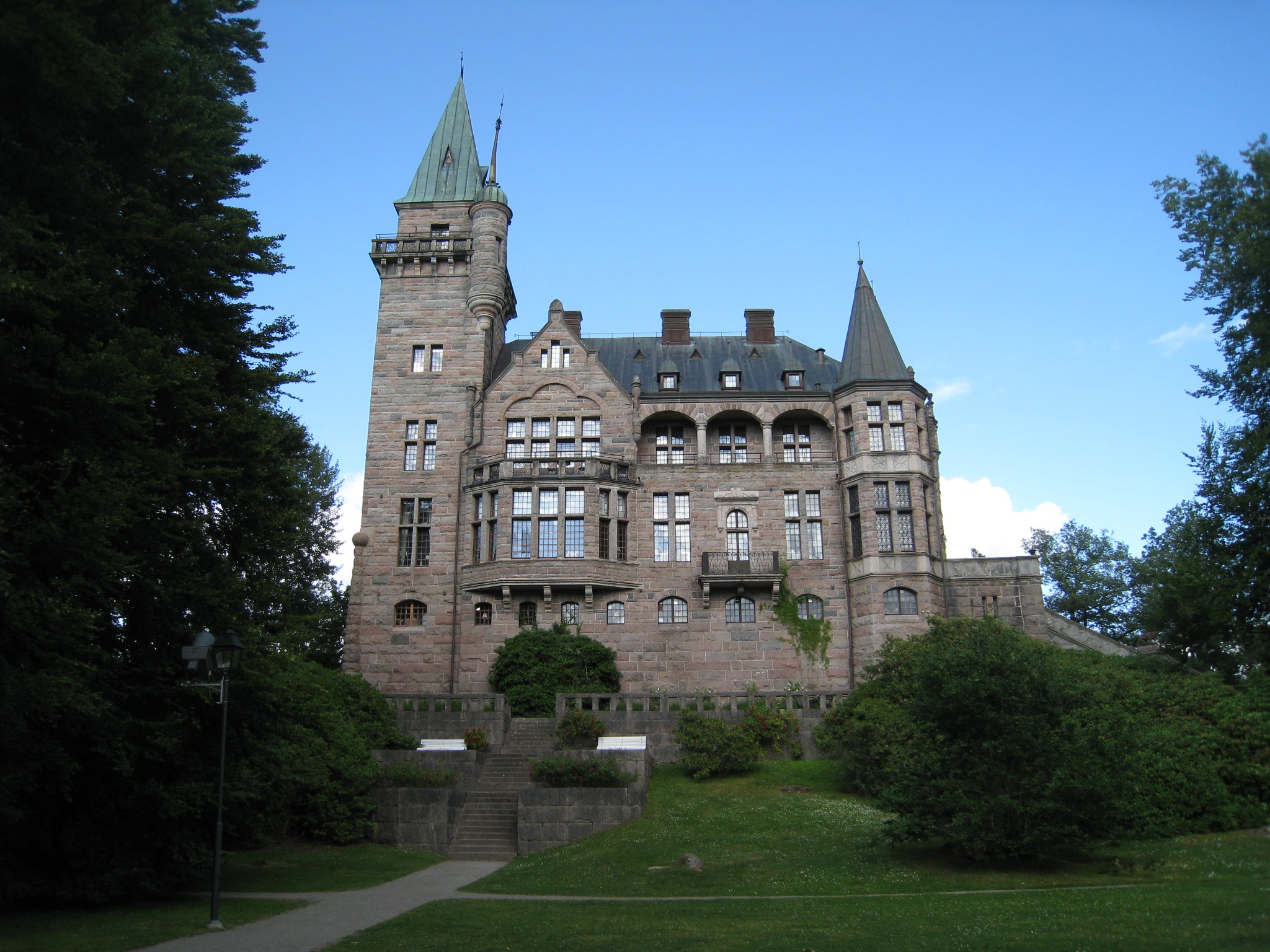
Hultaby Castle Ruins

Hultaby Castle ruins in Vetlanda, Sweden
Vetlanda, Sweden
High Medieval (11th–13th c.)
Archaeological Site

Hultaby Castle ruins are a significant medieval site located in Vetlanda, Sweden. The castle's construction began in the second half of the 13th century, placing it firmly within the High Medieval period. This period in Swedish history was marked by the consolidation of noble power and the establishment of fortified residences to assert control over territories.

The castle itself measures approximately 28 by 32 metres, a modest size reflecting its role as a noble residence rather than a large military fortress. The main castle area is characterized by the remains of 10 building foundations arranged in an L-formation along the southern and eastern sides of the site. Beyond the central castle grounds, archaeological evidence indicates there were about fifteen additional buildings scattered around, suggesting a sizeable complex that included outbuildings likely used for various domestic and agricultural purposes.

Architectural features and layout

The castle's upper structure included a great hall, two smaller chambers, and a tower. These primary buildings were constructed of timber, a common choice in medieval Scandinavia due to abundant forest resources and the relative ease of construction. Timber structures would have been supported by stone foundations, as indicated by the surviving building bases.

The presence of a great hall highlights the castle's role as a center for administration and social gatherings. This hall would have been the focal point for feasts, meetings, and the exercise of lordly authority. The accompanying smaller rooms and tower would have served residential and defensive functions.

Historical context and significance

Hultaby Castle was inhabited in the mid-14th century by Erengisle Sunesson (Bååt), a prominent Swedish councillor of the realm and the earl of the Orkney Islands. His occupancy underscores the castle's importance within the Swedish nobility and its connections to broader Scandinavian politics.

The castle's destruction is attributed to Count Henrik of Holstein, known as "Järn Henrik" (Iron Henrik), who was the bailiff of King Albrecht of Mecklenburg. During the 1360s, Sweden was embroiled in civil strife between rival kings Magnus Eriksson and Albrecht of Mecklenburg. It is believed that Hultaby Castle was burnt down during this turbulent period, reflecting the violent power struggles that shaped medieval Swedish history.

The surrounding landscape and archaeological remains

The area around the castle ruins shows clear traces of the medieval cultivated landscape. Stone mounds left from historic farming practices are still visible, providing insight into the agricultural methods of the time. Additionally, the local flora includes plants such as leopard's bane, greater yellow-rattle, and common milkwort, species typically associated with hay meadows and grazing land. These botanical indicators help reconstruct the environmental conditions and land use surrounding the castle during its occupation.

Preservation and current state

Today, Hultaby Castle remains as archaeological ruins, with the stone foundations marking the layout of the medieval complex. The timber structures have not survived, which is common for wooden medieval buildings in northern Europe. The site offers valuable archaeological and historical information about 13th and 14th-century Swedish noble residences and their role in regional power dynamics.

Visitors to the site can explore the foundations and surrounding landscape, gaining a tangible sense of the castle's scale and its integration into the medieval environment. Interpretative efforts at the site help contextualize the castle within Sweden's High Medieval period and the broader conflicts of the 14th century.

Frequently asked questions (FAQ)

What is the historical significance of Hultaby Castle Ruins?
Hultaby Castle Ruins are remnants of a medieval stronghold dating back to the 14th century. The castle played a pivotal role in the regional power dynamics during its time, serving as a defensive structure and a noble residence.
When was Hultaby Castle originally built?
Hultaby Castle was constructed in the early 14th century, with its strategic location chosen for defense purposes. Over the centuries, it witnessed various renovations and expansions, reflecting the architectural styles of different periods.
Can I visit Hultaby Castle Ruins?
Yes, Hultaby Castle Ruins are open to the public for visits. Visitors can explore the site and enjoy the scenic views of the surrounding landscape, making it a great spot for history enthusiasts and nature lovers alike.
What are the opening hours for Hultaby Castle Ruins?
Hultaby Castle Ruins are generally open year-round, but specific visiting hours may vary depending on the season. It is recommended to check local resources or visitor information before planning your trip.
Is it possible to access Hultaby Castle Ruins with a wheelchair?
The ruins are located in a natural setting, and while some paths may be accessible, they can be uneven and challenging for wheelchair users. It is advisable to contact local tourism services for detailed accessibility information before your visit.
What is the best time to visit Hultaby Castle Ruins?
The best time to visit Hultaby Castle Ruins is during the late spring to early autumn months, when the weather is milder, and the surrounding nature is in full bloom. This period offers an ideal backdrop for exploring the ruins and enjoying outdoor activities.
Are there any nearby attractions to visit when I go to Hultaby Castle?
Yes, there are several attractions near Hultaby Castle, including beautiful hiking trails and local heritage sites in Vetlanda. The region also features charming towns and landscapes perfect for a full day of exploration.
How much does it cost to visit Hultaby Castle Ruins?
Visiting Hultaby Castle Ruins is typically free of charge, allowing you to experience the historical site without an entrance fee. However, it is always wise to check for any special events that might have associated costs.

Information

Hill Castle

Sources & official resources

Verify the information above using these authoritative references.

Loading map...

Visitor reviews

No reviews yet. Been here? Write the first review and help other travelers!

Write the first review

Visited this castle? Share your experience

Your review helps other travelers and adds first-hand knowledge to our encyclopedia.
Write a review

(5/5)

0/2000 characters

Your review will be visible after admin approval

Nearby castles

55.3 km
Kronoberg Castle Ruins — Sweden castle

Kronoberg Castle Ruins

Växjö, Sweden

Kronoberg Castle stands as a significant medieval ruin located on an island in the serene lake Helgasjön, approximately 5 kilometers north of Växjö in Kronoberg County, Sweden. The castle's strategic position on a hill island provided natural defense advantages and control over the surrounding waterways, marking it as a vital military stronghold in the region during the late medieval period. The origins of Kronoberg Castle trace back to 1444 when Lars Mikaelson, the bishop of Växjö, initiated the construction of a stone building on the lakeshore. This initial structure was modest but laid the foundation for the castle's future military and administrative importance. However, during the Dano-Swedish War of 1470-1471, Danish forces destroyed this early building. Following the restoration of peace in 1472, the castle was reconstructed and significantly fortified, marking the beginning of its evolution into a formidable fortress. Architectural features and fortifications Kronoberg Castle was designed as a hill castle, utilizing the natural elevation of the island to enhance its defensive capabilities. The fortress was surrounded by thick stone walls that enclosed various defensive structures including battlements, towers, and a gatehouse. The castle's fortifications were continually enhanced over the centuries, reflecting advancements in military architecture and the evolving needs of warfare. By the late 16th century, the castle was equipped with at least 50 cannons, a testament to its role as a significant military bastion. The fortifications included bastions and artillery platforms designed to repel attacks, particularly from Danish forces during the frequent conflicts between Sweden and Denmark. Despite these defenses, the castle was besieged and burned multiple times, notably in 1570 and again in 1612. Historical significance and military role Early conflicts and reconstruction After its initial destruction in the Dano-Swedish War, Kronoberg Castle was rebuilt to serve as a stronghold near the contested border between Sweden and Denmark. During the Swedish Reformation, the castle and its estates were confiscated by King Gustav I Vasa, demonstrating its political as well as military importance. The Dacke War and subsequent fortifications In 1542, the castle was captured by rebels led by Nils Dacke during the Dacke War, a major peasant uprising against the crown. The rebellion was suppressed by 1543, and the castle returned to royal control. Recognizing its strategic value, the crown invested in further fortifying Kronoberg to secure the volatile border region. Role in the Northern Seven Years' War Kronoberg Castle played a crucial role during the Northern Seven Years' War (1564-1570). It served as a defensive bastion against Danish incursions, with Eric XIV using it as a support base in 1568 to repel a Danish attack from Skåne. Despite its defenses, the castle was besieged and burned by Danish forces in 1570, necessitating extensive reconstruction. Later military engagements and decline Between 1576 and 1580, reconstruction efforts restored the castle's defenses, including the installation of numerous cannons. Duke Charles continued to enhance the fortifications, but in 1612, Danish troops under Breide Rantzau once again captured and burned the castle. Reconstruction resumed in 1616, and the castle remained in good condition through the reign of King Charles XI. The castle's military importance diminished significantly after the Treaty of Roskilde in 1658, which shifted the Swedish-Danish border to Øresund. With the border far to the south, Kronoberg lost its strategic value and was gradually neglected, leading to its decay and eventual ruin. Present condition and visitor information Today, Kronoberg Castle exists as a ruined hill castle, with remnants of its stone walls, towers, and defensive structures visible on the island. The site offers a tangible connection to Sweden's medieval and early modern military history, attracting visitors interested in historical architecture and Scandinavian heritage. Previously open to tourists during the summer months, the castle has been permanently closed to visitors since January 2023 due to maintenance challenges. Despite this, the ruins remain an important cultural landmark in Kronoberg County, symbolizing the region's turbulent history and its role in the defense of Sweden's southern borders. Architectural and historical legacy Kronoberg Castle exemplifies the evolution of medieval fortifications in Scandinavia, reflecting changes in military technology and political power from the 15th to the 17th centuries. Its repeated destruction and rebuilding illustrate the intense conflicts between Sweden and Denmark over territorial control. The castle's location on an island in Helgasjön allowed it to control important waterways and served as a defensive refuge. The surviving ruins provide valuable insights into late medieval military architecture, including the adaptation to artillery warfare with extensive cannon emplacements. As a cultural heritage site, Kronoberg Castle continues to inspire interest in Sweden's medieval past and the complex history of the Nordic region's borderlands.

Late Medieval (14th–15th c.)
Details
61.6 km

Rumlaborg Castle Ruins

Huskvarna, Sweden

Rumlaborg Castle is a significant medieval fortress located in Huskvarna, Sweden, with origins dating back to around 1360. The earliest written record of the castle appears in 1366, marking its establishment as a strategic stronghold during the late medieval period. Constructed initially to safeguard important travel routes and defend Swedish territory, Rumlaborg played a crucial role in regional military and administrative history. The origins and early history of Rumlaborg The site of Rumlaborg was originally part of a bishop’s estate known as Humblarum, established in the 13th or early 14th century. In 1366, Albrekt of Mecklenburg fortified the location by building a stronghold to protect two vital roads, Västra Holavedsvägen and Östra Holavedsvägen, from incursions by Danish forces. Initially called Humlaborg, the fortress later adopted the name Rumlaborg. It became the administrative center for the region known as Rumlaborgs län until the mid-1500s. The castle's strategic importance is underscored by its role during the Engelbrekt rebellion in 1434. At that time, the fortress was defended by Otto Snaps but was eventually overtaken and burned by the rebel forces. This event marked a significant moment in the castle's history, demonstrating its military relevance in the conflicts of the period. Reconstruction and military significance in the 15th century Following its destruction, Rumlaborg was rebuilt in 1448 under the direction of Karl Knutsson Bonde, who reinforced the fortress to restore its defensive capabilities. Throughout the mid-15th century, Rumlaborg was a contested site, changing hands multiple times amid ongoing conflicts. In 1452, Danish forces under Eggert Krummedige attempted to seize the fortress. Although Krummedige later defected, Swedish forces led by Eric Nipertz regained control. The fortress was again contested during Karl Knutsson’s return in 1464, when Kettil Karlsson (Vasa) captured it and appointed his brother Erik Karlsson (Vasa) as commander. These events highlight Rumlaborg's continued strategic importance in regional power struggles. Decline and transformation in the early modern period During the rule of Sten Sture the Elder, the fortress was deliberately destroyed as military strategies evolved and regional defense priorities shifted. Subsequently, King Gustav Vasa focused fortification efforts on the nearby Jönköpingshus fortress, leading to Rumlaborg's decline and eventual abandonment as a military site. By the 17th century, Rumlaborg had lost its defensive purpose. In the 1850s, the site was transformed into an English-style park by H.C. Mörk, who introduced landscaping and a pavilion, marking a shift from military use to recreational and cultural significance. Architectural features and fortifications The earthworks and defensive structures The remains of Rumlaborg primarily consist of an irregular earthen mound at the center, which served as the fortress’s core. This mound was protected by two defensive earth walls, known as skansvallar, designed to absorb and deflect attacks. Surrounding the mound are three moats (vallgravar), which provided additional layers of defense by isolating the stronghold from the surrounding terrain. Outlying redoubts and strategic control points Rumlaborg was part of a broader defensive network that included two outlying redoubts to secure approaches along key routes. Varpa skans lay to the north near Brunstorp farm, while Garpa skans guarded the southern access along the Huskvarnaån river. These earthwork fortifications complemented the main fortress by monitoring and controlling movement through the area, enhancing the overall defensive capability. Kavlabron bridge and logistical significance A notable feature of the site is Kavlabron, a bridge constructed from cross-laid logs spanning the Huskvarnaån. This timber bridge was essential for maintaining access across the river, facilitating the movement of troops and supplies, and reinforcing Rumlaborg’s control over vital transport routes. Archaeological investigations and preservation Archaeological excavations conducted in the 1930s, led by Georg Sahlström and overseen by the local heritage society in cooperation with the National Heritage Board, uncovered significant elements of the fortress and its surroundings. These investigations revealed structural details and artifacts that provide insight into the castle’s medieval military function. Many artifacts recovered during these excavations are now preserved at the Huskvarna City Museum, located in an old powder magazine near Lake Vättern. These items offer tangible connections to the daily life and defense activities at Rumlaborg during its active period. Today, the site remains primarily as visible earthworks, with the original stone or wooden structures no longer extant. The landscape modifications, including mounds, ditches, and moats, clearly reflect the fortress’s design and defensive strategy. Rumlaborg stands as an important cultural heritage site illustrating medieval fortification techniques and regional history in southern Sweden.

Late Medieval (14th–15th c.)
Details
63.9 km
Teleborg Castle — Sweden castle

Teleborg Castle

Götaland, Sweden

Teleborg Castle stands as a remarkable example of early 20th-century architecture that evokes the grandeur and romanticism of medieval castles, despite its modern construction date. Located in Götaland, Sweden, this castle was built in 1900 by the architectural firm Lindvall & Boklund as a unique wedding gift from Count Fredrik Bonde af Björnö to his young wife, Anna Koskull. The castle's design deliberately reflects medieval stylistic elements, creating a striking visual impression that contrasts with its relatively recent origins. Historical background and origins The story of Teleborg Castle begins with Count Fredrik Bonde af Björnö, a man of eccentric taste and considerable means. He commissioned the castle as a morning gift to his wife Anna Koskull, demonstrating his devotion and desire to provide her with something extraordinary. The phrase "What does not a farmer do for his koskull"—a playful nod to his wife's name—captures the spirit behind the castle's creation. The couple moved into the castle in 1900, marking the beginning of its brief initial habitation by its founders. Tragically, the happiness was short-lived. Count Fredrik Bonde died just nine years after the castle was completed, and Anna Koskull survived him by only eight years, passing away in 1917. The couple had no children, and the castle was inherited by their grandson, Christer Bonde. This transition marked the beginning of the castle's varied uses throughout the 20th century. Architectural design and construction The castle's design was carefully overseen by the Count, who spared no expense in ensuring the highest quality materials and craftsmanship. Two prominent Skåne architects, Harald Boklund and August Lindvall, were engaged to bring his vision to life. The castle was constructed using granite and bricks sourced from Torpa near Växjö and from Västervik, lending it a robust and authentic appearance. Artisans of the highest caliber were employed to decorate the interiors. The finest stucco and decorative painters in Sweden contributed their skills, while fireplaces and tiles were imported from Gothenburg. The forging work, including metal fittings and ornamental ironwork, came from Copenhagen, reflecting a blend of Scandinavian craftsmanship. The total cost of construction was SEK 192,772 and 80 öre, a substantial investment at the time. This financial commitment underscores the importance placed on quality and detail, resulting in a castle that, although modern in age, carries the aura and aesthetic of a medieval fortress. Medieval inspiration in a modern castle Despite being built in the early 20th century, Teleborg Castle's architectural style is heavily influenced by medieval design principles. The castle features characteristic elements such as towers, battlements, and a prominent keep-like structure, all crafted to evoke the romantic imagery of the Middle Ages. This stylistic choice was part of a broader European trend during the period, where historicism and revivalist architecture sought to rekindle the grandeur of past eras. Changing roles and ownership through the 20th century After the deaths of its original owners, Teleborg Castle underwent several changes in function and ownership. Initially, Christer Bonde attempted to establish the castle as a guesthouse, capitalizing on its electric lighting, scenic surroundings, and proximity to Lake Trummen, which offered ice skating in winter. Subsequently, the castle served as a girl's pension for about a decade, reflecting its adaptation to more commercial and residential uses. In 1931, Christer Bonde reclaimed the castle for his personal use and developed the surrounding castle park, enhancing the estate's appeal and usability. Later, his son Fredrik Ulf Bonde took over in 1956. The castle was primarily used as a summer residence until 1964, often under the care of the owner's sister, Ulla Bonde. In 1964, the city of Växjö purchased Teleborg Castle and its park. Since then, it has been owned by Videum AB and leased by Runosson & Co. The castle now serves multiple purposes, including representation for the city council, hosting weddings, conferences, and accommodating parts of the nearby university. This diverse usage ensures the castle remains a vibrant part of the community. Preservation and modern use Today, Teleborg Castle is carefully maintained to preserve its unique historical and architectural character. The current caretakers share the original Count's dedication to quality and uniqueness, undertaking restorations that respect the castle's heritage while incorporating modern amenities. The castle's interiors feature luxurious bedrooms, functional conference rooms, and an elegant dining room with carefully curated menus, blending historical ambiance with contemporary comfort. The castle's distinctive style continues to fascinate visitors, offering a living experience of history and creativity. The surrounding park enhances the setting, providing a picturesque environment for events and leisure. Teleborg Castle thus stands as a testament to the enduring appeal of romantic medieval architecture reinterpreted through a modern lens. Visitor experience and atmosphere Visitors to Teleborg Castle often remark on the enchanting atmosphere created by its medieval-inspired architecture and lush parkland. The castle's staircases, halls, and decorative details evoke a sense of curiosity and wonder, much like what Anna Koskull might have felt when she first entered her new home. This blend of history, romance, and modern hospitality makes Teleborg Castle a unique destination in Götaland.

Modern (19th–20th c.)
Details