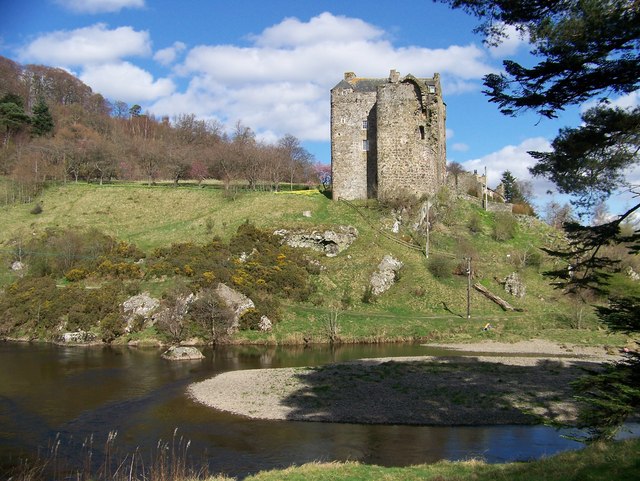
Horsburgh Castle
Horsburgh Castle stands as a significant 16th-century tower house ruin nestled near Glentress in the Scottish Borders of Scotland. This castle was constructed by the Scottish Horsburgh family, whose lineage is deeply intertwined with the region's history. The castle occupies a commanding hilltop position overlooking the confluence of the Linn Burn stream and the River Tweed, a location that was strategically chosen for its natural defensive advantages.
The site of Horsburgh Castle is layered with historical importance, as it was built atop the remains of a prehistoric hillfort. This earlier fortification highlights the long-standing military and strategic value of the location, predating the castle by many centuries. Aerial photography has revealed the outline of this ancient hillfort, preserving evidence of early defensive structures that once dominated the landscape.
Historical significance and ownership
The Horsburgh family held ownership of the estate from at least 1479 and maintained control well into the 20th century. Their stewardship spanned turbulent periods marked by border conflicts and political unrest in Scotland. Horsburgh Castle was an integral part of a broader defensive network along the Tweed valley, working in concert with neighbouring strongholds such as Neidpath Castle. These castles communicated through beacon fires, relaying warnings and strategic information across the landscape. This system underscores the castle’s military importance during the High and Late Medieval periods.
The family name itself, Horsburgh, derives from the local geography, meaning "horse brook," linking the castle’s identity closely to the surrounding environment. The legacy of the Horsburgh family extends beyond the medieval era; notably, a commemorative plaque honors Baroness Florence Horsbrugh (1889–1969), a prominent political figure who served as a minister in Winston Churchill’s wartime cabinet. This connection highlights the enduring prominence of the Horsburgh lineage in British history.
Architectural features and layout
The castle remains today primarily as the ruins of a tower house with a characteristic L-shaped footprint, typical of Scottish fortified residences from the 16th century. The northeastern wing housed a tower containing a staircase, which facilitated vertical movement within the defensive core of the building. The main block measured approximately 9.4 by 9.8 meters, with walls that survive up to six meters high in some areas, although the eastern wall has not endured.
The ground floor likely featured a vaulted ceiling, a construction technique employing masonry arches to provide additional strength and fire resistance. A notable surviving element is a cellar window in the western wall, indicative of the castle’s internal storage arrangements and security priorities.
The north wall of the ruins reveals evidence of two stories, though this section may have been partially reconstructed during the 19th century. The southern wall also shows signs of restoration from this period. Historical records suggest that the main entrance was located on the northern side, a strategic choice aligned with defensive considerations and the approach routes.
Defensive and strategic location
Perched on a hilltop at the junction of the Linn Burn and River Tweed, Horsburgh Castle exploited natural landscape features to enhance its defense. The elevated position provided commanding views over the surrounding valley, allowing early detection of approaching threats. The castle’s role in the network of border defenses was critical during centuries marked by frequent skirmishes and political instability along the Scottish-English border.
Preservation and cultural heritage
Today, Horsburgh Castle is recognized as a scheduled monument under the protection of Historic Environment Scotland. Although the castle survives only as ruins, it remains an important cultural and historical landmark within the Scottish Borders. The commemorative plaque dedicated to Baroness Florence Horsbrugh affixed to the north wall connects the site’s medieval past with its modern historical significance.
The preservation of the castle ruins alongside the visible outline of the prehistoric hillfort offers a unique window into the multi-layered history of the site. Visitors can appreciate both the medieval defensive architecture and the ancient strategic importance of the hilltop location. Horsburgh Castle thus embodies centuries of Scottish history, from prehistoric times through the medieval period to modern political heritage.
Visiting Horsburgh Castle
While the castle is in a ruined state, its location and historical context make it a fascinating destination for those interested in Scottish history and architecture. The site’s accessibility and the surrounding natural beauty of the Tweed valley enhance the visitor experience. As a protected monument, visitors are encouraged to respect the ruins and the landscape, ensuring the preservation of this heritage for future generations.
In summary, Horsburgh Castle exemplifies the typical features of a Scottish 16th-century tower house, with its strategic hilltop setting, defensive architecture, and enduring connection to the Horsburgh family. Its layered history, from prehistoric fortifications to modern commemorations, offers rich insights into the military, social, and political fabric of the Scottish Borders region.
Frequently asked questions (FAQ)
- How do I get to Horsburgh Castle?
- Horsburgh Castle is located near Glentress in the Scottish Borders. Visitors can reach the site by car or local transport, followed by a short walk to the hilltop ruins.
- What is the historical significance of Horsburgh Castle?
- Horsburgh Castle was a key defensive tower house in the 16th century, part of a network of castles communicating via beacon fires to protect the Tweed valley during border conflicts.
- Can I visit the interior of Horsburgh Castle?
- As Horsburgh Castle is a ruin, the interior is largely inaccessible and unsafe. Visitors can explore the exterior ruins and surrounding landscape but should exercise caution near unstable structures.
- When is the best time to visit Horsburgh Castle?
- The best time to visit Horsburgh Castle is during late spring to early autumn when weather conditions are favorable for walking and exploring the hilltop site.
- Is Horsburgh Castle protected?
- Yes, Horsburgh Castle is a scheduled monument protected by Historic Environment Scotland, ensuring its preservation and maintenance as a significant heritage site.
Information
Loading map...
Visitor reviews
No reviews yet. Been here? Write the first review and help other travelers!
Write the first reviewVisited this castle? Share your experience
Your review helps other travelers and adds first-hand knowledge to our encyclopedia.