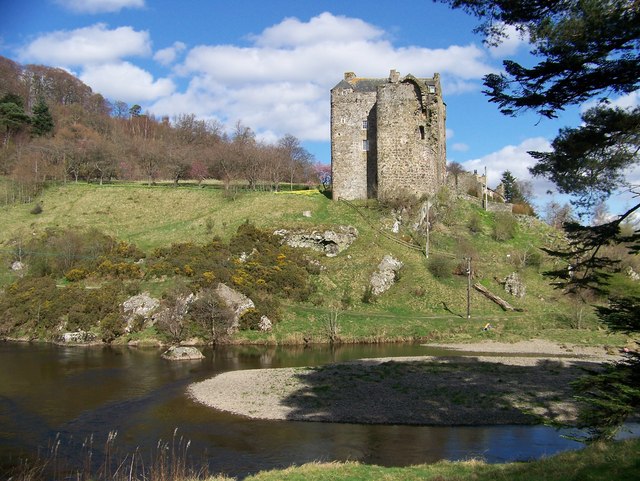
Traquair House
Traquair House stands as one of Scotland's most historically significant and continuously inhabited castles, located near the village of Traquair in the Scottish Borders. Its origins trace back to the 12th century, when it served as a royal hunting lodge for the early Scottish monarchy, with King Alexander I recorded as the first monarch to stay and hunt on the estate. This early royal association established Traquair's enduring importance within Scotland's noble and royal landscape.
The castle's strategic location in the Tweed Valley made it a key defensive site during the turbulent medieval period, particularly following the death of Alexander III in 1286. This event ushered in decades of conflict along the Scottish-English border, during which Traquair changed hands multiple times as control of the Borders region fluctuated. Its fortified residence played a vital role in the defense and administration of this contested frontier.
Medieval origins and early history
Initially established as a royal hunting lodge, Traquair evolved through the centuries into a fortified noble residence. The castle's medieval fabric reflects its dual function as both a retreat for monarchs and a stronghold in a volatile region. By the late 15th century, the estate was granted to Dr. William Rogers, a favored musician of King James III, before being sold to the Earl of Buchan in 1478. Subsequently, the estate passed to James Stuart, the Earl's illegitimate son and the first to bear the title Laird of Traquair. Stuart's marriage to the Rutherford heiress expanded the family's holdings, consolidating Traquair's status as a principal seat.
The stuart family and royal connections
From the late 15th century onward, Traquair House became the ancestral home of the Earls of Traquair for approximately four centuries. The castle's close ties to the Scottish monarchy were underscored by visits from prominent royals, including Mary, Queen of Scots in August 1566, during a period marked by political intrigue and religious turmoil. Later, King James VI visited in March 1602, reinforcing the estate's significance as a noble residence intertwined with Scotland's royal history.
The castle also played a role in the Jacobite risings of the 18th century. The Bear Gates, installed in 1738 by Charles Stuart, the fifth Earl of Traquair, are famed for their symbolic closure after passage by Charles Edward Stuart (Bonnie Prince Charlie) in 1745. Tradition holds that these gates remain closed until a Stuart monarch returns, reflecting the family's enduring loyalty to the Jacobite cause.
Architectural evolution and features
Traquair House is a sprawling mansion comprising approximately fifty rooms spread over several floors, primarily constructed from sturdy local stone. The building showcases architectural layers accumulated over centuries, with expansions and alterations occurring before the 17th century. Its preservation with minimal changes since that time offers a rare glimpse into the evolution of Scottish noble residences.
Interior highlights
The Drawing Room houses an extensive collection of portraits and photographs documenting the family's lineage, while the Dressing Room features decorative schemes depicting historical aspects of daily life. The Museum Room contains one of Scotland's oldest secular wall paintings, dating from around 1530, alongside royal charters bearing seals and signatures, providing tangible connections to the estate's governance and ownership.
The King's Room is notable for its collection of relics associated with Mary, Queen of Scots, including her rosary, crucifix, patronage purse, silk quilt, and correspondence. These artifacts offer an intimate link to the queen's presence and influence at Traquair. Adjacent rooms such as the Still Room, used as a breakfast area, display 18th-century porcelain, while the Dining Room, added in the late 1600s, represents one of the last major structural additions to the house.
Religious and brewing heritage
A Roman Catholic chapel built in 1829 following the Catholic emancipation reflects the family's enduring faith and changing religious freedoms in Scotland. Beneath the chapel lies the estate's historic brewery, featuring original oak fermentation tuns some over two centuries old, preserving a direct link to early Scottish brewing traditions.
The revival of the Traquair Brewery in 1965 by Peter Maxwell Stuart, the 20th Laird, re-established brewing on the estate using original 18th-century equipment, including a copper kettle installed in 1739 beneath the chapel. This revival honors the estate's long-standing tradition of brewing dating back to the time of Mary, Queen of Scots.
Landscape and gardens
The castle is surrounded by landscaped grounds featuring a garden maze originally planted with Leyland cypress trees and designed by John Schofield. After severe winter damage in 1983, the maze was replanted with more resilient beech trees, preserving this distinctive feature. The gardens complement the historic house, enhancing the estate's picturesque setting within the Scottish Borders.
Cultural significance and modern legacy
Traquair House remains a symbol of Scotland's rich noble and royal heritage, continuously inhabited and maintained by descendants of the original family line. Its use as a filming location for the 1970 horror film "Tam-Lin", starring Ava Gardner, brought cinematic recognition to the estate. Today, it is owned by Catherine Maxwell Stuart, the 21st Lady of Traquair, who continues the family's stewardship.
The castle's combination of historic architecture, royal associations, Jacobite symbolism, and cultural traditions such as brewing make it a unique heritage site. Visitors can explore its richly decorated interiors, historic artifacts, and beautiful grounds, gaining insight into centuries of Scottish history embodied in this remarkable hill castle.
Frequently asked questions (FAQ)
- What is the historical significance of Traquair House?
- Traquair House is one of Scotland's oldest inhabited castles with royal origins dating back to the 12th century, serving as a royal hunting lodge and noble residence with strong ties to the Stuart family and Jacobite history.
- Can visitors see the original brewing equipment at Traquair House?
- Yes, Traquair House features a historic brewery with original oak fermentation tuns and an 18th-century copper kettle, reflecting the estate's long tradition of brewing dating back to Mary, Queen of Scots.
- Are there any royal artifacts on display at Traquair House?
- The King's Room contains relics associated with Mary, Queen of Scots, including her rosary, crucifix, patronage purse, silk quilt, and correspondence, providing a tangible connection to her presence.
- Why are the Bear Gates at Traquair House significant?
- The Bear Gates, installed in 1738, were closed after passage by Bonnie Prince Charlie in 1745 and are traditionally kept shut until the return of a Stuart monarch, symbolizing the family's Jacobite loyalty.
- What architectural styles are represented in Traquair House?
- Traquair House exhibits a mix of architectural styles accumulated over centuries, primarily reflecting late medieval origins with later additions, preserving a rich historical layering.
Information
Sources & official resources
Verify the information above using these authoritative references.
Loading map...
Visitor reviews
No reviews yet. Been here? Write the first review and help other travelers!
Write the first reviewVisited this castle? Share your experience
Your review helps other travelers and adds first-hand knowledge to our encyclopedia.