
Hornberg Castle
Hornberg Castle is a remarkable hill castle situated on a steep outcrop above the Neckar valley in Neckarzimmern, Germany. It stands as the largest and oldest of the castles in the valley, with origins tracing back to the 11th century. The castle's strategic location on a narrow ridge approximately 228.6 meters above sea level allowed it to control vital river traffic and trade routes through the Neckar valley, a factor that defined much of its historical significance.
The castle was originally constructed as two separate fortifications, an upper and a lower castle, sharing a common outer bailey. This dual structure was unified around 1510 by the addition of a surrounding wall, creating a single fortified complex. Over the centuries, Hornberg Castle underwent numerous expansions, restorations, and changes in ownership, reflecting the turbulent history of the region.
Early history and strategic importance
The first documented mention of Hornberg Castle dates from 1184, identifying it as property of the Counts of Lauffen, who controlled the Neckar valley and its river traffic. The castle was likely founded in the late 12th century, although some sources suggest an 11th-century origin. It functioned as a critical defensive fortress securing the Neckar valley and overseeing important long-distance trade routes.
Initially, Hornberg Castle was built by the Nobles of Sulz as a satellite to their main seat, Sulz Castle. Its purpose was to secure the connecting road through the Steinbachklinge between the imperial cities of Hall and Rothenburg. Shortly thereafter, the Sulz family constructed Kirchberg Castle on the opposite side of the Jagst ford, together forming a network of fortifications controlling key crossing points in the region. These castles were part of the Staufen imperial holdings, underscoring their political and military importance.
Ownership and historical developments
Throughout its history, Hornberg Castle changed hands frequently. After the Counts of Lauffen, parts of the castle came under the Lords of Dürn, while the Bishopric of Speyer maintained overlordship until 1803. The castle was often divided between different owners, with the upper and lower sections controlled separately, making it a joint-heritage castle.
In 1464, Lutz Schott von Schottenstein purchased the castle and undertook significant fortifications, merging the two castles and the outer bailey into a unified complex. The renowned knight Götz von Berlichingen acquired Hornberg Castle in 1517, residing there for 45 years until his death in 1562. His grandson, Philipp Ernst von Berlichingen, initiated major expansions and renovations beginning in 1573, transforming the castle into a Renaissance residence.
Since 1612, the castle has been owned by the Gemmingen family, who remain its proprietors today. The castle endured occupation and plundering during the Thirty Years’ War in 1634 and 1645, and suffered damage during the Nine Years’ War in 1689. Restoration efforts were completed by 1700. The castle was abandoned after 1738 but underwent partial restoration starting in 1825, with extensive 20th-century renovations reviving its historic fabric.
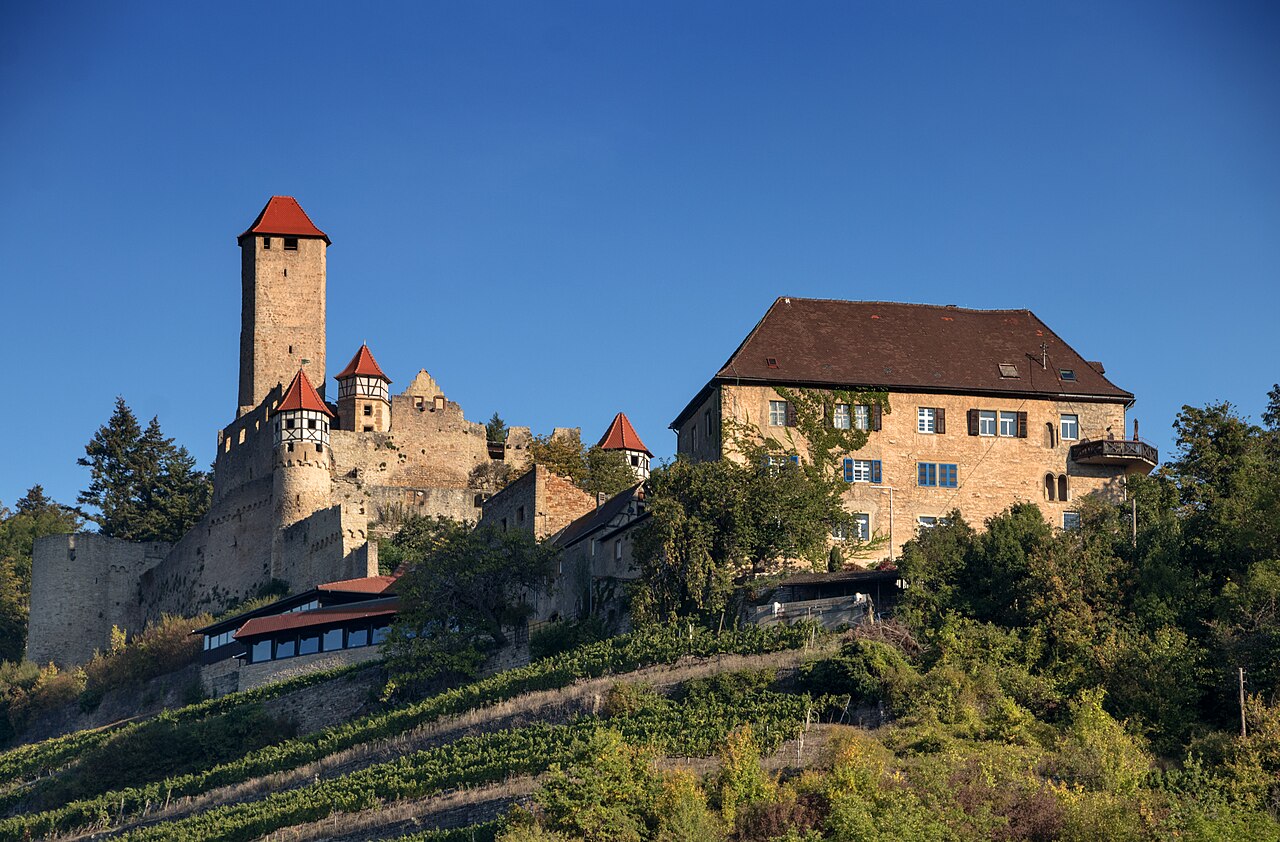
Photo by Derzno • CC BY-SA 4.0
Architectural features and layout
Hornberg Castle occupies a narrow ridge approximately 170 meters in length, with a complex layout reflecting its evolution over centuries. The lower castle contains the oldest surviving structure, a Romanesque tower palace dating from the mid-12th century. This tower palace measures roughly 12 by 25.5 meters, with walls up to 2.7 meters thick on the north side. It rises about 15 meters high and originally included multiple floors. Notable architectural details include three Romanesque twin windows with intricately carved capitals depicting grapevines, indicative of the castle's residential and representative functions.
The upper castle is dominated by a massive shield wall on the north side, currently standing 7.5 meters tall and up to 7 meters thick in the center. While its exact age and original purpose remain uncertain, it is a formidable defensive feature. The main tower, or bergfried, is an imposing structure approximately 33 meters tall at the highest point of the site. Its unusual oval exterior combined with a rectangular interior is unique among regional castles. The bergfried features narrow slit windows on the rear side and six windows on the top floor that offer panoramic views of the surrounding landscape. The original entrance was located about 15 meters above ground level for defensive purposes, later connected to the upper castle by a Renaissance stair tower.
Chapel and residential buildings
Within the upper castle lies a 15th-century chapel characterized by a pointed arch portal and cross vaults, reflecting Gothic architectural influences. Beneath the chapel is the Gemmingen family crypt, emphasizing the castle's role as a noble residence. The main residential building, or palas, was constructed in the 16th century by Jakob von Berlichingen. It includes a kitchen with Gothic rib vaulting and a large knights’ hall featuring a historic fireplace, underscoring the castle's dual defensive and domestic functions.
A notable architectural highlight is the hexagonal spiral staircase tower known as the Wendelstein, built in 1573 by Philipp Ernst von Berlichingen. This ornate tower serves as the entrance to the bergfried and the museum, showcasing Renaissance craftsmanship and design.
Outer bailey and supporting structures
The outer bailey housed essential economic buildings such as former stables, now converted into a restaurant, the Wingerthaus or wine master’s house, a laundry building repurposed as cold storage, and an 18th-century sheep barn adapted for hotel rooms and wine sales. These stone structures replaced earlier wooden buildings, reflecting the castle's continuous adaptation to changing needs.
Water supply and defensive challenges
Water supply was a significant challenge for Hornberg Castle due to its elevated and exposed position. Access to water relied on a mule path leading to a small eastern gate and at least two wells documented in 15th-century records, though their exact locations remain unknown. An old clay pipe once transported water from a spring above the castle, but this system was vulnerable during sieges, posing a critical risk to the castle's inhabitants.
Modern restoration and current use
After suffering significant roof damage during World War II in 1944-45, the castle underwent prompt repairs. Extensive restoration efforts throughout the 20th century revived the castle's historical structures and adapted parts of the complex for modern use. Since 1968, Hornberg Castle has housed a museum displaying medieval arms and armor, including the original suit of Götz von Berlichingen. The museum offers visitors insight into the castle's rich history and architectural evolution.
Today, the castle functions as a hotel and event venue, with the outer bailey buildings serving hospitality and wine sales, maintaining the castle's longstanding connection to the region's viticulture. The historic vineyard associated with the castle, documented since 1184 and possibly dating back to Roman times, remains active under the stewardship of the Gemmingen family.
Hornberg Castle stands as a testament to medieval fortification techniques, Renaissance architectural enhancements, and the enduring legacy of noble families in southwestern Germany. Its well-preserved structures, rich history, and scenic location make it a significant cultural and heritage landmark in the Neckar valley.
Frequently asked questions (FAQ)
- How do I visit Hornberg Castle and what are the opening hours?
- Hornberg Castle is open to visitors with a museum and hotel facilities. Opening hours vary seasonally, so it is recommended to check the official website or contact the castle directly for current visiting times.
- What is the historical significance of Hornberg Castle?
- Hornberg Castle played a strategic role in controlling the Neckar valley and river traffic from the 11th century onwards. It was owned by notable families such as the Counts of Lauffen, the Lords of Dürn, and the Gemmingen family, and was home to the famous knight Götz von Berlichingen.
- Can I explore the architectural features of Hornberg Castle?
- Yes, visitors can explore the castle's Romanesque tower palace, the massive shield wall, the bergfried with its unique oval shape, the 15th-century chapel, and Renaissance additions like the Wendelstein spiral staircase tower.
- Is Hornberg Castle accessible for visitors with mobility issues?
- Due to its hilltop location and historic structures, some areas of Hornberg Castle may be challenging for visitors with mobility issues. It is advisable to inquire in advance about accessibility options and available assistance.
- Are there guided tours available at Hornberg Castle?
- Guided tours are often available, providing detailed historical and architectural insights. Visitors should check the castle's official resources for tour schedules and booking information.
Photo gallery

Information
Website
Visit websiteSources & official resources
Verify the information above using these authoritative references.
Loading map...
Visitor reviews
No reviews yet. Been here? Write the first review and help other travelers!
Write the first reviewVisited this castle? Share your experience
Your review helps other travelers and adds first-hand knowledge to our encyclopedia.