Holy Forty Martyrs Church
The Holy Forty Martyrs Church in Veliko Tarnovo, Bulgaria, is a significant medieval Eastern Orthodox church constructed in 1230 during the reign of Tsar Ivan Asen II. This church holds a prominent place in Bulgarian history as it was built to commemorate Ivan Asen II's decisive victory over the Despotate of Epirus near Klokotnitsa on the feast day of the Holy Forty Martyrs of Sebaste. The church's name directly reflects this connection, marking a symbolic and spiritual celebration of the battle's success.
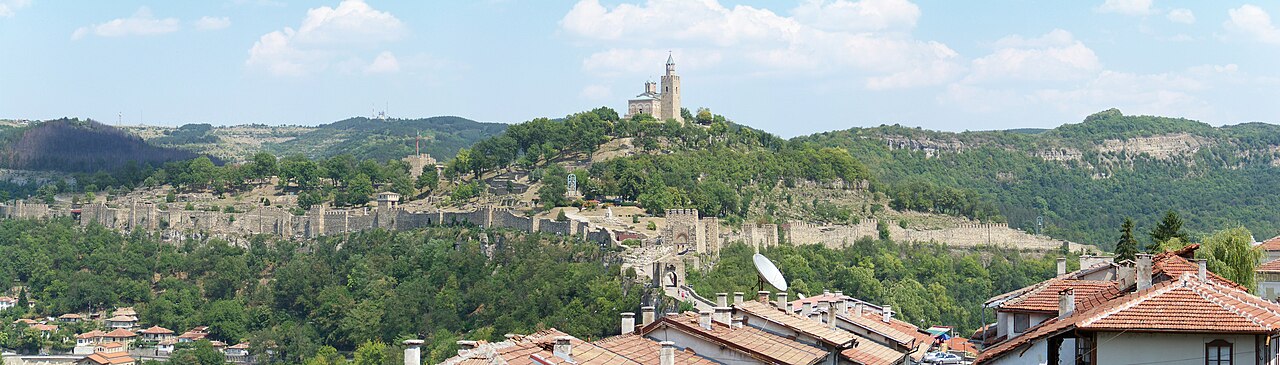
Located in the former capital of the Second Bulgarian Empire, the church served as the main church of the Great Lavra monastery situated at the foot of the Tsarevets fortress on the left bank of the Yantra River. It was a royal church during Ivan Asen II's reign, reflecting the political and religious significance of Veliko Tarnovo as a medieval Bulgarian capital.
Architectural features and design
The Holy Forty Martyrs Church is an elongated six-columned basilica featuring three semicircular apses and a narrow narthex on its western side. The basilica layout is typical of Eastern Orthodox ecclesiastical architecture of the High Medieval period. The church's exterior includes a later addition on the west side, which also features decorative elements such as arches and colored small ceramic plates inserted into the walls, a common ornamental technique in medieval Bulgarian architecture.
The interior originally was richly adorned with mural paintings, likely completed around 1230, although most of these were destroyed during the Ottoman period. Only a limited number of frescoes remain, primarily on the northern half of the narthex's west side. The presence of such murals highlights the church's role not only as a place of worship but also as a repository of religious art.
Historical significance and transformations
Following the Ottoman conquest, the church initially retained its Christian character, possibly until the first half of the 18th century. Subsequently, it was converted into a mosque in 1853, which led to the destruction of much of its original iconography, including the mural paintings, icons, and the iconostasis. Structural alterations were also made at this time to accommodate its new function.
The church houses some of the most important historical artifacts of the Bulgarian Empire, including the columns of Khan Omurtag, Khan Krum, and Asen's Column. These columns bear inscriptions in the Greek language and were placed in the church by Ivan Asen II as a tribute to his powerful ancestors. The inscription on Omurtag's column describes the construction of a new palace on the Danube River, though its precise location remains unknown. The inscription on Krum's column mentions the "Fortress of Rodostro," with the text uniquely turned upside down.
The columns and inscriptions
These monumental columns are invaluable for understanding the political and cultural history of early medieval Bulgaria. They serve as tangible links to the reigns of these notable rulers and their accomplishments. The placement of these columns within the church underscores the building's role as a symbol of dynastic continuity and national pride during the Second Bulgarian Empire.
Preservation and current condition
Today, the Holy Forty Martyrs Church stands as a partially preserved monument reflecting Bulgaria's medieval heritage. Despite the damage sustained during the Ottoman period and the loss of much of its original decoration, the church remains an important historical and architectural site in Veliko Tarnovo. Its surviving frescoes and architectural elements provide valuable insight into medieval Bulgarian ecclesiastical art and architecture.
The church's location near the Tsarevets fortress and the Yantra River situates it within a historically rich landscape that continues to attract scholars and visitors interested in Bulgaria's medieval past.
Religious and cultural importance
The church's dedication to the Holy Forty Martyrs of Sebaste ties it to a significant Christian feast celebrated throughout Eastern Orthodoxy. Its foundation by a Bulgarian tsar to commemorate a military victory highlights the interweaving of religious faith and political power in medieval Bulgaria. As a royal church and part of a major monastery complex, it played a central role in the spiritual life of the capital and the empire.
Loading map...
Visitor reviews
No reviews yet. Been here? Write the first review and help other travelers!
Write the first reviewVisited this castle? Share your experience
Your review helps other travelers and adds first-hand knowledge to our encyclopedia.