
Holt Castle
Holt Castle, located in the village of Holt in Wrexham County Borough, Wales, is a significant medieval fortress situated on the Welsh-English border alongside the River Dee. Constructed on a sandstone base, the castle's origins date back to the late 13th century, specifically to the year 1282, when it was initiated by King Edward I following his invasion of North Wales in 1277. The castle was strategically positioned to assert English control over the region and to serve as a defensive stronghold in the contested borderlands.
The castle was granted by Edward I to the loyal lord John de Warrene, who was entrusted with completing the fortress. By 1311, the construction of the castle was finished, and a planned English settlement was established adjacent to it to accommodate settlers. This settlement was part of Edward I's broader strategy to consolidate English power in the region through colonization and military presence.
Architectural design and features
Holt Castle was notable for its distinctive design, which included a five-towered layout. This design was somewhat unusual for its time and region, reflecting both military and symbolic considerations. The castle was also known by the Latin name Castrum Leonis or Castle Lyons, a reference to the carved lion motif that adorned the stonework above the main gate, symbolizing royal authority and strength.
The castle's foundation was built on solid sandstone rock, providing a natural defensive advantage. Key surviving architectural elements include the lower walls of the inner keep, the postern gate, a buttress, a chute exit, and the foundations of the outer gate's square tower. These remnants give insight into the castle's original form and defensive capabilities.
Historical significance and events
Throughout its history, Holt Castle played a pivotal role in the turbulent relations between England and Wales. In 1400, during the uprising led by Owain Glyndŵr, Welsh forces succeeded in burning down the English town adjacent to the castle, although the fortress itself was not captured. This event underscored the castle's military importance and the ongoing conflict in the border region.
By the 16th century, Holt Castle had fallen into disuse and decline, reflecting broader changes in military technology and political stability. However, it regained strategic importance during the First English Civil War in the 17th century. The castle was garrisoned by Royalist troops but changed hands multiple times. It was captured by Parliamentarian forces in 1643, retaken by Royalists in the spring of 1644, and finally surrendered after a prolonged siege in January 1647 to Parliamentarian commander Thomas Mytton.
The aftermath of the siege was grim; thirteen members of the Parliamentarian garrison who had been captured were executed, with their bodies disposed of in the castle's moat. This episode reflects the brutal nature of the civil conflict and the castle's role as a contested military asset.
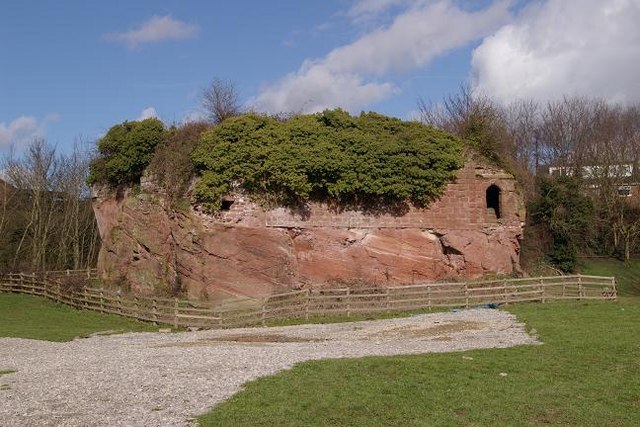
Photo by Peter Craine • CC BY-SA 2.0
Decline and partial dismantling
Following the civil wars, much of Holt Castle was dismantled between 1675 and 1683 by Sir Thomas Grosvenor, 3rd Baronet of Eaton. The stonework was removed using barges to transport it downstream to rebuild Eaton Hall. By the 18th century, only fragments of the castle remained, including part of a tower and a rectangular building.
Today, the most substantial remains of Holt Castle rest on its sandstone base. Visitors can observe the surviving masonry features, which provide valuable insights into medieval castle construction and the site's historical narrative.
Legacy and cultural importance
Holt Castle stands as a testament to the complex history of the Welsh-English border during the High Medieval period and beyond. Its architecture, strategic location, and the events it witnessed reflect the shifting power dynamics of the region. Though largely in ruins, the castle remains a point of interest for historians, archaeologists, and visitors interested in medieval military architecture and the history of Wales and England.
Frequently asked questions (FAQ)
- How do I get to Holt Castle?
- Holt Castle is located in the village of Holt, Wrexham County Borough, Wales. It is accessible by local roads and is near the River Dee, with parking available nearby for visitors.
- What is the historical significance of Holt Castle?
- Holt Castle was built by Edward I in the late 13th century as a strategic fortress on the Welsh-English border. It played a key role during the Welsh uprising of Owain Glyndŵr and the English Civil War.
- Can I visit the remains of Holt Castle today?
- Yes, visitors can explore the ruins of Holt Castle, including the sandstone foundations and remaining masonry features. The site offers insight into medieval castle architecture and history.
- When was Holt Castle built?
- Construction of Holt Castle began in 1282 under the orders of Edward I and was completed by 1311.
- Why is Holt Castle also known as Castrum Leonis?
- Holt Castle was called Castrum Leonis or Castle Lyons because of the lion motif carved above its main gate, symbolizing royal authority and strength.
Photo gallery

Information
Loading map...
Visitor reviews
No reviews yet. Be the first to share your experience!