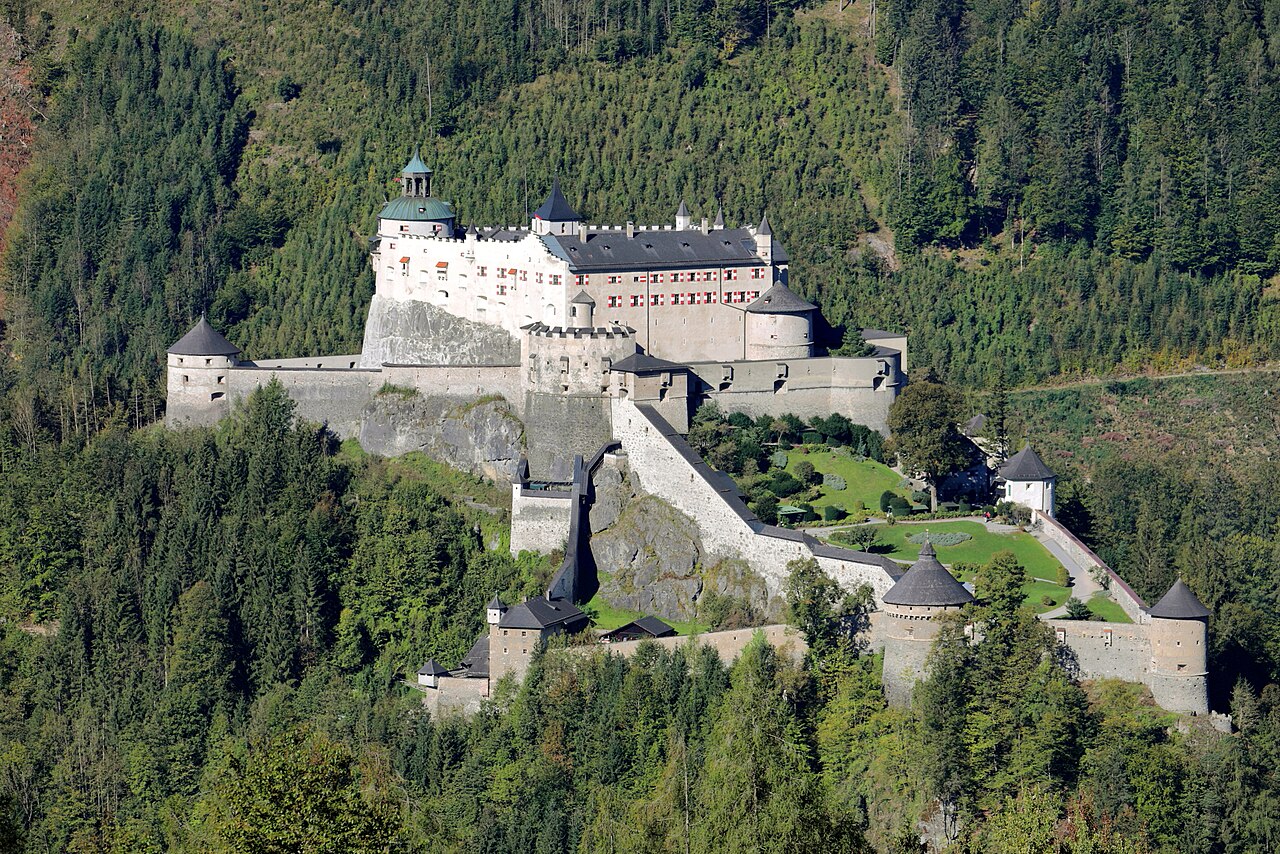
Golling Castle
Golling Castle is a remarkable high medieval hill castle strategically perched on a rocky elevation overlooking the Salzach river valley in Golling an der Salzach, Austria. Its commanding position near the narrow Lueg Pass between the Hagen and Tennen Mountains has made it a vital defensive and administrative site for centuries. The castle’s origins trace back to a Roman-era watchtower, with a wooden motte-and-bailey structure established in the early Middle Ages. The current stone fortress was constructed in the 13th century under the auspices of the Prince-Archbishops of Salzburg, likely during the tenure of Archbishop Eberhard II.
Historical significance and early origins
The location of Burg Golling has been of strategic importance since antiquity. The site overlooked an ancient Roman road connecting the cities of Virunum and Iuvavum (modern Salzburg), which passed close to the Lueg Pass. This pass served as a crucial transit route through the Eastern Alps since the Bronze Age. Roman military engineers initially erected a wooden watchtower here to monitor movement along this vital artery.
Following the decline of Roman authority and the Bavarian conquest of the region in the early Middle Ages, a wooden motte castle was constructed on the site. This early fortification consisted of a raised earthwork mound topped by timber buildings, typical of motte-and-bailey castles prevalent in the medieval period. This wooden stronghold was eventually replaced by the extant stone castle in the 13th century, marking a transition to more durable and imposing fortifications.
Construction and architectural features
The stone castle was built primarily to secure control over the Salzach valley and the important trade and military routes passing through the Lueg Pass. Burg Golling is classified as a hill castle, situated on a natural rocky outcrop at an elevation of approximately 469 meters above sea level. The fortress features robust stone walls, a defensive moat, and a strategically designed entrance accessed via a bridge spanning the moat.
The bridge itself has a layered history of construction and reconstruction, with significant rebuilds recorded in 1532 and 1713. The moat and bridge served as critical components of the castle’s defensive system, controlling access and providing protection against attackers. The castle’s walls were modified over time, including partial demolition in 1619 to prevent the spread of fire from a nearby market blaze and subsequent rebuilding in 1621.
Internally, the castle housed administrative and residential quarters, including a princely chamber paved in 1633 and later enhanced with heating in 1722 under the direction of Prince-Archbishop Franz Anton von Harrach. The southern wing was expanded in the 19th century to serve as a prison, reflecting the castle’s evolving role in regional governance and law enforcement.
Historical events and ownership
The first documented mention of Golling Castle dates to 1325, when Archbishop Friedrich granted the castle for life to Margarete von Huchel and her sons in exchange for a payment of 300 pounds of silver pennies. By 1375, ownership reverted to the archbishopric under Archbishop Pilgrim II, and from 1438 onwards, the castle remained under direct archiepiscopal control.
Throughout the late medieval and early modern periods, the castle played a significant role in regional conflicts. It was notably involved during the Peasants’ War of 1525, serving as a rallying point for local rebels. The fortress endured damage from military actions and natural disasters, including flooding in 1573 and a lightning strike in 1599, necessitating multiple repairs and renovations.
In the early 18th century, under the leadership of Prince-Archbishop Franz Anton von Harrach, the castle underwent further renovations to improve its residential comforts and administrative functions. These enhancements included the installation of a heated chamber and other modernizations befitting a princely residence.
Adaptive reuse and preservation
By the late 19th century, the castle’s southern wing was repurposed as a prison, marking a shift from military fortress to civil administrative use. After the abolition of the regional court in 1923, parts of the castle were adapted for residential purposes and to accommodate customs and tax offices.
Since the early 1970s, Golling Castle has been preserved as a cultural heritage site and now hosts a local history museum. The museum displays artifacts from the castle’s extensive past alongside fossil finds from the surrounding region, connecting the site’s human history with its geological context. The castle’s well-preserved structures and museum function make it an important destination for visitors interested in medieval architecture and regional history.
Architectural layout and notable features
The castle’s layout reflects its defensive and administrative purposes. The main entrance is accessed via a bridge over the moat, leading to a fortified gatehouse. The walls are constructed of local stone, featuring battlements and defensive towers that provided vantage points for surveillance and protection.
The internal courtyard and residential quarters include the princely chamber, which was upgraded over centuries to meet the needs of its occupants. The southern wing’s conversion into a prison introduced new architectural elements related to security and containment.
Throughout its history, Burg Golling has seen continuous modifications that illustrate the evolution of castle architecture from wooden motte structures to stone fortresses adapted for administrative governance and later civil use.
Visiting golling castle today
Today, visitors to Golling Castle can explore its well-preserved medieval architecture and learn about its historical significance at the on-site museum. The castle’s location offers panoramic views of the Salzach valley and nearby mountain ranges, enhancing the visitor experience.
The museum’s exhibits provide insights into the castle’s role in regional history, including its military, administrative, and cultural functions over the centuries. The site is accessible to the public, making it a valuable cultural and educational resource in the Salzburg region.
Frequently asked questions (FAQ)
- How do I get to Golling Castle?
- Golling Castle is easily accessible by car and public transportation. If you are traveling by train, the Golling-Abtenau station is nearby, and from there, it’s a short bus ride or a pleasant walk to the castle.
- What are the opening hours of Golling Castle?
- Golling Castle is open to visitors from April to October, typically from 10 AM to 5 PM. It is advisable to check the castle's official website for any updates on specific days or hours of operation, especially during holidays.
- Can I purchase tickets in advance for Golling Castle?
- Yes, you can purchase tickets in advance through the castle's official website or at the entrance. Advanced booking is recommended during peak tourist season to avoid long wait times.
- When was Golling Castle built?
- Golling Castle dates back to the 13th century, originally constructed as a fortress. Over the centuries, it has undergone various renovations, reflecting different architectural styles.
- Why is Golling Castle historically significant?
- Golling Castle played a crucial role in the defense of the region and served as a noble residence throughout the centuries. Its historical importance is highlighted by its well-preserved architecture and the rich stories of its former inhabitants.
- Is it possible to access Golling Castle with a wheelchair?
- Golling Castle has made efforts to improve accessibility; however, some areas may still present challenges due to the castle's historical nature. It is recommended to contact the castle staff in advance to inquire about specific accessibility options.
- What is the best time to visit Golling Castle?
- The best time to visit Golling Castle is during the spring and early autumn months when the weather is pleasant, and the surrounding landscape is beautiful. Visiting during these times also allows you to enjoy fewer crowds compared to peak summer months.
- Are there nearby attractions to visit after Golling Castle?
- Yes, there are several nearby attractions, including the scenic Golling Waterfall and the charming town center of Golling an der Salzach. These sites offer additional opportunities for exploration and enjoyment after your visit to the castle.
- What architectural styles can be seen at Golling Castle?
- Golling Castle features a mix of architectural styles, primarily Romanesque and Gothic elements. Visitors can admire the unique blend of these styles in the castle's towers, walls, and interiors, showcasing its historical development over the centuries.
Information
Website
Visit websiteSources & official resources
Verify the information above using these authoritative references.
Loading map...
Visitor reviews
No reviews yet. Been here? Write the first review and help other travelers!
Write the first reviewVisited this castle? Share your experience
Your review helps other travelers and adds first-hand knowledge to our encyclopedia.