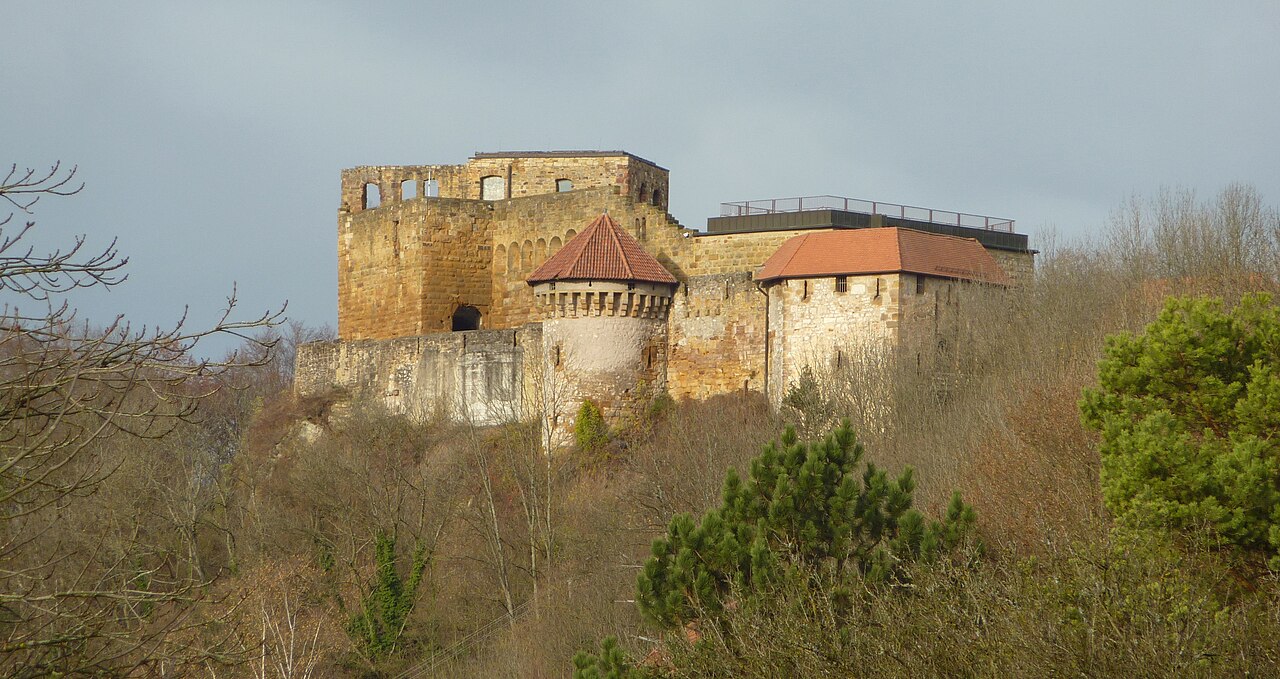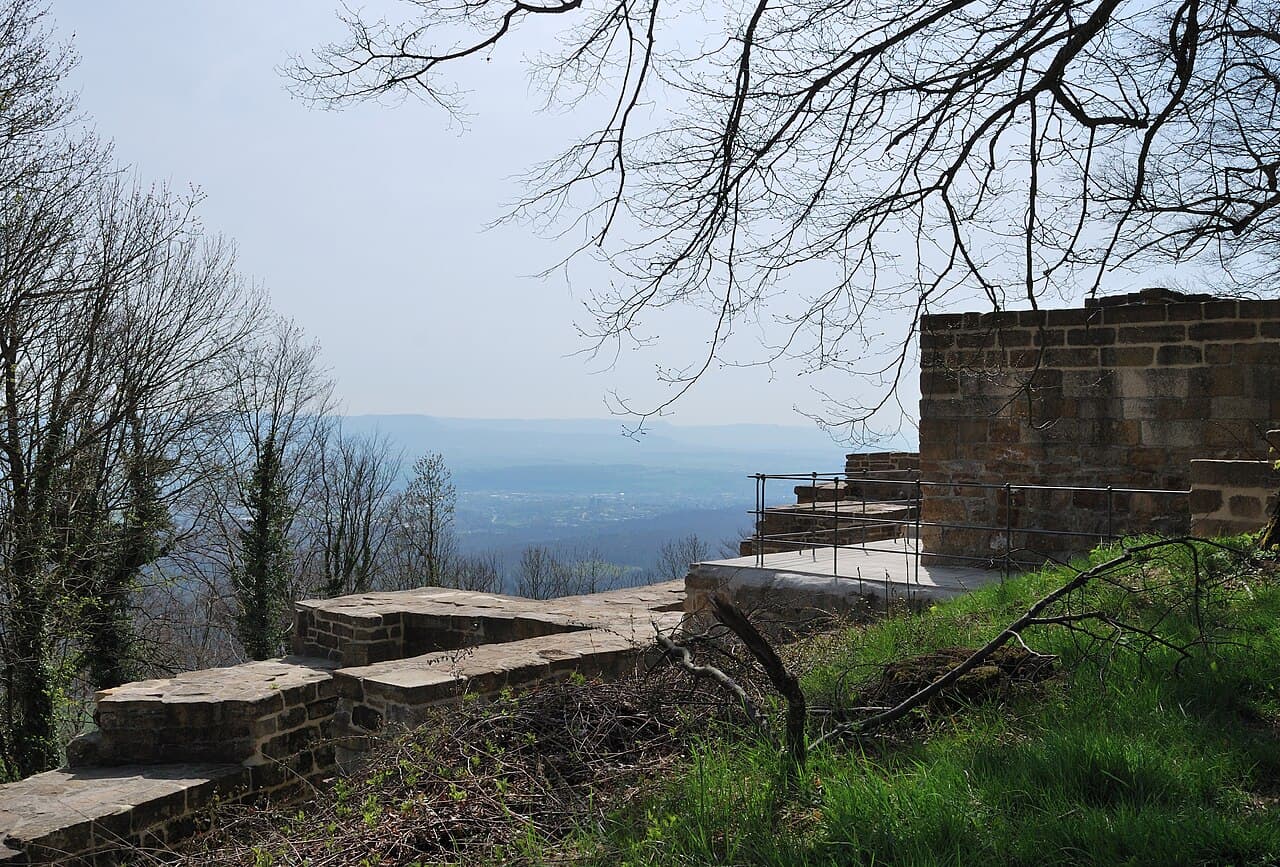
Hohenstaufen Castle Ruins
Hohenstaufen Castle stands as a significant historical landmark atop the conical Hohenstaufen mountain near the town of Göppingen in Germany. This hill castle was originally constructed around 1070 by Duke Frederick I of Swabia, who belonged to the influential House of Hohenstaufen, also known as the Staufer dynasty. The castle served as the ancestral seat and family fortress, symbolizing the power and prestige of the Staufers during the High Medieval period. Its strategic location allowed it to oversee and protect the surrounding territory, securing the family's interests in the region.
The site of Hohenstaufen Castle has a rich history of human occupation that predates the medieval fortress. Archaeological evidence reveals that the hill was inhabited during the Bronze Age, the late Hallstatt period, and the Merovingian era, with finds such as pottery and burial grounds indicating continuous settlement. These early communities left a lasting imprint on the landscape, highlighting the hill's long-standing cultural and strategic importance well before the castle's construction.
Construction and architectural features
The castle was expanded from an earlier fortification into a more substantial stronghold by Frederick I of Swabia around 1070. This expansion marked the beginning of the castle as the namesake and home of the Staufer family. The castle's design reflects typical High Medieval hill castle architecture, featuring an elongated, oval-shaped layout adapted to the summit's topography.
Castle layout and defensive structures
Hohenstaufen Castle comprised two main parts: the Kernburg (inner core) and the Vorburg (outer courtyard), separated by a defensive wall constructed in the 12th century. This wall served as a crucial fortification line, protecting the inner sanctum of the castle. The castle was further fortified with battlements and defensive towers, including a prominent bergfried—a large stone tower that functioned as the main keep and last refuge during sieges.
The bergfried and masonry
The bergfried was a defining feature of Hohenstaufen Castle, measuring approximately ten meters on each side. It was built using rusticated ashlar masonry, known in German as Buckelquadermauerwerk, characterized by roughly hewn square stones that provided both strength and an imposing appearance. Although the bergfried survived in ruinous form into the late 16th century, it was demolished in 1705 due to concerns about its structural stability.
Historical significance and ownership
Hohenstaufen Castle was the seat of the powerful House of Hohenstaufen, which produced several Holy Roman Emperors and shaped medieval European politics. The castle remained a family possession until the extinction of the Staufer dynasty in 1268. Following this, the castle was declared an imperial possession by King Rudolf I of Habsburg in 1288, marking a shift in control and political significance.
The castle's strategic and symbolic importance made it a contested site between the Holy Roman Emperor and regional rulers, especially the Counts of Württemberg. The counts seized the castle in 1319, but it was besieged by Emperor Charles IV in 1360. Later, it was sold to Duke Albert of Austria in 1366 before finally coming under Württemberg control in 1372.
In the early 16th century, the castle was granted to Georg Staufer von Bloßenstaufen, who claimed descent from the original Staufer family. This reestablished a symbolic link to the castle's founding lineage. However, the castle's prominence ended during the German Peasants' War in 1525, when insurgents besieged and destroyed it, setting it ablaze. The destruction marked the beginning of the castle's decline into ruin.
Decline, ruin, and archaeological preservation
After its destruction, the castle fell into disuse and was gradually dismantled. Stones from the ruins were repurposed for the construction of the Renaissance Göppingen Castle under Duke Christoph of Württemberg. By the late 16th century, only the castle's walls and towers remained, without roofs or timber elements. The bergfried, though still standing as a ruin, was demolished in 1705 due to safety concerns.
Plans to rebuild the fortress in the 18th century were abandoned following the death of Duke Carl Alexander in 1737. Over time, visible remains diminished, leaving primarily foundations and fragments of walls.
Significant archaeological excavations were undertaken in the 20th century, notably by Walther Veeck between 1936 and 1938, and further work from 1967 to 1971. These efforts uncovered and stabilized the castle's foundations, enabling preservation and public access. Conservation work continued into the 21st century, including preservation efforts in 2009 and the installation of a commemorative stele in 2002 to honor the castle's historical legacy.
Archaeological findings and cultural heritage
The site has yielded important archaeological finds, including pottery from the Merovingian period and earlier, such as the distinctive "older yellow wheel-thrown ware of the Runder Berg type," dating from the 8th to mid-11th centuries. Nearby burial grounds with approximately twenty graves correspond to the late Merovingian or early High Medieval periods, underscoring the long human presence on the mountain.
Today, Hohenstaufen Castle exists primarily as a collection of ruins and archaeological remains. The castle's foundations and some wall sections remain visible, showcasing the characteristic rusticated ashlar masonry and layout of a medieval hill castle. A modern restaurant built in 2010 near the summit replaces an earlier shelter, serving visitors who come to explore the historic site.
The Staufer Museum, located at the intersection of Pfarrgasse and Kaiserbergsteige in Hohenstaufen, houses artifacts recovered from the castle and provides detailed historical information. Visitors can access the castle ruins via a trail starting between two churches adjacent to the museum, making the site both an educational and cultural destination.
Frequently asked questions (FAQ)
- How do I get to Hohenstaufen Castle ruins?
- The castle ruins are accessible via a hiking trail starting between two churches near the Staufer Museum in Hohenstaufen. The trail leads up to the summit of Hohenstaufen mountain where the ruins are located.
- What is the historical significance of Hohenstaufen Castle?
- Hohenstaufen Castle was the ancestral seat of the powerful Staufer dynasty, which provided several Holy Roman Emperors. It played a key role in medieval German politics and was a contested site between imperial and regional rulers.
- Can I visit the Staufer Museum?
- Yes, the Staufer Museum in Hohenstaufen is open to visitors and displays artifacts and historical information about the castle and the Staufer family. It is located at the intersection of Pfarrgasse and Kaiserbergsteige.
- When was Hohenstaufen Castle destroyed?
- The castle was destroyed in 1525 during the German Peasants' War when insurgents besieged and set fire to the fortress. After this event, it fell into ruin and was gradually dismantled.
- Are there any remains of the castle still visible?
- Yes, the ruins include foundations, fragments of walls, and the site of the former bergfried tower. Archaeological excavations have preserved these remains, allowing visitors to explore the castle's layout and masonry.
Photo gallery

Information
Sources & official resources
Verify the information above using these authoritative references.
Loading map...
Visitor reviews
No reviews yet. Been here? Write the first review and help other travelers!
Write the first reviewVisited this castle? Share your experience
Your review helps other travelers and adds first-hand knowledge to our encyclopedia.