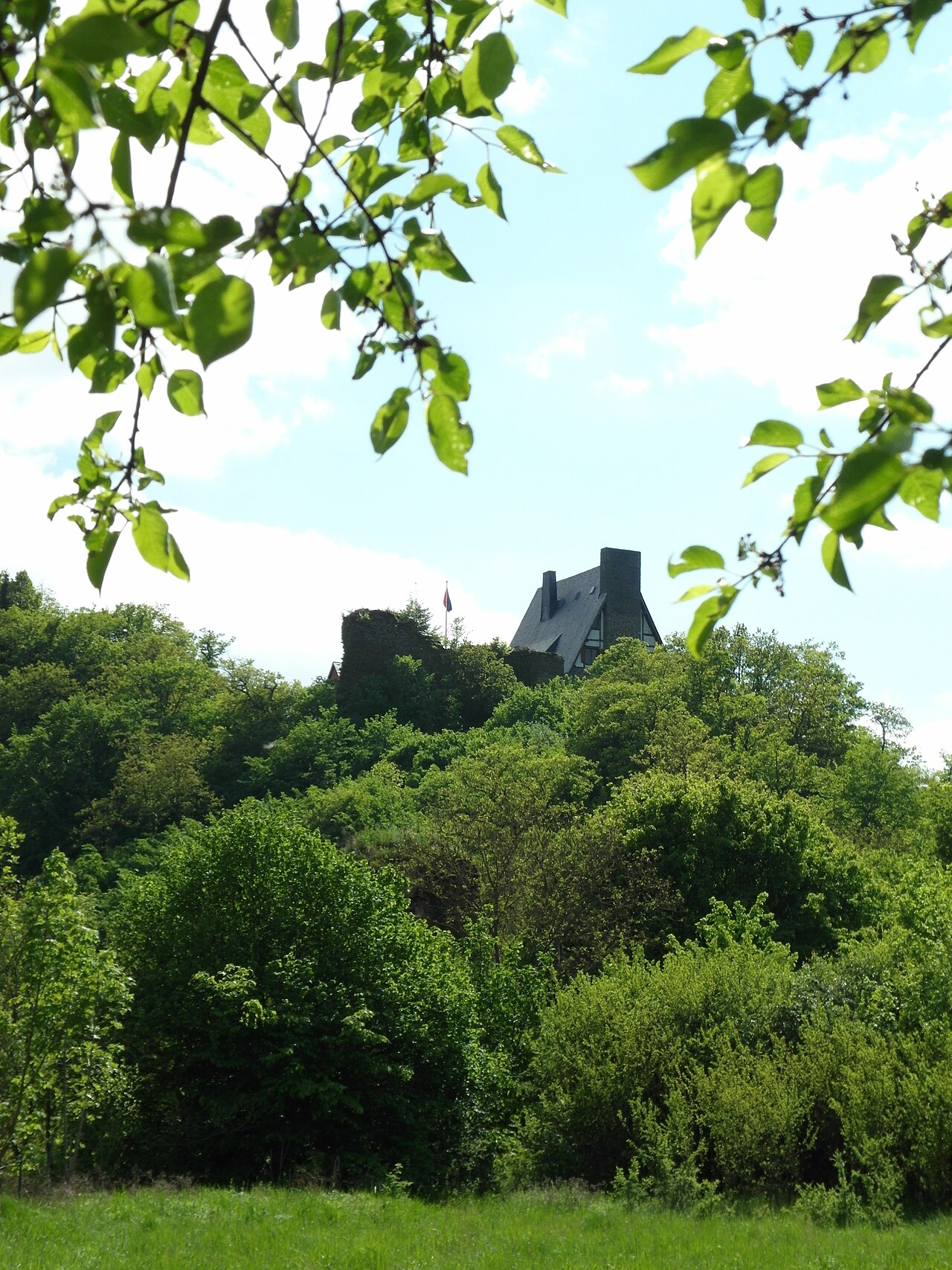
Hohennagold Castle Ruins
Hohennagold Castle stands as a remarkable ruined fortress overlooking the Black Forest town of Nagold, Germany. This site preserves the remains of a 12th-century hill castle that once dominated the surrounding landscape with its strategic position atop Schlossberg hill, rising 529.8 meters above sea level. The castle's location on rugged porphyry rock provided natural defensive advantages, combined with extensive man-made fortifications that evolved over centuries.
The earliest fortification at the site possibly dates back to around 750 AD, attributed to Count Ruodbrecht, an uncle of Charlemagne. This early medieval stronghold underscores the long-standing strategic importance of the location. The castle as it is known today was initially constructed circa 1100 by the Counts of Nagold, who later rose to prominence as the Counts Palatine of Tübingen in 1145. Between 1153 and 1162, the castle underwent extensive expansion, enhancing its defensive and residential capacities.
Historical evolution and ownership
In the mid-13th century, control of the castle transferred to the Counts of Hohenberg. A branch of this family adopted the title Counts of Nagold and transformed the castle into their primary residence during the 13th and 14th centuries. This period saw the castle evolve from a purely military fortress into a noble domicile with administrative functions.
In 1364, the castle was sold to the Counts of Württemberg, who reinforced the outer ward with additional bastions and towers. These fortifications were designed to withstand the increasingly sophisticated siege warfare of the late medieval period. The castle also served as a residence for ministeriales, a class of unfree knights or officials responsible for managing the estate and military duties on behalf of the counts.
Architectural features and fortifications
Castle layout and defensive structures
The castle complex is characterized by a central keep (bergfried) standing approximately 17 meters tall with walls 2.5 meters thick. The entrance to this tower is notably elevated at nine meters above ground level, a defensive feature designed to hinder attackers. Adjacent to the bergfried is a protective tower reaching 25 meters in height, accessible by internal staircases, illustrating the castle's multi-tiered defense system.
Surrounding the keep are curtain walls that connect various defensive towers, including a well-preserved tower in the northwestern corner. The outer ward contains a mix of half-round and angular towers, which reflect architectural adaptations over several centuries to meet evolving military needs.
The castle was further protected by a zwinger, a fortified outer enclosure that served as an additional barrier against attackers. Archaeological evidence suggests the entire complex was once encircled by a moat, enhancing its defensive capabilities by impeding direct assaults.
Shield wall and outer defenses
A particularly imposing feature is the shield wall, measuring approximately 2.5 meters thick and rising to about 10 meters in height. This thick wall was a crucial element in defending against siege engines and infantry assaults, demonstrating the castle's robust military architecture.
Destruction and preservation
During the Thirty Years' War, in 1645, the castle was captured by Bavarian troops and suffered severe damage. The following year, in 1646, much of the remaining structure was deliberately demolished, leading to its abandonment as a military stronghold.
In the closing months of World War II, the northwest tower was destroyed in a low-level Allied air attack in 1945. Post-war efforts focused on preserving the ruins, aiming to maintain the castle as a historical monument rather than restoring it fully.
Today, the ruins of Hohennagold Castle remain a significant cultural heritage site, offering visitors insight into medieval military architecture and the region's noble history. The preserved walls, towers, and defensive structures provide a tangible connection to the castle's centuries-long role in local and regional power dynamics.
Location and visitor experience
Situated on a commanding hilltop with panoramic views over the town of Nagold and the nearby bend of the Nagold river, the castle's location underscores its original purpose as a defensive fortress. Visitors can explore the ruins, including the remains of the bergfried, curtain walls, and outer ward towers, gaining an understanding of medieval fortification techniques.
The site’s rugged terrain and preserved structures offer a compelling glimpse into the challenges of castle construction and defense in the High Medieval period. Interpretive signage and guided tours help illuminate the castle's historical context and architectural significance.
Architectural style and significance
Hohennagold Castle exemplifies High Medieval hill castle architecture with its robust stone construction, elevated bergfried, and layered defensive elements. The combination of Romanesque military design features with later medieval adaptations such as bastions and zwingers reflects the evolution of castle architecture in response to changing military technologies and noble requirements.
The castle's preservation as a ruin allows for the study of medieval fortification strategies and residential layouts, making it an important site for historians and architects interested in the development of castle design in southwestern Germany.
Frequently asked questions (FAQ)
- When was Hohennagold Castle originally built?
- Hohennagold Castle was originally constructed around 1100 by the Counts of Nagold, marking its origins in the High Medieval period.
- What architectural features remain visible at Hohennagold Castle?
- Visitors can see the bergfried, curtain walls, half-round and angular towers, a zwinger, and remnants of a moat, illustrating its medieval defensive design.
- Who owned Hohennagold Castle during the 14th century?
- In the 14th century, the castle was owned by the Counts of Württemberg, who enhanced its fortifications and used it as a residence for their ministeriales.
- How was Hohennagold Castle affected during the Thirty Years' War?
- The castle was captured and severely damaged by Bavarian troops in 1645, and much of it was deliberately demolished in 1646.
- Is it possible to visit the ruins of Hohennagold Castle today?
- Yes, the ruins are accessible to visitors and offer panoramic views of Nagold, with preserved structures providing insight into medieval castle architecture.
Information
Website
Visit websiteSources & official resources
Verify the information above using these authoritative references.
Loading map...
Visitor reviews
No reviews yet. Been here? Write the first review and help other travelers!
Write the first reviewVisited this castle? Share your experience
Your review helps other travelers and adds first-hand knowledge to our encyclopedia.