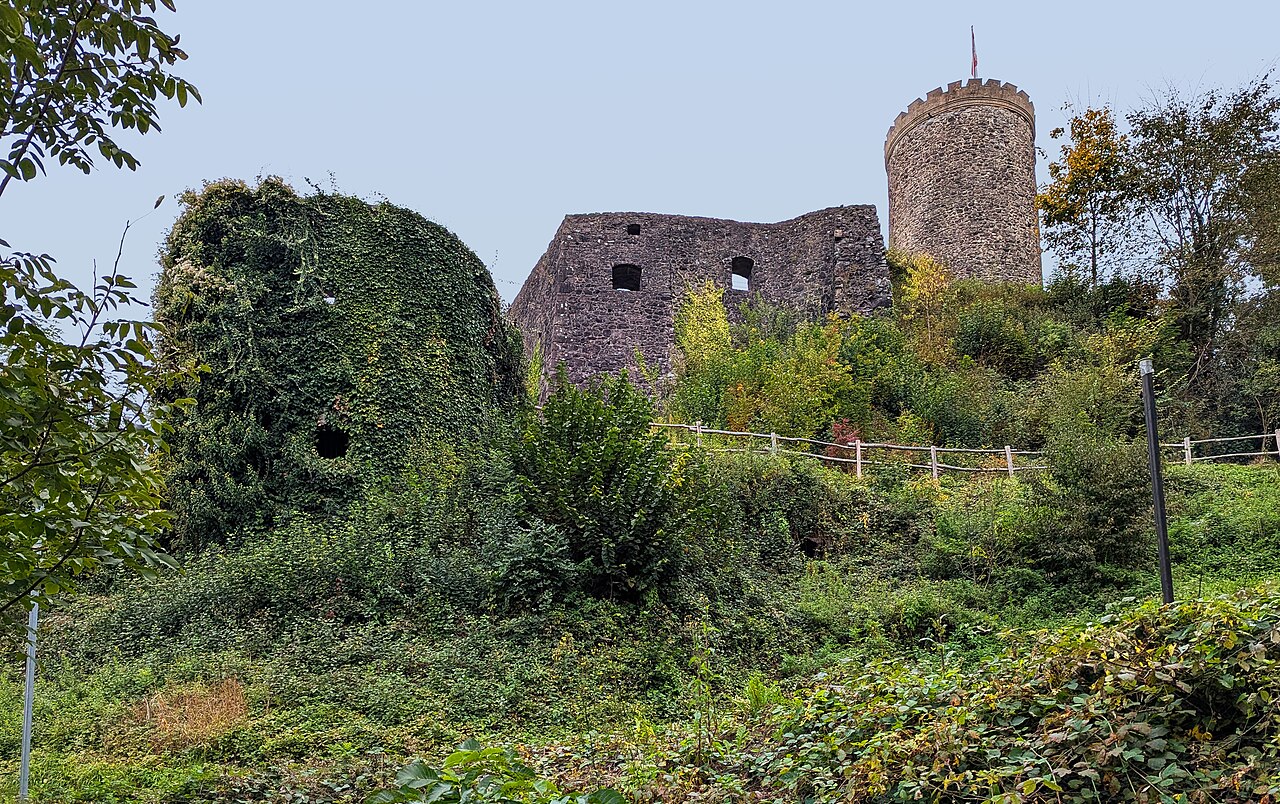
Hohengeroldseck Castle
Hohengeroldseck Castle stands as a remarkable example of a medieval hill castle located in the scenic Black Forest region of Baden-Württemberg, Germany. Constructed in the mid-13th century, this fortress served as the ancestral seat and administrative center of the influential Geroldseck family. Its strategic position atop a rocky promontory overlooking the Kinzig and Schutter river valleys allowed it to dominate the surrounding landscape and control key territories in the upper Ortenau region.
Historical background and significance
The castle's origins date back to between 1240 and 1250, when Walter I von Geroldseck commissioned its construction. It quickly became the focal point of the "Upper Lordship" of Hohengeroldseck, a domain that encompassed extensive lordships including Lahr, Mahlberg, and Schiltach, as well as several monasteries and a judicial district spanning from Basel to Seltz. For nearly four centuries, it remained the power base of the Geroldseck family, who wielded considerable influence in the region.
In 1277, following a territorial division, the castle's importance was solidified as the seat of the Upper Lordship. The 15th century saw significant political changes, such as the partial acquisition of the Geroldseck holdings by Margrave Jakob I of Baden in 1442, who purchased half of the lordships of Lahr and Mahlberg for 30,000 gulden. This transaction marked a shift in regional power dynamics.
The castle's military significance was demonstrated during the 1486 siege by Elector Palatine Philipp, which lasted six weeks under the command of the Palatine artillery master Martin Merz. After its capture, Hohengeroldseck remained under Palatinate control until 1534, reflecting the turbulent political landscape of the late medieval period.
By the late 16th century, the Geroldseck family had moved their residence to the nearby Renaissance-style Schloss Dautenstein in Seelbach, signaling a transition from medieval fortifications to more modern noble residences. The castle's ownership became contested after the death of Jakob von Hohengeroldseck in 1634 without a male heir, leading to imperial interventions by Emperor Ferdinand II and subsequent enfeoffments to the Cronberg family.
The strategic importance of Hohengeroldseck was underscored during the Nine Years' War (1688–1697), also known as the Palatinate War of Succession, when French forces destroyed the fortress in January 1689. After the extinction of the Cronberg line in 1692, competing claims by Markgraf Friedrich Magnus of Baden and Karl Kasper Franz von der Leyen led to Austrian military support for the von der Leyen family, who have retained ownership since then.
From 1711 until the dissolution of the Holy Roman Empire in 1806, the castle grounds formed part of the County of Hohengeroldseck, later transitioning to the Principality of von der Leyen until 1813. Preservation efforts began in the late 19th century, with restorations continuing into the 20th and 21st centuries. The site has been recognized as a cultural heritage monument of Baden-Württemberg since 2005.
Architectural features and layout
Perched approximately 524 meters above sea level, Hohengeroldseck Castle exemplifies the typical design of a hill castle with a focus on defense and territorial control. The fortress occupies a rocky outcrop, providing natural protection and commanding views of the surrounding valleys.
The castle's main enclosure measures roughly 95 meters in length and 50 meters in width, surrounded by a formidable ring wall nearly two meters thick. This defensive wall includes a battlemented walkway with crenellations and narrow arrow slits, allowing defenders to monitor and repel attackers effectively.
Within the walls, two principal buildings rest on a sturdy porphyry rock foundation. These structures, extending about 50 meters in length and up to 20 meters wide, flank an open courtyard that likely served as a multifunctional space for daily activities, gatherings, and administration.
The most prominent building is the four-story palas, or knights’ house, which retains much of its original façade. The palas housed a great hall approximately 80 square meters in size on its second upper floor, a significant space used for official functions, ceremonies, and social events.
In the 1950s, a spiral staircase was installed inside the rear tower of the palas to facilitate safer access during restoration efforts. Despite the castle's ruinous state, the stone walls still rise to heights of around ten meters in places, preserving the outline of the fortress and showcasing medieval construction techniques.
Defensive elements and fortifications
The castle's design reflects the military architectural principles of the High to Late Medieval periods, emphasizing strong defensive capabilities. The thick ring wall and battlements provided protection against sieges, while the elevated position enhanced visibility and control over the terrain.
Additional defensive outworks, though less preserved, would have supplemented the main enclosure, creating layered defenses typical of hill castles of this era. The use of natural rock formations as foundations enhanced the castle's resilience and strategic advantage.
Historical events and ownership transitions
Hohengeroldseck Castle's history is marked by significant events reflecting the political and military upheavals of the region. The 1486 siege by Elector Palatine Philipp demonstrated the castle's military importance in regional conflicts. Its capture and subsequent control by the Palatinate until 1534 illustrate the shifting allegiances and territorial disputes common in the Holy Roman Empire.
The castle's destruction in 1689 during the Nine Years' War by French troops marked the end of its function as a military stronghold. The subsequent legal disputes over ownership highlight the complex feudal and dynastic politics of the era, involving the Habsburgs, Margraviate of Baden, and the von der Leyen family.
Since the late 17th century, the castle has remained in a ruined state but has been preserved as a historical monument. The von der Leyen family continues to own the site, maintaining its cultural and historical significance.
Cultural heritage and preservation efforts
Recognized as a cultural heritage site of Baden-Württemberg, Hohengeroldseck Castle attracts historians, architects, and visitors interested in medieval architecture and regional history. Preservation efforts initiated in the late 19th century and continuing through the 20th and 21st centuries have focused on stabilizing the ruins and preventing further decay.
Visual documentation of the castle includes a detailed 1645 illustration by the author Grimmelshausen and a 1496 depiction from a war chronicle by Philipp Münch, which provide valuable insights into its historical appearance and military engagements.
Today, the ruins offer a tangible connection to the medieval past and serve as a testament to the architectural and historical legacy of the Black Forest region. Local efforts to maintain the site ensure that it remains accessible and informative for future generations.
Visitor information and accessibility
Hohengeroldseck Castle is accessible to the public as a historical ruin. Visitors can explore the remains of the palas, curtain walls, and battlements, gaining insight into medieval fortification design and feudal history. The hilltop location provides scenic views of the Black Forest valleys, enhancing the visitor experience.
While the site is largely in ruins, pathways and safety measures have been implemented to facilitate exploration. Visitors are encouraged to wear appropriate footwear for uneven terrain and to respect the preservation efforts by not disturbing the ruins.
The castle's location within the municipality of Seelbach makes it accessible via local roads, with nearby amenities available in the town. It is advisable to check local tourism resources for current visiting hours and any guided tour options.
Frequently asked questions (FAQ)
- How do I get to Hohengeroldseck Castle?
- Hohengeroldseck Castle is located in Seelbach, Germany, and can be accessed by car or public transportation. The nearest train station is in Seelbach, from which you can take a short taxi ride or enjoy a scenic walk to the castle.
- What is the historical significance of Hohengeroldseck Castle?
- Hohengeroldseck Castle dates back to the 13th century and served as a stronghold for the noble family of Hohengeroldseck. It played a crucial role in regional politics and defense during medieval times, showcasing the architectural style and military strategies of its era.
- When was Hohengeroldseck Castle built?
- Construction of Hohengeroldseck Castle began in the early 13th century, around 1220. Over the centuries, it has undergone various renovations, reflecting the architectural styles and historical events of different periods.
- Can I visit Hohengeroldseck Castle?
- Yes, Hohengeroldseck Castle is open to the public for visits. Guests can explore the castle grounds, enjoy guided tours, and learn about its rich history and architecture.
- Is it possible to access the castle with a wheelchair?
- Hohengeroldseck Castle has some accessibility options, but due to its historical nature, not all areas may be fully wheelchair accessible. It is recommended to check in advance for specific accessibility information and assistance options.
- What are the opening hours of Hohengeroldseck Castle?
- Hohengeroldseck Castle is typically open to visitors from April to October, with specific opening hours varying by season. It is advisable to check the official website or contact the castle for the most current visiting hours before planning your trip.
- What are the ticket prices for Hohengeroldseck Castle?
- Ticket prices for Hohengeroldseck Castle are generally affordable, with discounts available for students, seniors, and children. Group rates may also apply, so it’s best to inquire ahead of your visit for the latest pricing information.
- When is the best time to visit Hohengeroldseck Castle?
- The best time to visit Hohengeroldseck Castle is during the spring and early autumn months, when the weather is pleasant and the surrounding landscape is at its most beautiful. These seasons also tend to see fewer crowds, allowing for a more enjoyable experience.
- What nearby attractions can I explore after visiting Hohengeroldseck Castle?
- After visiting Hohengeroldseck Castle, you can explore the charming town of Seelbach, which offers lovely walking paths and local shops. Additionally, the scenic Black Forest region is nearby, providing opportunities for hiking, biking, and enjoying nature.
Information
Website
Visit websiteSources & official resources
Verify the information above using these authoritative references.
Loading map...
Visitor reviews
No reviews yet. Been here? Write the first review and help other travelers!
Write the first reviewVisited this castle? Share your experience
Your review helps other travelers and adds first-hand knowledge to our encyclopedia.