Hohenfels Castle
Hohenfels Castle, also known as Château du Hohenfels, is a notable hill castle ruin located in the dense woods west of the village of Dambach, within the Bas-Rhin department of France. This region, part of Northern Alsace and near the Northern Vosges mountains, is rich in medieval history and features numerous castles that reflect the turbulent past of the area.
The castle's exact date of construction remains uncertain, but it was first documented in 1293, placing its origins in the late medieval period. The existing structure primarily dates from the 14th century, aligning with the period of its initial prominence. Built on a narrow rocky spur, the castle was strategically positioned to control the surrounding landscape, utilizing the natural topography for defense.
Historical ownership and conflicts
Initially, Hohenfels Castle was held by the Lords of Ettendorf until the mid-14th century. In 1369, three-quarters of the castle were sold to Ulrich von Finstingen, a notable noble of the region. Later, in 1383, half of the castle passed to the Counts of Leiningen through marriage, indicating the castle's role as a significant feudal asset.
The castle's history is marked by destruction and rebuilding, reflecting the political and military upheavals of the region. In 1423, it was destroyed by the combined forces of the cities of Strasbourg and Haguenau. This event was part of broader conflicts involving city-states and nobility in Alsace. The castle was subsequently rebuilt, continuing to serve as a fortified residence.
During the German Peasants' War in 1525, Hohenfels Castle suffered destruction once more. This widespread uprising against feudal oppression led to many castles and noble estates being attacked. The castle was again restored after this conflict.
Its final destruction came in 1679, when French troops burned it to the ground during the wars of Louis XIV, after which it was never rebuilt. This marked the end of its active use and began its transition into a ruin.
Architectural features and layout
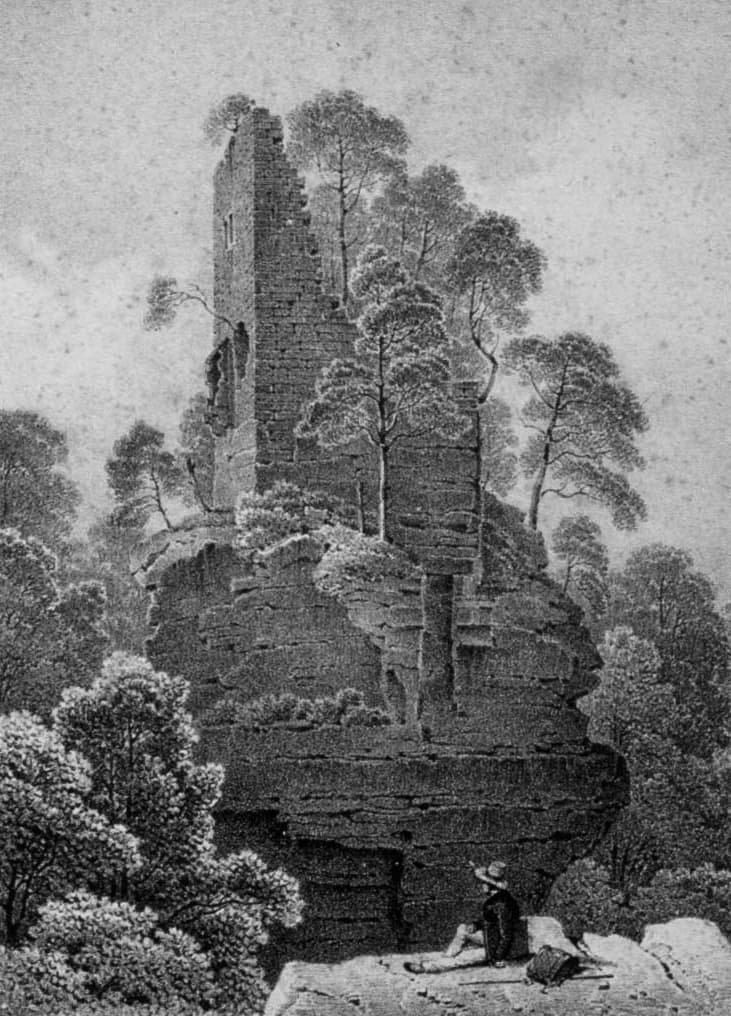
Hohenfels Castle is classified as a hill castle, constructed on a rocky spur that was naturally defensible. The site is divided into two parts by a dry moat, a defensive ditch carved into the rock to separate the upper and lower sections of the castle. This division created a layered defense system common in medieval fortifications.
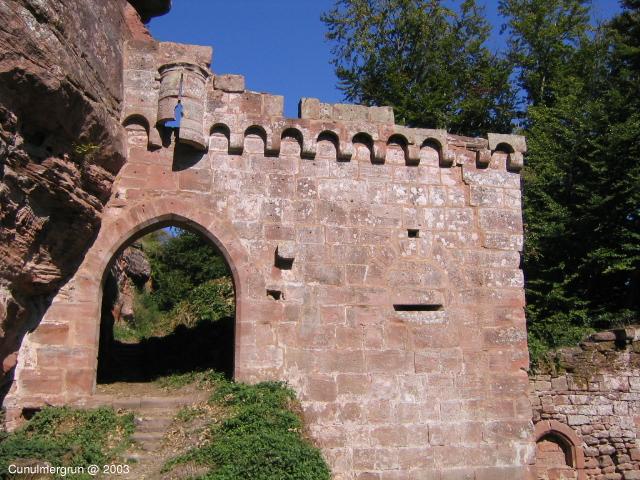
Although much of the structure is now in ruins, remnants include portions of the outer walls, some rooms, stone staircases, and a well carved from the sandstone rock. The castle's semi-troglodyte nature, integrating rock formations into its design, is a distinctive feature that provided natural protection and reduced construction needs.
The uppermost part of the rocky spur, where the main keep or donjon would have stood, is currently inaccessible, limiting full exploration of the site. However, the accessible ruins offer insight into medieval defensive architecture and the adaptation to the local terrain.
Present condition and visitor information
Today, Hohenfels Castle stands as a ruined medieval fortress, freely accessible to visitors who can explore the surviving walls and carved stone features. The castle's location in a forested area adds to its atmospheric setting, attracting hikers and history enthusiasts alike.
The site is not equipped with extensive visitor facilities, and the top of the spur remains closed due to safety concerns. Despite this, the castle remains a popular destination for those interested in medieval architecture and the history of the Alsace region.
Historical significance and regional context
The castle's history reflects the complex feudal and military dynamics of Alsace during the late medieval period. Its multiple destructions correspond with significant regional conflicts, including city-state wars and peasant uprisings. The final destruction by French troops in the late 17th century aligns with the expansionist policies of Louis XIV, which reshaped the political landscape of the region.
Hohenfels Castle's ruins contribute to the cultural heritage of Bas-Rhin and serve as a tangible link to the area's medieval past. Its architectural features demonstrate typical defensive strategies of hill castles in the Vosges and Alsace, including the use of natural rock formations and dry moats.
Frequently asked questions (FAQ)
- How do I get to Hohenfels Castle from Dambach?
- Hohenfels Castle is located west of Dambach in the Bas-Rhin department. Visitors can reach the site by hiking through forest trails starting from Dambach village, as the castle is situated on a wooded rocky spur.
- What remains can I expect to see at Hohenfels Castle?
- Visitors can explore the ruins including portions of the outer walls, stone rooms, staircases, and a well carved from sandstone. The top of the rocky spur is inaccessible, but the accessible ruins provide insight into medieval castle architecture.
- When was Hohenfels Castle destroyed and why?
- The castle was destroyed multiple times, notably in 1423 by Strasbourg and Haguenau troops, again in 1525 during the German Peasants' War, and finally in 1679 by French troops. These destructions were linked to regional conflicts and wars.
- Is there an entrance fee to visit Hohenfels Castle?
- There is no entrance fee to visit Hohenfels Castle; the ruins are freely accessible to the public.
- What architectural style is Hohenfels Castle built in?
- Hohenfels Castle exhibits characteristics of late medieval defensive architecture, with adaptations to the rocky terrain, including a dry moat and semi-troglodyte construction, though no specific architectural style like Gothic or Renaissance is distinctly recorded.
Photo gallery

Photo by Jacques Rothmüller•Public domain
Information
Loading map...
Visitor reviews
No reviews yet. Been here? Write the first review and help other travelers!
Write the first reviewVisited this castle? Share your experience
Your review helps other travelers and adds first-hand knowledge to our encyclopedia.