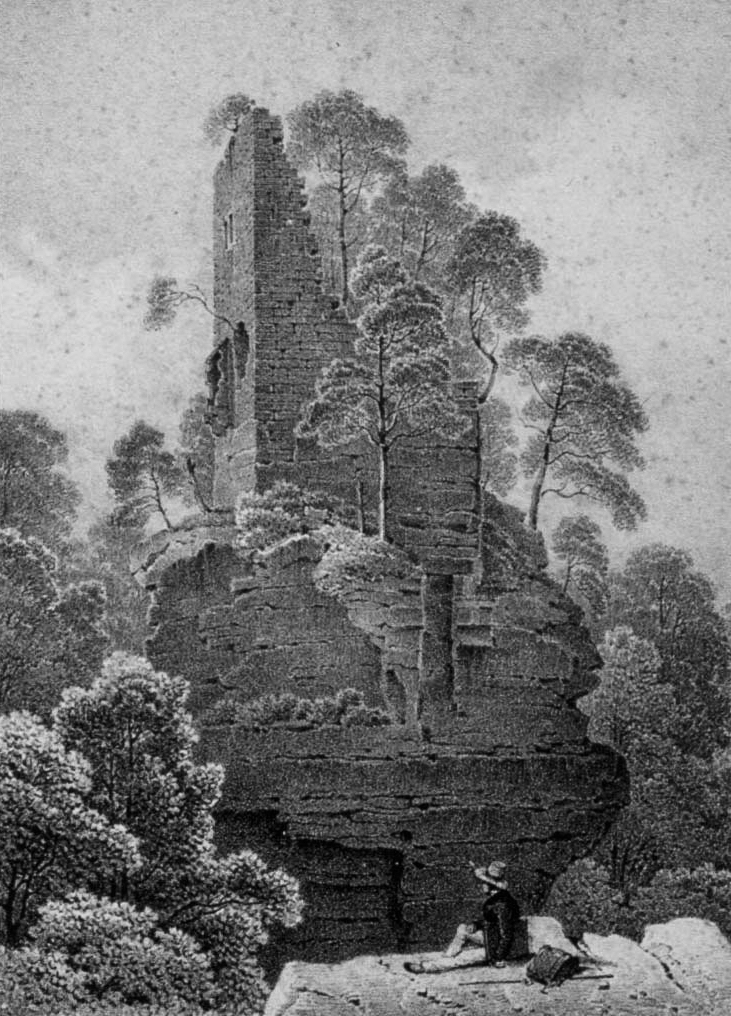
Falkenstein Castle
Falkenstein Castle, locally known as Château du Falkenstein, is a striking medieval fortress located northeast of the village of Lieschbach in the Moselle department of France. This castle is situated in the region known as Northern Alsace or the Northern Vosges and stands prominently on a narrow sandstone ridge overlooking the Zinsel valley. Its unique semi-troglodyte design, with rooms and staircases carved directly into the sandstone rock, marks it as a remarkable example of medieval military architecture integrated with natural geological features.
The origins of Falkenstein Castle date back to the early 12th century, with the first historical mention in 1127. It was constructed by Count Peter of Lützelburg to protect his estates within the expansive Forêt Sainte (Holy Forest) of Haguenau. This strategic location served as a defensive stronghold to safeguard the surrounding lands and assert control over the region. After the death of Peter's son, Renaud, in 1150 without heirs, ownership of the castle was divided between Folmar of Sarrewerden and the powerful Hohenstaufen dynasty, reflecting the complex feudal relationships of the time.
The medieval history and ownership changes
Throughout the 13th and 14th centuries, the castle was associated with the emerging Falkenstein family, who appear in records from 1205 onward. In 1335, a significant peace treaty known as a paix castrale was signed, dividing the castle into three parts by transverse walls, an unusual arrangement that reflected the shared ownership among noble families. This tripartite division created distinct sections within the fortress, each controlled by different family branches or lords.
Ownership disputes and divisions continued over the following centuries. In 1419, Jacob of Finstingen became the lord of Falkenstein, acting on behalf of the Sarrewerden family. Later, in the late 15th century, the Falkenstein brothers—Godfrey, Ortlieb, and William—agreed to divide the castle's property among themselves with strict conditions to prevent unauthorized sales. Despite this, conflicts arose, including an attempted sale to the counts of Zweibrücken-Bitsch and a family dispute resolved in 1487, the same year when Wilhelm of Falkenstein consecrated a new chapel within the castle, highlighting its continued religious and residential use.
By 1515, the Falkenstein family had consolidated full ownership of the castle. Balthasar of Falkenstein initiated a modernization campaign to update the fortress's defenses and living quarters, which was carried on by his sons, reflecting Renaissance influences in the castle's architecture and functionality.
Destruction and decline in the 16th and 17th centuries
In 1564, Philipp IV, Count of Hanau-Lichtenberg, acquired Falkenstein Castle. Unfortunately, only months after this purchase, a devastating fire, reportedly caused by lightning, engulfed the castle, burning for five days and leaving it in ruins. This catastrophe ended the castle's role as a noble residence, and it was never rebuilt to its former glory. However, some parts of the ruins remained inhabited by a forester employed by the Count, indicating limited use of the site.
The castle's fortunes further declined during the turbulent years of the Thirty Years' War. In 1623, troops under the command of Ernst von Mansfeld inflicted severe damage on the already ruined castle and the forester's residence, making habitation impossible. The final destruction came in 1676 and 1677 when French forces led by Joseph de Montclar demolished what remained of the fortress, ensuring it would not be used for military purposes again.
Architectural features and structural remains
Falkenstein Castle is distinguished by its integration with the natural sandstone rock formation on which it stands. The castle occupies a rocky spur approximately 120 meters long, rising 22 meters high, and varying in width from three to eight meters. This elevated position at 386 meters altitude provided commanding views over the Zinsel valley, crucial for surveillance and defense.
The castle's semi-troglodyte nature is evident in its rooms and staircases carved directly into the sandstone. Among the most significant surviving features is the 16th-century water tower on the western side of the spur. This tower served multiple purposes: protecting the vital well, defending the surrounding area, and providing living quarters on its upper floor. The well tower's design exemplifies the multifunctional architecture typical of medieval fortifications.
The entrance portal remains a notable feature, controlling access to the fortress interior. Nearby are the remnants of the keep (donjon), the central fortified tower that acted as the last line of defense and sometimes housed the lord's residence. The castle also contains cave rooms hollowed out from the rock, emphasizing its troglodytic character and providing natural protection from the elements.
During the 14th century, defensive enhancements included the construction of a ditch and curtain wall on the upper rock plateau, dividing the castle into two separate courtyards with distinct entrances. Stone towers were added along the northern and western edges, strengthening the fortress's defense against siege warfare.
The Renaissance period brought additional architectural developments, including new buildings within the castle walls. A chapel consecrated in 1487 by Wilhelm of Falkenstein reflects the ongoing religious significance of the site. A carved pathway leads visitors to the summit of the rock, facilitating movement between different castle sections.
One of the castle's ingenious features is a 16th-century hoist platform, still visible today. This platform was used to raise building materials and supplies up the steep cliffs during construction and repairs, demonstrating advanced logistical solutions in medieval castle building. Atop the residential tower, a lavabo basin was installed, fed by a water reservoir. The basin artistically channels water through a carved human mask flanked by two heraldic shields, combining functional and decorative elements.
The sandstone itself bears the marks of centuries of weathering, shaped by wind and rain, which has sculpted the rock face and added to the fortress's rugged aesthetic. Approximately 100 meters east of Falkenstein lie the ruins of the Helfenstein castle, illustrating the area's medieval density of fortifications.
Modern conservation and visitor experience
Recognized for its historical and architectural significance, Falkenstein Castle was declared a protected monument in 1930. The site experienced damage during a severe storm in 1999, leading to temporary closure for safety reasons. Extensive restoration and consolidation efforts were undertaken, culminating in the reopening of the castle to the public in 2013.
Today, visitors can freely explore the castle ruins, which offer a fascinating glimpse into medieval fortification techniques and noble life. The site features an orientation table installed in 1981 by the Vosges Club at the summit, providing information on the castle's altitude and pointing out nearby landmarks, enhancing the visitor experience by connecting the fortress to its wider landscape.
Falkenstein Castle remains a popular destination for history enthusiasts, hikers, and those interested in medieval architecture. Its unique combination of natural rock formations and man-made structures, alongside its rich history of noble ownership, conflict, and decline, make it a compelling subject for study and exploration.
Frequently asked questions (FAQ)
- How do I get to Falkenstein Castle?
- Falkenstein Castle is located northeast of Lieschbach in the Moselle department of France. Visitors typically reach it by car or hiking trails from nearby villages such as Philippsbourg.
- What is the historical significance of Falkenstein Castle?
- Falkenstein Castle is a medieval fortress built before 1127 by Count Peter of Lützelburg to protect his estates. It played a key role in regional defense and witnessed numerous ownership changes and conflicts over centuries.
- Can I explore the castle ruins freely?
- Yes, since consolidation works were completed in 2013, Falkenstein Castle is freely accessible to the public. Visitors can explore the ruins and enjoy panoramic views of the Zinsel valley.
- When was Falkenstein Castle destroyed?
- The castle was severely damaged by fire in 1564, further ruined during the Thirty Years' War in 1623, and finally destroyed by French troops in 1676-1677.
- What are the main architectural features of Falkenstein Castle?
- Key features include the semi-troglodyte sandstone rooms, the 16th-century water tower, the entrance portal, the keep remains, cave rooms, and the well tower with living quarters on top.
- Is there any visitor information available on site?
- An orientation table installed in 1981 by the Vosges Club is located at the summit, providing altitude information and directions to nearby landmarks to enhance the visitor experience.
Information
Current owner
French state
Loading map...
Visitor reviews
No reviews yet. Been here? Write the first review and help other travelers!
Write the first reviewVisited this castle? Share your experience
Your review helps other travelers and adds first-hand knowledge to our encyclopedia.