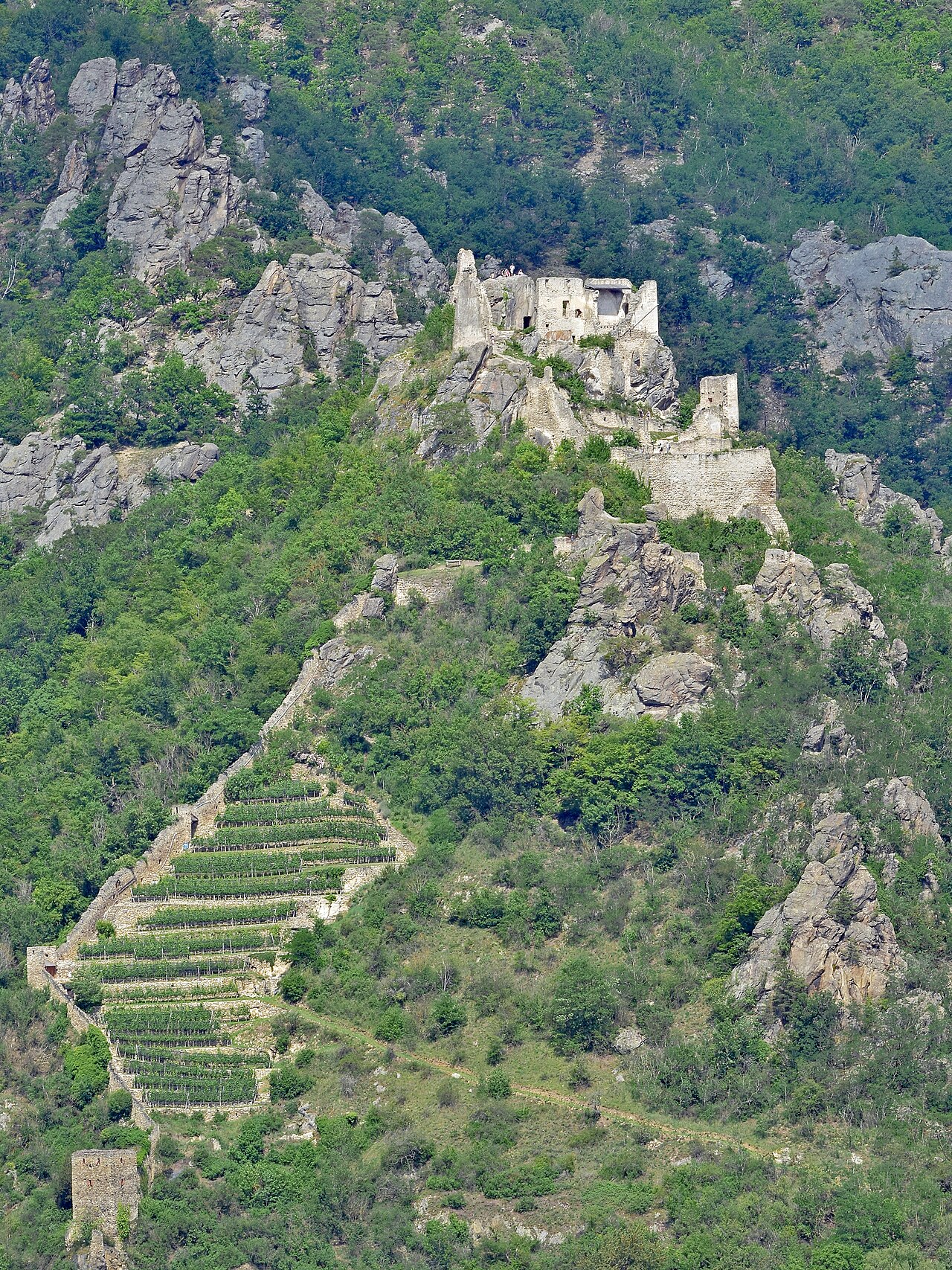
Hinterhaus Castle Ruins
The Hinterhaus Castle ruins are a captivating historical site located near the town of Spitz in the scenic Wachau valley of Austria. Originating in the 12th century, this hill castle once served as a strategic stronghold for the Kuenring family, a powerful noble lineage that exerted control over the region during the High Medieval period. The castle's commanding position atop a rocky ridge of the Jauerling range provided extensive views over the Danube River and the surrounding vineyards, underscoring its military and administrative importance.
Historical significance and feudal context
The earliest documented mention of Hinterhaus Castle dates back to 1243, confirming its role during a time when feudal powers were consolidating control in Lower Austria. The fortress was closely tied to the knights of Spitz, who were vassals to the Kuenrings. This relationship placed the castle within a complex feudal hierarchy, where it functioned as a local seat of power and defense. Throughout the 13th and 14th centuries, Hinterhaus Castle played a vital role in overseeing the Wachau valley, a key corridor along the Danube that was crucial for trade and military movements.
The k uenring family and regional control
The Kuenring family were among the most influential noble houses in medieval Austria, known for their extensive landholdings and political influence. Hinterhaus Castle was one of several strongholds through which they exerted their authority. The castle's strategic location allowed the Kuenrings and their vassals to monitor and protect vital routes along the Danube, as well as to administer their estates effectively.
Architectural layout and defensive features
The ruins of Hinterhaus Castle reveal a well-planned hilltop fortress designed to maximize natural defenses. The castle complex is divided into three main sections, each serving distinct defensive and functional roles. The central part of the castle is situated on the Hausberg, a rocky outcrop that forms the core of the fortress. This area contained the primary living quarters and fortifications, built predominantly from locally sourced stone.
Outer baileys and layered defense
Flanking the central stronghold are two outer baileys, located to the northeast and southwest. These baileys acted as additional defensive barriers and service areas, controlling access to the main castle. Their placement reflects the medieval military strategy of creating multiple layers of defense to slow and repel attackers. The baileys likely housed stables, workshops, and storage facilities essential for sustaining the castle's inhabitants during sieges.
The red gate and medieval defense methods
One of the notable surviving features of the castle is the Red Gate, which provides visitors with insight into medieval fortification techniques. This gate would have been a critical choke point, fortified to resist assault and control entry. The castle's walls, battlements, and gate structures exemplify the defensive architecture typical of the High Medieval period, designed to withstand sieges and protect its occupants.
Cultural heritage and legends
Beyond its military and administrative functions, Hinterhaus Castle holds a place in local folklore. The legend of Adelheid, the spectral wife of Heinrich "the Iron," adds a layer of cultural mystique to the site. According to tradition, Adelheid's ghost appears annually on the anniversary of Heinrich's death, a haunting tied to themes of loyalty and penance. Such stories enrich the castle's historical narrative, connecting visitors with the human experiences of its former residents.
Modern preservation and visitor experience
In the 20th century, the ruins came under the ownership of the market town of Spitz in 1970, marking a new chapter focused on preservation. Since 1977, local organizations have actively worked to maintain and stabilize the remaining structures, ensuring that Hinterhaus Castle remains accessible to the public. Today, visitors can explore the ruins, walk through the historic Red Gate, and enjoy panoramic views of the Danube River and the renowned Tausendeimerberg vineyard.
Accessibility and educational value
The site offers a tangible connection to medieval life and military architecture. Informational signage and guided tours help visitors understand the castle's layout, construction techniques, and historical context. The combination of preserved ruins and natural surroundings makes Hinterhaus Castle a compelling destination for history enthusiasts, hikers, and cultural tourists alike.
Geographical setting and strategic importance
Situated on a prominent rocky ridge within the Jauerling mountain range, Hinterhaus Castle's location was carefully chosen for its defensive advantages. The ridge overlooks the Wachau valley, a fertile and strategically vital region along the Danube. This vantage point allowed the castle's occupants to monitor river traffic and surrounding lands effectively, providing early warning of potential threats and enabling control over trade routes.
Natural terrain as a defensive asset
The castle's builders skillfully integrated the natural rocky terrain into the fortifications, enhancing its defensibility. The steep slopes and rugged outcrops limited access points, forcing attackers into narrow approaches easily defended by the castle's garrison. This use of topography is characteristic of hill castles from the medieval period, which relied on elevation and natural obstacles to augment man-made defenses.
Frequently asked questions (FAQ)
- How do I get to Hinterhaus Castle ruins in Spitz?
- Hinterhaus Castle ruins are accessible by hiking trails from the town of Spitz, located in the Wachau valley. The site is well-signposted, and the walk offers scenic views of the Danube and surrounding vineyards.
- What is the historical significance of Hinterhaus Castle?
- Hinterhaus Castle was a strategic stronghold in the 12th century under the Kuenring family, overseeing the Wachau valley and controlling important trade routes along the Danube.
- Can visitors explore the ruins of Hinterhaus Castle?
- Yes, the ruins are open to the public and maintained for safe exploration. Visitors can walk through the Red Gate and see the layout of the medieval fortress while enjoying panoramic views.
- When is the best time to visit Hinterhaus Castle ruins?
- The best time to visit is during the warmer months from late spring to early autumn when hiking conditions are favorable and the vineyards are lush and green.
- Is there an entry fee to visit Hinterhaus Castle ruins?
- There is no entry fee to visit the Hinterhaus Castle ruins, making it an accessible historical site for all visitors.
Information
Sources & official resources
Verify the information above using these authoritative references.
Loading map...
Visitor reviews
No reviews yet. Been here? Write the first review and help other travelers!
Write the first reviewVisited this castle? Share your experience
Your review helps other travelers and adds first-hand knowledge to our encyclopedia.