Burg Hartenstein
Burg Hartenstein is a striking example of a medieval hill castle located in the scenic Kremstal valley, nestled within the rugged granite landscape of the Waldviertel region in Lower Austria. Positioned approximately 15 kilometers west of the town of Krems, this castle holds a significant place in the region's history and architectural heritage. Its origins date back to the 12th century, making it a valuable relic of the high medieval period.
The castle's strategic siting on a hilltop provided natural defensive advantages, typical of hill castles constructed during this era. The surrounding granite terrain contributed to its fortification, allowing it to serve as a stronghold for various noble families over the centuries. Despite much of its past shrouded in historical obscurity, Burg Hartenstein's legacy is intertwined with the prominent noble lineage of the Kuenringer family, who likely founded the castle in the late 12th century.
Historical lineage and ownership transitions
The earliest documented reference to Burg Hartenstein appears in a record from 1187 mentioning Heinricus de Hertinsteine, confirming the castle's existence during the high medieval period. Ownership initially belonged to the Kuenringer family, a powerful dynasty influential in the Waldviertel region. Subsequent proprietors included the Kaja and Kamegg families until around 1270.
Following this period, the castle passed to the brothers Hertnit and Leutold von Stadekke, and by circa 1300, it was held by Heinrich von Wallsee. The Wallsee family, originally from the Swabian region, frequently succeeded the Kuenringer in the Waldviertel, administering Burg Hartenstein through appointed burgraves responsible for its management and defense.
From 1380 to 1411, the castle was under the control of the Maissau family, followed by ownership by Christoph von Rappach in 1416. The estate then passed to Hans and Leopold von Neidegg around 1430, before being acquired by Jörg Scheck vom Walde in 1445. These frequent changes in ownership reflect the dynamic political and social shifts within the region during the late medieval period.
Decline, military significance, and later ownership
By the second half of the 17th century, Burg Hartenstein experienced gradual abandonment as its owners favored more comfortable and modern residences. Nevertheless, the castle retained military importance during the Thirty Years’ War, enduring a brief siege by Swedish forces in 1645. This conflict led to the destruction of the outer fortification known as the "Nasn," though the main castle structure survived largely intact.
In 1666, the estate was purchased by Georg Ludwig Graf Sinzendorf. After his death in 1682, ownership transferred to Prince Paul Esterházy, a prominent figure in Austrian nobility. Later, in 1726, Emperor Charles VI granted the castle to Philipp Ferdinand von Gudenus, whose family maintained possession until 1927.
During the late 18th century, significant alterations contributed to the castle's dilapidation. Johann Heinrich von Gudenus removed valuable architectural elements such as doors and window frames for reuse in his nearby hunting lodge, Els. By the early 19th century, the castle's remaining two towers were repurposed as granaries, marking a transition from military to agricultural utility.
19th and 20th-century transformations and preservation efforts
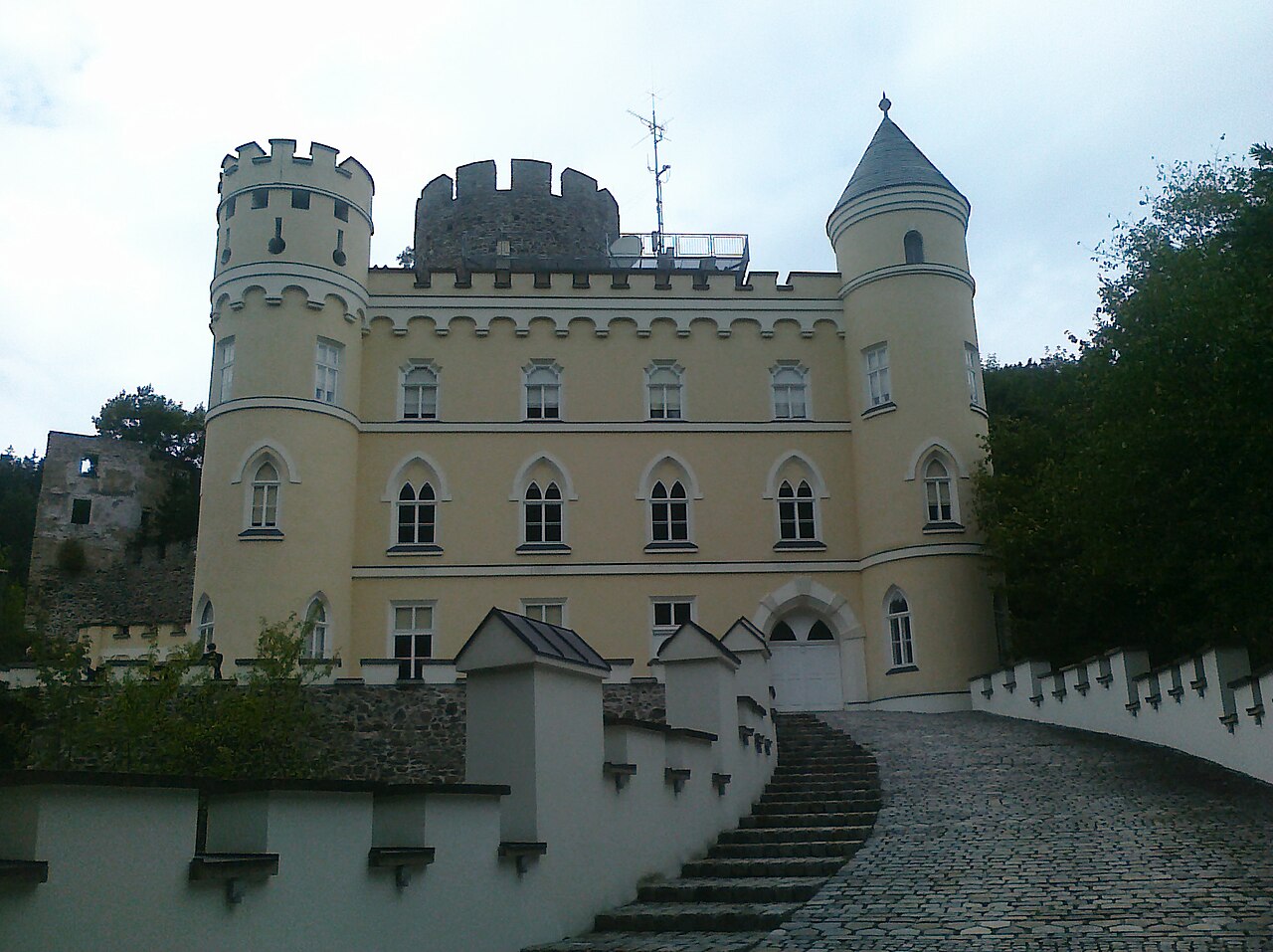
In 1892, Dr. Otto Pospischil leased the property and undertook significant renovations, converting the outer bailey into a cold water sanatorium. Between 1892 and 1896, this section was rebuilt in a historicist architectural style that mimicked medieval castle features but was distinct from the original medieval construction. The main castle, however, remained in a state of ruin.
During the Nazi era, the site was repurposed by the German Youth Hostel Association as a "youth castle," reflecting its continued social use despite its ruined condition. Post-World War II attempts by Dr. Erich Buchmeier to revive the sanatorium were unsuccessful. In 1993, the castle and its grounds were acquired by Peter Kotauczek and his company BEKO, marking a new chapter in its stewardship.
Architectural features and current remains
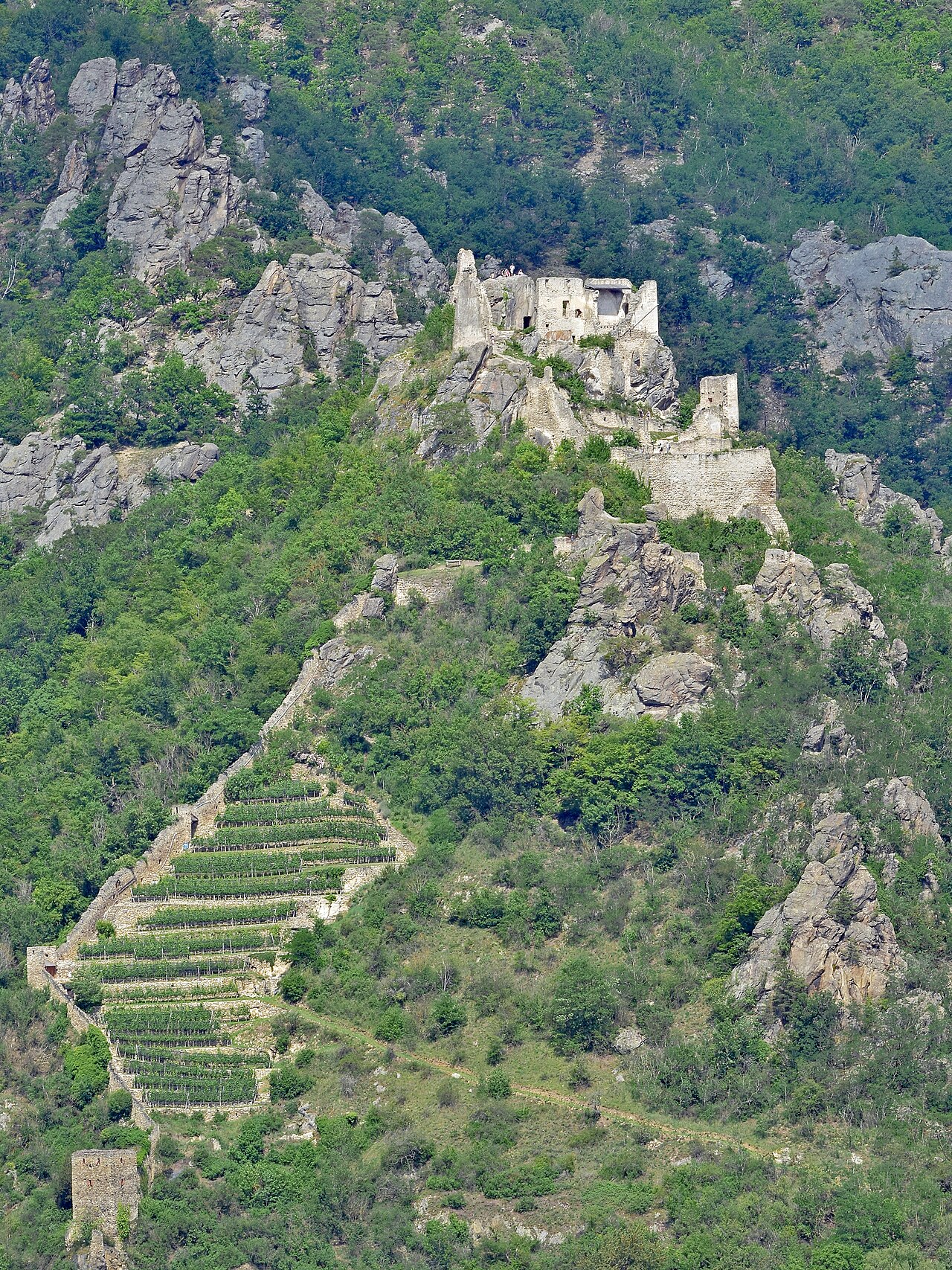
Burg Hartenstein occupies a commanding hilltop position within the granite-dominated landscape typical of the Waldviertel. The site comprises the ruins of the main castle and a reconstructed outer bailey, the latter reflecting the late 19th-century historicist style rather than authentic medieval architecture.
Two towers from the original medieval castle still stand, notable for their adaptation as granaries in the early 1800s. This reuse underscores the castle's shift from a defensive fortress to an agricultural utility. The removal of original architectural elements in the late 18th century, including doors and window frames, has contributed to the castle's present ruinous state.
The destruction of the "Nasn" outer fortification during the 1645 Swedish siege represents a significant loss in the castle's defensive architecture. Despite the absence of inscriptions or decorative elements, the ruins convey the castle's historical importance and medieval character.
Archaeological significance: the gudenus cave
Adjacent to the castle lies the Gudenus Cave, a site of considerable archaeological importance. Excavations have uncovered evidence of Neanderthal habitation dating back nearly 100,000 years. The discovery of stone tools and hand axes within the cave highlights the area's prehistoric human activity, adding a deeper temporal dimension to the castle's historical landscape.
The proximity of this cave enriches the cultural heritage of Burg Hartenstein, linking it not only to medieval history but also to the broader narrative of human evolution and settlement in the region.
Visiting burg hartenstein today
Today, Burg Hartenstein stands as a compelling historical site offering visitors a glimpse into medieval castle architecture and the layered history of Lower Austria. The ruins invite exploration of its surviving towers and the surrounding landscape, while the reconstructed outer bailey presents an example of 19th-century historicist architecture inspired by medieval forms.
The site's archaeological significance, combined with its dramatic setting in the Waldviertel granite hills, makes it a unique destination for history enthusiasts, architecture scholars, and tourists interested in Austria's rich cultural past.
Frequently asked questions (FAQ)
- How do I get to Burg Hartenstein?
- Burg Hartenstein is located about 15 km west of Krems in the Kremstal valley. Visitors can reach it by car or local transport to Weinzierl am Walde, followed by a short hike up the hill where the castle stands.
- What is the historical significance of Burg Hartenstein?
- Burg Hartenstein dates back to the 12th century and was founded by the Kuenringer family. It played a role in regional defense and noble administration through the high medieval period and witnessed events such as the 1645 Swedish siege during the Thirty Years’ War.
- Can I visit the Gudenus Cave near the castle?
- The Gudenus Cave is an important archaeological site near Burg Hartenstein, known for Neanderthal artifacts. Access may be restricted to protect the site, so visitors should check local guidelines or tours for opportunities to explore the cave.
- What remains of the original castle can be seen today?
- Today, visitors can see the ruins of the main castle including two surviving towers that were repurposed as granaries in the 19th century. The outer bailey was rebuilt in a historicist style in the late 19th century but differs from the original medieval structures.
- Is Burg Hartenstein accessible for visitors year-round?
- Access to Burg Hartenstein is generally possible year-round, but visitors should consider weather conditions as the site is on a hilltop. There are no formal visitor facilities, so planning ahead is recommended.
Information
Sources & official resources
Verify the information above using these authoritative references.
Loading map...
Visitor reviews
No reviews yet. Been here? Write the first review and help other travelers!
Write the first reviewVisited this castle? Share your experience
Your review helps other travelers and adds first-hand knowledge to our encyclopedia.