Hesperange Castle
Hesperange Castle, also known locally as Château de Hesperange or Schloss Hesperingen, is a significant medieval fortress ruin located in the town of Hesperange, just south of Luxembourg City in Luxembourg. This castle stands as a testament to the region's turbulent history during the High Medieval period and reflects the architectural and political shifts in the area from the 13th century onward.
Early history and origins
The village of Hesperange was first documented in 867/868 as property belonging to the abbey of Echternach. The castle itself was likely constructed in the early 13th century by the Lords of Rodemack (also known as Rodenmacher in German), a noble family who were granted the land by the Counts of Luxembourg. This timing places the castle firmly within the High Medieval era, a period marked by the construction of many fortified residences and castles across Europe to assert feudal control and provide defense.
Strategic importance and medieval conflicts
Hesperange Castle played a role in the regional power struggles of the 15th century. When the Burgundian armies captured Luxembourg City in 1443, the Lords of Rodemack sided with the French, opposing Burgundian and later Habsburg control. Gerhard of Rodemack notably fought alongside the French against Maximilian I of Austria, the Holy Roman Emperor, during this period of conflict.
As a consequence of these hostilities, the castle was destroyed twice by Austrian troops, first in 1480 and again in 1482. These destructions reflect the castle’s strategic military importance and the violent power struggles of the late medieval period in the region.
Ownership changes and decline
In 1492, the castle was granted to Christoph von Baden, Maximilian's nephew. The Lords of Baden held the castle for several centuries but faced financial difficulties, leading them to mortgage the property in 1632. It was only in 1740 that they managed to regain full ownership.
The castle’s decline accelerated after the French Revolutionary troops took possession in 1796. In 1798, the French authorities declared Hesperange Castle national property and sold it at auction. Over time, the castle grounds were subdivided and sold off in separate plots, leading to the construction of houses within and around the ruins by 1820.
Architectural features and current condition
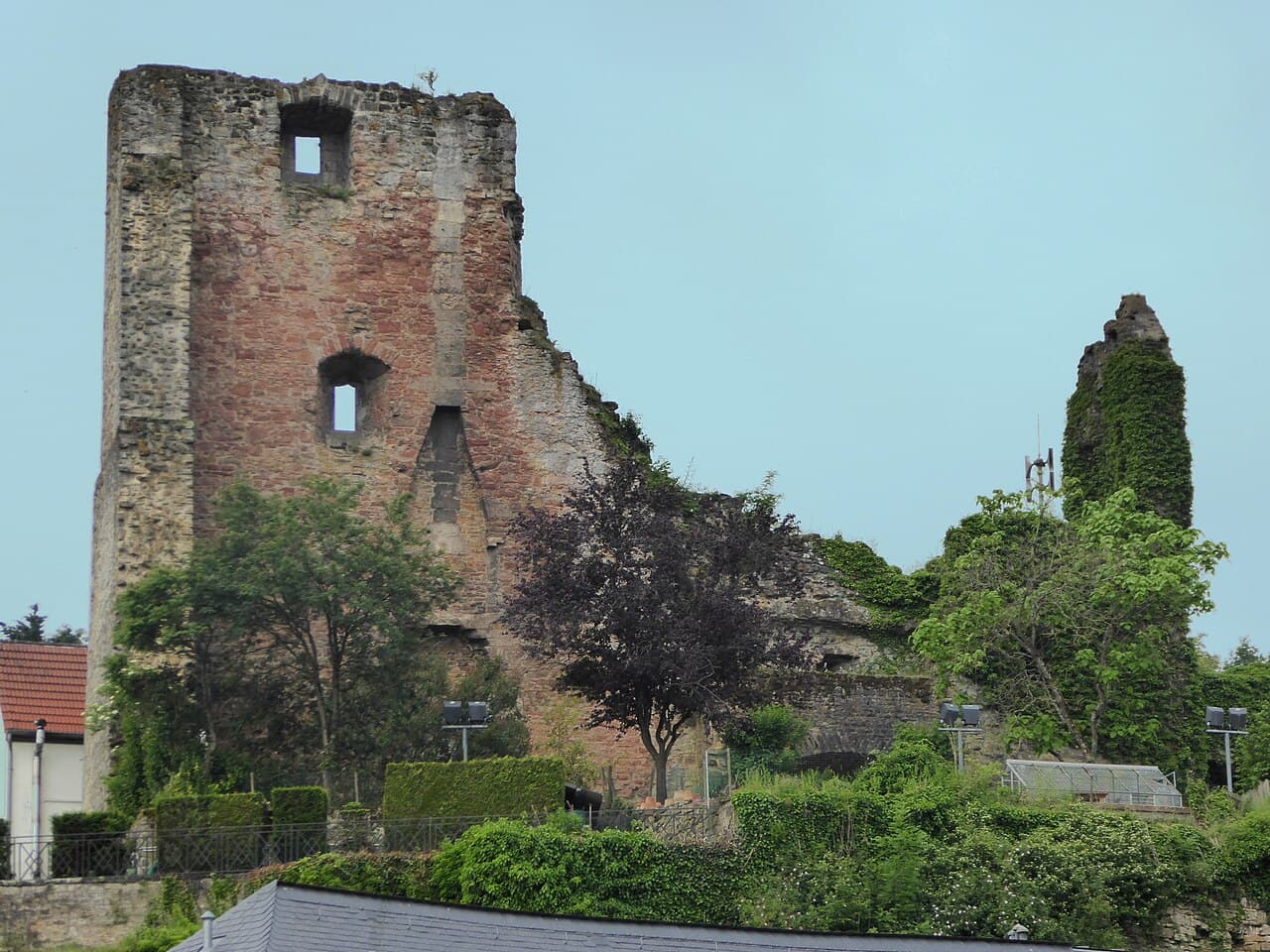
While much of the original structure has been lost to destruction and subsequent development, the ruins of Hesperange Castle still offer valuable insights into High Medieval castle architecture. The castle was originally a hill castle, strategically positioned to oversee the surrounding landscape and control access routes.
Typical features likely included defensive walls, towers, a gatehouse, and living quarters, consistent with castles of its period and region. However, due to the extensive damage and later construction on the site, only fragments remain visible today.
The ruins were officially declared a National Heritage site in 1984, underscoring their cultural and historical significance for Luxembourg. Despite this designation, the ruins remain on private property and are not accessible to the public. Visitors can view the site from the adjacent street, which leads to houses built against and within the castle remains.
Cultural significance and heritage preservation
Hesperange Castle’s history encapsulates the complex feudal allegiances and military conflicts of the region during the High Medieval and early modern periods. Its repeated destruction and rebuilding illustrate the shifting political landscape influenced by Burgundian, French, and Habsburg powers.
As a protected ruin, the castle serves as a poignant reminder of Luxembourg’s medieval past and the architectural heritage of fortified noble residences. The preservation of the site, even in partial ruin, contributes to the broader understanding of medieval fortifications in the region and offers a tangible connection to the noble families who shaped Luxembourg’s history.
Visiting today
While direct access to the ruins is restricted due to private ownership, visitors to Hesperange can appreciate the castle’s location and historical ambiance from the surrounding streets. The juxtaposition of modern houses with ancient stone ruins creates a unique environment where past and present coexist.
For those interested in medieval history and architecture, Hesperange Castle provides an evocative example of a High Medieval hill castle that has endured centuries of conflict and change.
Frequently asked questions (FAQ)
- How do I visit Hesperange Castle?
- Hesperange Castle ruins are on private property and not open for public tours. Visitors can view the site from the nearby street, Montée du Château, which offers a good vantage point.
- What is the historical significance of Hesperange Castle?
- Hesperange Castle played a key role in regional conflicts during the 15th century, especially involving the Lords of Rodemack and their alliances with French and Burgundian forces.
- When was Hesperange Castle built?
- The castle was likely constructed in the early 13th century during the High Medieval period by the Lords of Rodemack.
- Why was Hesperange Castle destroyed multiple times?
- The castle was destroyed in 1480 and 1482 by Austrian troops due to its strategic importance and the Lords of Rodemack siding with the French against Maximilian I of Austria.
- Is Hesperange Castle accessible for photography?
- While you cannot access the ruins directly, the castle can be photographed from public streets nearby, providing views of the remaining stone structures and the surrounding area.
Photo gallery

Information
Current owner
Private owner
Address
Montée du Château, Luxembourg
Loading map...
Visitor reviews
No reviews yet. Been here? Write the first review and help other travelers!
Write the first reviewVisited this castle? Share your experience
Your review helps other travelers and adds first-hand knowledge to our encyclopedia.