Bock Fortifications
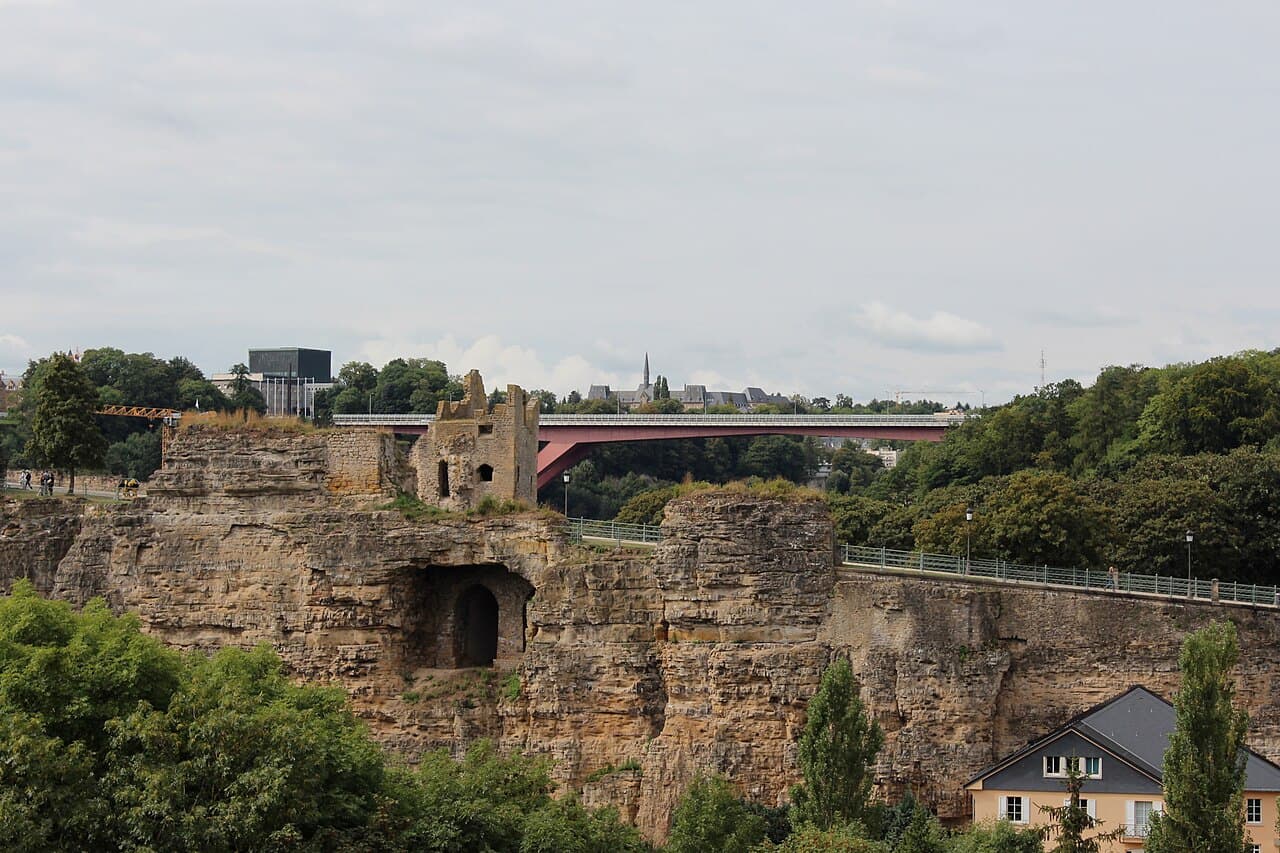
The Bock fortifications form a significant historical and architectural landmark in Luxembourg City, Luxembourg. Situated on a rocky promontory in the northeastern corner of the city's old historical district, the Bock overlooks the River Alzette, which surrounds it on three sides, providing a natural defensive position. This strategic location was first fortified in 963 AD when Count Siegfried established the Castle of Lucilinburhuc, marking the origin of what would become the city of Luxembourg.
Although the earliest substantial fortifications date to the early medieval period, archaeological evidence suggests that the site was inhabited during the Roman and Frankish eras. Notably, traces of a 4th-century Roman watchtower have been identified near the Fish Market area, where two important Roman roads intersected—one connecting Reims to Trier, and the other linking Metz to Liège. This indicates the Bock's long-standing military and strategic importance.
Early medieval origins and growth
The original castle built by Count Siegfried was modest but strategically positioned atop the Bock promontory. Over the following centuries, this fortification was expanded and reinforced with additional walls and defensive structures to protect the growing settlement. By 987, a castle chapel was constructed near the Fish Market, the site where today's St Michael's Church stands, reflecting the intertwined religious and military functions of the fortress.
Under the rule of Conrad I, the castle became the official residence of the Counts of Luxembourg. Throughout the medieval period, the fortress was repeatedly damaged, captured, and rebuilt as various powers, including the Burgundians in 1473, the Habsburgs in 1477, and the Spaniards in 1555, contested control over Luxembourg. These conflicts necessitated continual upgrades to the fortifications to withstand evolving military technologies.
Renaissance and early modern military adaptations
During the 17th century, the Bock fortifications underwent significant modernization to adapt to the era's increasing use of artillery. In the 1640s, under Spanish rule, the Swiss engineer Isaac von Treybach redesigned the defenses, introducing a system of three separate forts—the Large Bock, Middle Bock, and Small Bock—each separated by deep cuts in the rock and connected by bridges. This complex defensive arrangement replaced much of the medieval castle structures.
In 1684, the fortress was captured by the forces of Louis XIV after a month-long siege led by the renowned military engineer Vauban. Vauban then undertook extensive reconstruction and reinforcement of the fortifications, emphasizing the importance of underground defenses. The Large Bock became the centerpiece of the new fortress, enclosed by a formidable 12-meter-high wall and connected to the old town via the Pont du Château.
The casemates and underground fortifications
One of the most remarkable features of the Bock fortifications is the extensive network of casemates, which originated from the cellars of the medieval castle. These underground galleries were expanded significantly in 1744 during the Austrian period under General Neipperg. The main passageway extends approximately 110 meters in length and up to 7 meters in width, with branches equipped with 25 cannon slots—12 on the north side and 13 on the south—providing substantial artillery coverage.
The casemates cover an area of around 1,100 square meters and were designed to serve as barracks capable of housing several hundred soldiers during times of conflict. Their robust construction and strategic design allowed the fortress to withstand prolonged sieges, including the notable seven-month defense against French forces during the French Revolutionary Wars in 1794. Despite the siege, the fortress walls remained unbreached until the garrison's surrender.
Demolition and modern preservation
The military significance of the Bock fortifications declined following the Treaty of London in 1867, which mandated the demolition of Luxembourg's fortresses to maintain European peace. The dismantling process took 16 years and was a costly endeavor, amounting to 1.5 million gold francs. Despite this, significant portions of the underground casemates survived.
In 1933, the casemates were opened to the public, transforming the site into a major tourist attraction. During World War II, these underground passages served as bomb shelters, capable of protecting up to 35,000 people. In recognition of their historical and architectural value, the Bock casemates were inscribed as a UNESCO World Heritage Site in 1994, drawing approximately 100,000 visitors annually.
Recent restoration efforts, including work carried out in 2008 and 2009, have focused on preserving the structural integrity of the casemates and reopening previously inaccessible mine galleries that once contained explosives designed to demolish parts of the fortress in case of enemy capture.
Architectural significance and legacy
The Bock fortifications represent a complex layering of military architecture spanning from the early medieval period through the renaissance and into the early modern era. The site illustrates the evolution of fortress design in response to changing military technologies, especially the transition from medieval stone castles to bastioned fortresses with integrated underground defenses.
The combination of natural topography, including the steep cliffs of the promontory, and human-engineered fortifications, such as the high walls, bastions, and extensive casemates, exemplify the strategic military thinking of successive rulers. The Bock's enduring presence has shaped Luxembourg's identity and urban development, marking it as a key historical and cultural symbol.
Visitor experience today
Today, visitors to the Bock can explore the ruins of the medieval castle and traverse the extensive underground casemates, gaining insight into centuries of military engineering and the fortress's role in European history. The site offers panoramic views over Luxembourg City and the Alzette valley, enriching the historical experience with striking natural scenery.
Interpretive displays and guided tours provide detailed information on the fortress's construction phases, historical sieges, and architectural features, making the Bock a compelling destination for those interested in military history, architecture, and heritage preservation.
Frequently asked questions (FAQ)
- How do I get to Bock Fortifications?
- Bock Fortifications are located in the heart of Luxembourg City and are easily accessible by public transport. You can take a bus or tram to the city center and then walk to the fortifications, which are a short distance from major landmarks.
- What is the historical significance of Bock Fortifications?
- Bock Fortifications were originally built in the 10th century and played a crucial role in the defense of Luxembourg City. They represent an important part of the city's military history and are recognized as a UNESCO World Heritage site due to their outstanding universal value.
- When was Bock Fortifications constructed?
- The construction of Bock Fortifications began in the 10th century, with significant expansions and modifications occurring over the following centuries. The fortifications were continuously updated until the 19th century, reflecting advances in military architecture.
- Can I visit Bock Fortifications year-round?
- Yes, Bock Fortifications are open to visitors year-round, although certain areas may be restricted during inclement weather or maintenance. It's advisable to check the official website for any temporary closures before your visit.
- Why is Bock Fortifications a popular tourist attraction?
- Bock Fortifications attract visitors due to their rich history, stunning views of the city, and unique architectural features. The site offers insight into Luxembourg’s past and is a favorite spot for photographers and history enthusiasts alike.
- Is it possible to take guided tours of Bock Fortifications?
- Yes, guided tours of Bock Fortifications are available and provide an in-depth look at the site's history and architecture. These tours are led by knowledgeable guides who can share fascinating stories and insights about the fortifications.
- What are the opening hours for Bock Fortifications?
- Bock Fortifications typically open at 10 AM and close at 6 PM, but hours may vary seasonally. It's best to check the official website for the most current information on opening hours and any special events.
- Are there any ticket prices for visiting Bock Fortifications?
- Entry to Bock Fortifications is generally free, making it an accessible attraction for all visitors. However, guided tours may have a fee, so it's advisable to check in advance if you plan to join one.
- What is the best time to visit Bock Fortifications?
- The best time to visit Bock Fortifications is during the spring and fall when the weather is mild and comfortable for exploring. Additionally, visiting early in the day or later in the afternoon can help you avoid crowds and enjoy a more peaceful experience.
- Are there any nearby attractions to explore after visiting Bock Fortifications?
- Yes, after visiting Bock Fortifications, you can explore the nearby Old Town, which is also a UNESCO World Heritage site. Other attractions include the National Museum of History and Art and the Grand Ducal Palace, both within walking distance.
Photo gallery

Information
Loading map...
Visitor reviews
No reviews yet. Been here? Write the first review and help other travelers!
Write the first reviewVisited this castle? Share your experience
Your review helps other travelers and adds first-hand knowledge to our encyclopedia.