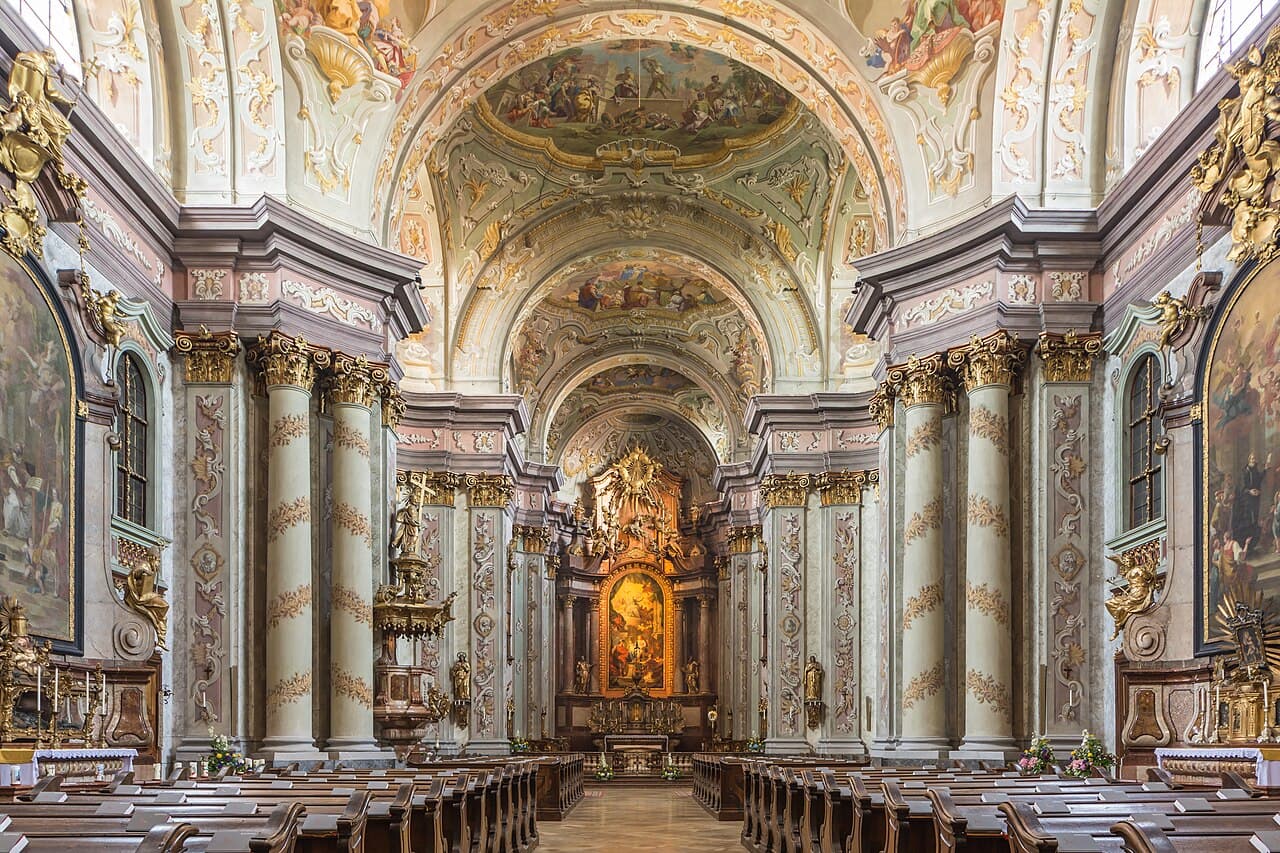
Herzogenburg Monastery
Herzogenburg Monastery is a significant religious and architectural landmark located in the town of Herzogenburg, Lower Austria. Founded in 1112 by Bishop Ulrich I of Passau, this Augustinian monastery has a rich history spanning over nine centuries. Originally established at St. Georgen an der Traisen, the monastery was relocated in 1244 due to frequent flooding, settling in its current position along the Traisen River. The monastery complex is renowned for its impressive Baroque architecture, extensive art collections, and its resilience through turbulent historical periods.
Early history and foundation
The monastery’s origins trace back to the early 12th century when Bishop Ulrich I founded it at St. Georgen an der Traisen, near the confluence of the Traisen and Danube rivers. This location was initially chosen for its strategic and economic significance. However, persistent flooding made the site untenable, prompting a move approximately 10 kilometers upstream to the present-day town of Herzogenburg in 1244. This relocation allowed the monastery to thrive and become a central religious and economic institution in the region.
Herzogenburg Priory quickly gained influence, managing local markets such as the "Upper Market" and later acquiring the "Lower Market" in 1806, consolidating its control over the town’s commercial activities. Throughout the Middle Ages, the monastery faced numerous challenges, including damage from conflicts between Hussite forces and supporters of King Matthias Corvinus, as well as destructive fires in the 16th century. Despite these setbacks, abbots like Georg Eisner spearheaded restoration efforts that helped maintain the monastery’s prominence.
Baroque transformation and architectural evolution
Beginning in 1714, Herzogenburg Monastery underwent a major transformation under the guidance of the celebrated architect Jakob Prandtauer, a master of Austrian Baroque design. This extensive remodeling project incorporated contributions from other prominent architects and artists such as Johann Bernhard Fischer von Erlach and Joseph Munggenast. The reconstruction aimed to modernize the monastery complex, enhancing both its aesthetic appeal and functional capacity.
The architectural layout of the monastery today reflects this Baroque vision, with buildings arranged around formal courtyards and gardens. The south wing, initially built to accommodate guests, showcases Prandtauer’s characteristic masonry and design principles. Extending from this wing is the grand Kaisersaal or Imperial Hall, designed by Fischer von Erlach, featuring exquisite stonework by Johann Gallus Hügel. This hall served as a ceremonial space reflecting the monastery’s cultural and social importance.
The collegiate church
Central to the monastery complex is the collegiate church dedicated to Saints George and Stephen. The original church was founded circa 1014 by Emperor Henry II, making it one of the oldest ecclesiastical sites in the region. While few Gothic elements remain, such as the entrance portal and the upper part of the church tower’s second story, the majority of the structure was rebuilt in the late Baroque style between 1743 and 1785. This reconstruction was overseen by Franz Munggenast, son of Joseph Munggenast, and included sculptural decorations by Johann Joseph Resler and ceiling frescoes by prominent artists Daniel Gran and Bartolomeo Altomonte.
The church houses a remarkable pipe organ built in 1752 by Johann Hencke. This instrument features 40 registers across three manuals and a pedalboard, including the Großpositiv manual, which mirrors the Hauptwerk in arrangement to provide rich musical versatility. The church’s bell tower contains five bells tuned to specific musical notes, with the largest bell, known as the "Pummerin" or "Bummerin," cast in 1719 by Franz Ulrich Scheichel. This bell is notable for its size and weight, measuring 188 centimeters in diameter and weighing 3,864 kilograms. It was rehung on a traditional wooden yoke in 2019 to preserve its historic acoustic qualities.
Historical challenges and survival
Throughout its history, Herzogenburg Monastery endured significant challenges including the Reformation, which led to a decline in monastic population, and military threats such as the Turkish incursions in the late 17th century. In 1683, the priory played a role in local defense under the leadership of canon Gregor Nast, helping to repel advancing forces. The monastery also survived the Josephine reforms of the late 18th century, which saw the dissolution of many religious houses. Herzogenburg expanded by absorbing the former monasteries of Dürnstein and St. Andrä an der Traisen, thereby strengthening its religious and economic position.
In the 20th century, the priory faced economic hardships during the two World Wars, inflation in the interwar period, and the Soviet occupation after World War II. Despite these difficulties, the monastery remained an active religious institution and cultural center.
Art collections and cultural significance
Herzogenburg Monastery is home to an extensive collection of art and historical artifacts, with a particular emphasis on late Gothic works. The collection includes panel paintings, sculptures, stained glass windows, manuscripts, and incunabula (early printed books). The monastery’s library and coin cabinet further highlight its art-historical importance in Lower Austria.
A unique artifact is a well-preserved Roman face helmet dating from around 150 AD, discovered locally in a gravel pit. This item underscores the region’s deep historical roots extending back to antiquity.
The monastery’s Baroque picture gallery contains not only religious artworks but also secular pieces, reflecting the broad cultural interests of the priory’s patrons and residents.
Recent restoration and preservation efforts
From 2000 to 2012, Herzogenburg Monastery underwent a comprehensive restoration to celebrate its 900th anniversary. This project included refurbishment of the external facades, restoration of the inner courtyard, and renewal of historic gardens such as the Prelate’s Garden, orchard, and rose garden. Interior renovations focused on key spaces including the Kaisersaal, chapels dedicated to Saints Frigdianus and the choir, as well as the library and its valuable collections.
The restoration has ensured the preservation of the monastery’s rich architectural heritage and artistic treasures, securing its status as a vital cultural and historical site in Lower Austria.
Architectural significance and regional impact
The Baroque tower of the priory church is a prominent feature in the Lower Traisen valley skyline, often compared to the nearby Dürnstein monastery tower. This visual landmark symbolizes the monastery’s enduring presence and influence in the region. The harmonious blend of Gothic remnants and Baroque grandeur makes Herzogenburg Monastery a fascinating study in architectural evolution and religious history.
Frequently asked questions (FAQ)
- When was Herzogenburg Monastery founded and by whom?
- Herzogenburg Monastery was founded in 1112 by Bishop Ulrich I of Passau at St. Georgen an der Traisen before relocating to Herzogenburg in 1244 due to flooding.
- What architectural style characterizes Herzogenburg Monastery?
- The monastery is primarily characterized by its Baroque architectural style, extensively remodeled from 1714 under Jakob Prandtauer and other notable architects.
- What are some notable features of the collegiate church at Herzogenburg?
- The collegiate church features late Baroque design, with sculptural decorations by Johann Joseph Resler, ceiling frescoes by Daniel Gran and Bartolomeo Altomonte, and a significant pipe organ built by Johann Hencke in 1752.
- How did Herzogenburg Monastery survive the Josephine reforms?
- Herzogenburg Monastery survived the Josephine reforms by absorbing the former monasteries of Dürnstein and St. Andrä an der Traisen, expanding its holdings and religious influence.
- What unique artifacts are housed at Herzogenburg Monastery?
- The monastery houses a rich collection of late Gothic art and a unique Roman face helmet dating from around 150 AD, discovered locally.
Photo gallery

Information
Sources & official resources
Verify the information above using these authoritative references.
Loading map...
Visitor reviews
No reviews yet. Been here? Write the first review and help other travelers!
Write the first reviewVisited this castle? Share your experience
Your review helps other travelers and adds first-hand knowledge to our encyclopedia.



