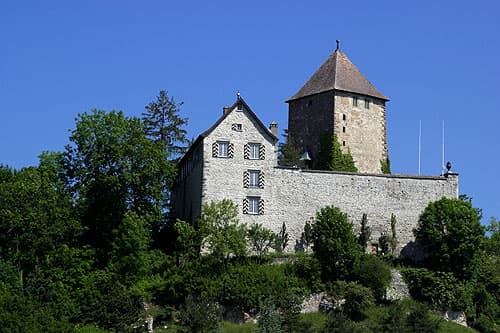
Herblingen Castle
Herblingen Castle in Stetten, Switzerland, stands as a remarkable example of a high medieval hill castle that has undergone significant transformations over the centuries. Originally constructed in the early 13th century by the noble Lords of Herblingen, the castle's enduring presence reflects the architectural and historical shifts from a fortified medieval stronghold to an elegant aristocratic residence.
The castle's origins trace back to the early 1200s, with the bergfried—a tall, robust defensive tower—being the oldest surviving structure. This tower exemplifies the typical medieval masonry techniques used in fortifications of that era, designed for surveillance and defense. The castle's strategic location on a hill provided commanding views of the surrounding landscape, an essential feature for military and territorial control during the high medieval period.
Historical records indicate that the chapel within the castle complex was rebuilt in 1281 by Konrad von Herblingen, a significant figure in the castle's early history. While local legend attributes the chapel's consecration to Pope Leo IX in the 11th century, this claim lacks documentary evidence, and the earliest confirmed consecration was performed by Bishop Albert on behalf of the Bishop of Constance in the late 13th century. The chapel's religious function persisted through turbulent times, including the Reformation, when Catholic worship continued despite widespread religious changes in the region.
Medieval ownership and architectural features
The castle originally belonged to the Herblingen family, who maintained possession until their extinction in the 15th century. Following their demise, ownership passed through various hands, including the Dukes of Austria, who managed the property by appointing stewards and pledging it to local noble families such as the Truchsess family of Diessenhofen in the 14th century. This period saw the castle serving both as a military fortification and an administrative center.
Throughout the 14th and 15th centuries, the castle's fortifications included a ring wall, battlements, a drawbridge, and moats, all typical defensive features designed to protect the stronghold from siege and attack. The castle's layout featured a central courtyard surrounded by these defensive structures, with the bergfried providing a last refuge in case of breach.
Transition of ownership in the late medieval period
In 1469, the castle was acquired by Adam Cron, a prominent citizen of Schaffhausen, marking a shift from noble to bourgeois ownership. The 16th century saw several changes in proprietors, including Hans Löw and Beringer von Landenberg, before the city of Schaffhausen took control in 1534. That same year, the property was transferred to the Brümsi family. The castle also served as the administrative center for the Obervogtei Reiat from 1566 until the early 18th century, underscoring its continued regional importance.
18th-century transformation and architectural evolution
A major turning point in Herblingen Castle's history came in 1733 when Johann Wilhelm Gestefeld, a Viennese bank director, purchased the property. Gestefeld undertook extensive renovations that dramatically altered the castle's medieval character. The defensive walls, battlements, drawbridge, and moats were removed or filled in, reflecting a shift from military utility to residential elegance. The castle was converted into a refined palatial residence, with architectural modifications that emphasized comfort and aesthetic appeal over defense.
This transformation included the removal of the ring wall and other fortifications, replaced by landscaped gardens and open grounds. The manor house was remodeled to reflect contemporary tastes, incorporating elements more typical of noble residences of the 18th century rather than a fortress. These changes illustrate the broader trend in castle architecture during the post-medieval period, where many former fortresses were adapted into stately homes.
Later ownership and modern use
Following Gestefeld's financial collapse in 1779, the castle passed to the von Meyenburg family until 1833. Over the 19th and 20th centuries, Herblingen Castle saw a succession of over twenty owners, reflecting its changing role and the evolving social and economic landscape. In the 20th century, the castle gained regional recognition for housing a restaurant and an antique shop, activities that ceased with subsequent ownership changes.
In 1998, artworks from the castle were auctioned publicly at Christie's, marking a moment of cultural dispersal. Since 2000, the castle has been privately owned by the Günthart brothers, who use it as both a corporate site and private residence. Despite its private status, the castle remains an important cultural property in Switzerland, recognized for its historical significance and architectural heritage.
Architectural remains and cultural significance
Today, the most prominent surviving feature of Herblingen Castle is the bergfried, which offers a tangible connection to its medieval origins. The tower's robust construction and imposing height continue to dominate the castle silhouette, serving as a landmark in the region. The surrounding manor house, reflecting 18th-century renovations, complements the medieval tower, illustrating the site's layered architectural history.
Although the castle is not open to the public, its status as a cultural property of national importance in Switzerland ensures its preservation and recognition. The castle's history encapsulates the evolution of medieval fortifications into noble residences, mirroring broader socio-political and architectural trends in Swiss history. The site also lends its name to the former municipality of Herblingen, now part of Schaffhausen since 1964, underscoring its local historical significance.
Herblingen Castle stands as a testament to the dynamic history of Swiss castles, embodying centuries of architectural innovation, noble lineage, and cultural transformation. Its preserved structures offer valuable insights into the defensive strategies of the high medieval period and the aesthetic shifts of the 18th century, making it a significant monument in Switzerland's heritage landscape.
Frequently asked questions (FAQ)
- How do I visit Herblingen Castle?
- Herblingen Castle is privately owned and not open to the public, so visits are not possible. However, its exterior can be viewed from nearby public areas in Stetten.
- What is the historical significance of Herblingen Castle?
- Herblingen Castle is significant for its evolution from a 13th-century fortified hill castle to an 18th-century palatial residence, reflecting regional political and architectural changes.
- When was the castle chapel rebuilt and consecrated?
- The castle chapel was rebuilt in 1281 by Konrad von Herblingen and consecrated by Bishop Albert on behalf of the Bishop of Constance.
- Can I see the medieval defensive features of the castle?
- Most medieval defensive features like battlements, drawbridge, and moats were removed in the 18th century during renovations, so they are no longer visible.
- Who owns Herblingen Castle today?
- Since 2000, Herblingen Castle has been privately owned by the Günthart brothers, who use it as a corporate site and private residence.
Photo gallery

Information
Current owner
Private owner
Loading map...
Visitor reviews
No reviews yet. Been here? Write the first review and help other travelers!
Write the first reviewVisited this castle? Share your experience
Your review helps other travelers and adds first-hand knowledge to our encyclopedia.