Helme Castle
Helme Castle, located in Valgamaa, Estonia, stands as a significant medieval fortress with a rich history dating back to the early 14th century. Constructed by the Livonian Order, a crusading military organization, the castle occupies a naturally defensible promontory overlooking a river, strategically positioned along historic routes connecting the provinces of Sakala and Ugandi. The site itself bears evidence of earlier fortifications by the Sakalian people, an ancient Estonian tribe, underscoring its longstanding military importance.
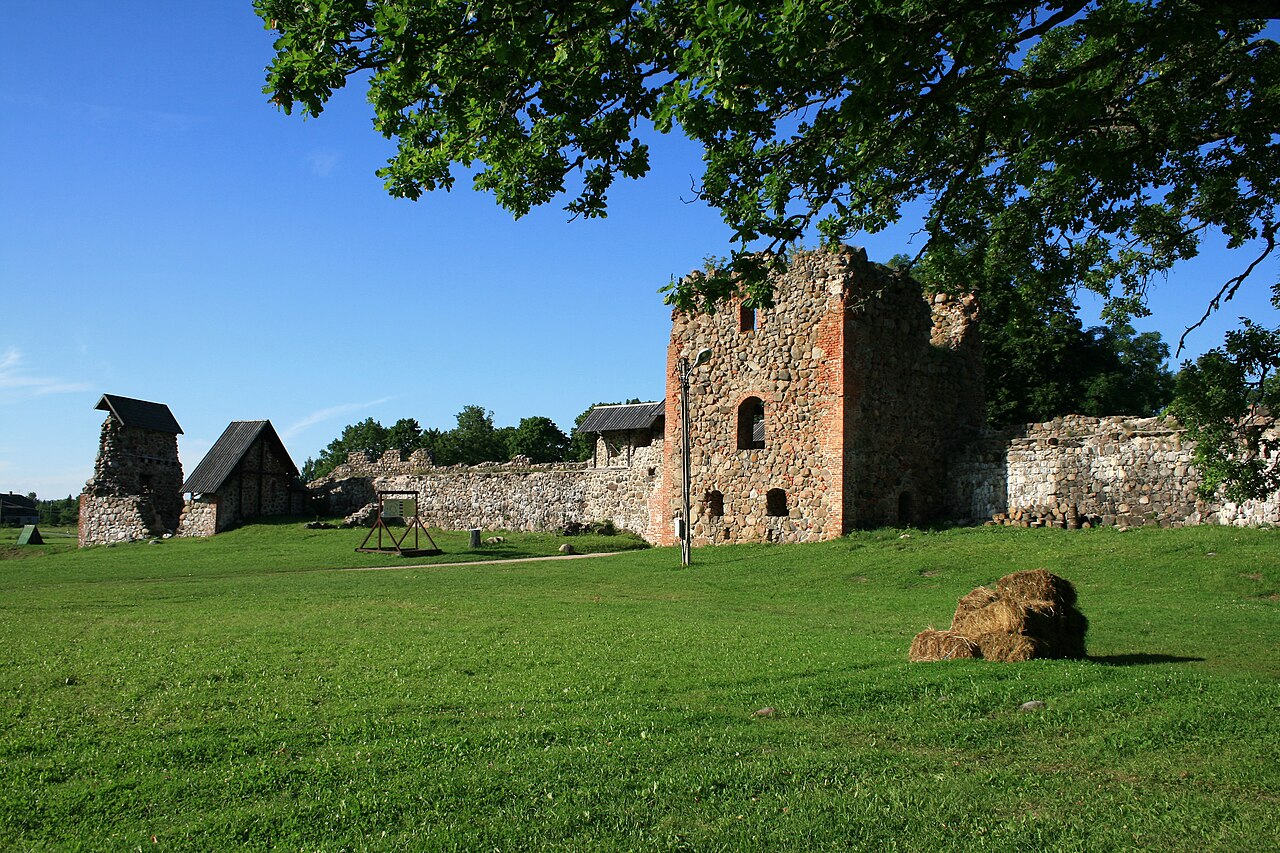
The castle's oval-shaped layout, approximately 120 by 60 meters, is enclosed by thick stone walls and protected by two deep moats. This design leveraged the natural topography of a steep hill rising up to twenty meters above the riverbank, enhancing its defensive capabilities. The fortress's ground plan is irregular, conforming to the ridge's shape and aligned north-south to maximize strategic advantage. Inside the walls, a series of chambers and a prominent central tower served as the keep, acting as the stronghold's heart and symbol of authority.
Historical context and construction
The earliest documented mention of the Helme church parish dates to 1329, during a Lithuanian raid, suggesting the area's volatile medieval environment. Shortly thereafter, in the first half of the 14th century, the Livonian Order established the stone castle known as Ordensburg Helmet. This construction marked the Order's efforts to consolidate control in the region, which was then a contested borderland.
Helme Castle's strategic location was vital for controlling movement and asserting dominance over the surrounding lands. The castle was part of a larger complex that included a medieval borough adjacent to it, which persisted until the 17th century. This settlement likely supported the castle's garrison and administration, serving as a local hub of governance and commerce.
Military significance and conflicts
Throughout its history, Helme Castle played an active role in regional conflicts. It is first explicitly documented in 1412 when Master Konrad von Feitinghof of the Livonian Order issued a signed document from the site, indicating its administrative importance. During the Livonian War (1558–1583), the fortress remained intact after the nearby Battle of Härgmäe in 1560, demonstrating its resilience.
However, in July 1575, the castle fell to Russian forces after a siege, reflecting the shifting power dynamics in the Baltics. Subsequently, the fortress became part of the Polish-Lithuanian Commonwealth, serving as the center of the Helme starosty within the Pärnu voivodeship. During the reign of King Stefan Batory, the estate was owned by the Nonhart brothers, highlighting its continued administrative relevance.
The castle survived the Polish-Swedish wars (1600–1620), but its military role ended during the Russo-Swedish War in 1658. Swedish troops deliberately destroyed the fortress by blowing it up before withdrawing, effectively ending its use as a defensive stronghold. Since then, Helme Castle has remained in ruins, gradually succumbing to time and the elements.
Architectural features and layout
The fortress's design reflects typical late medieval military architecture of the Livonian Order, combining natural terrain advantages with man-made defenses. The oval plan, surrounded by double moats, was unusual and provided layered protection. The main entrance was located on the southern end, guarded by a forecastle or Silla- ("bridge") and Keldrimägi ("cellar hill") defensive structures. A wooden or stone bridge connected this outer fortification to the main gate, controlling access across the moat.
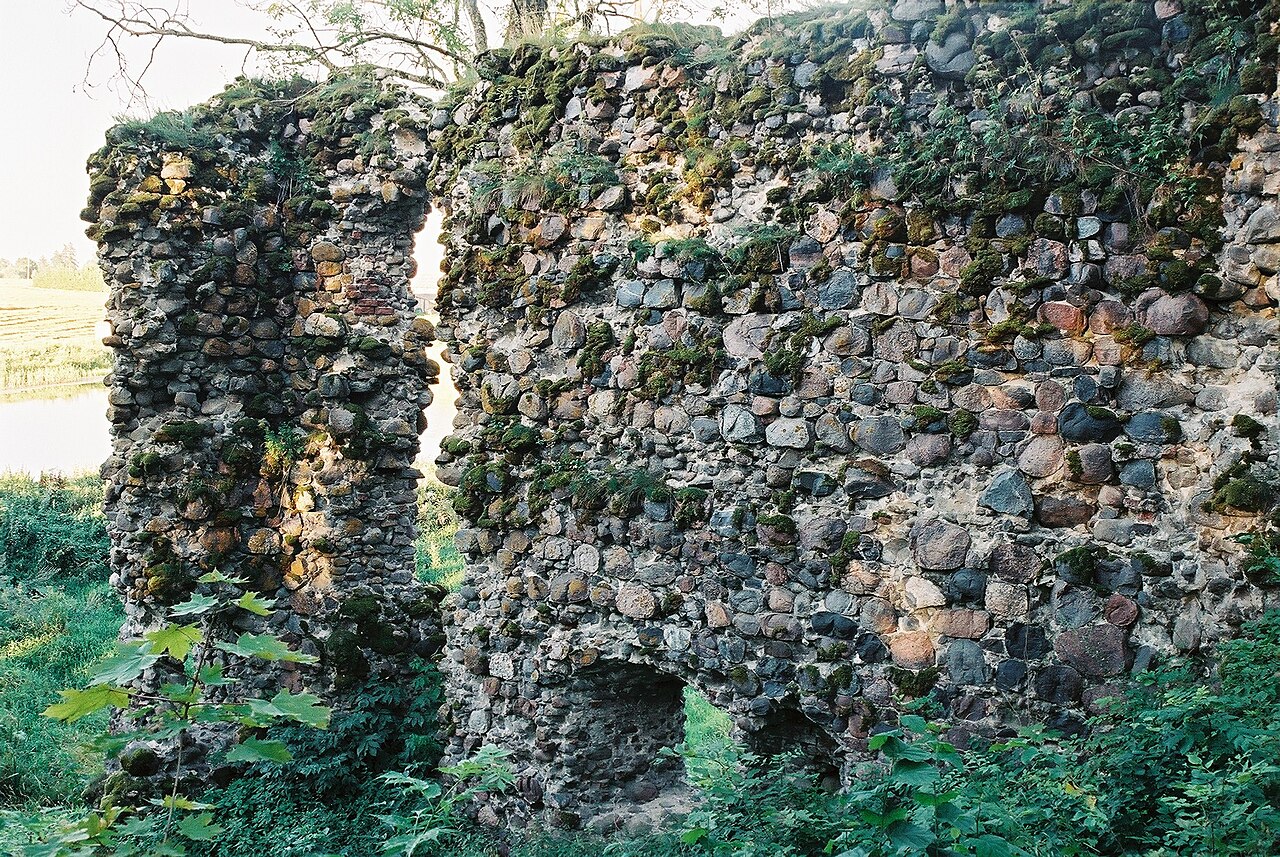
Inside the walls, the castle contained a continuous row of chambers along the perimeter, used for various military and administrative functions. The central tower, the oldest part of the complex, acted as a keep and refuge during sieges. The walls still display high window openings that allowed defenders to observe and repel attackers while providing light to interior spaces.
Defensive advantages
Built on a promontory rising steeply above the river, the castle's location was naturally defensible. The two surrounding moats enhanced this protection, making direct assaults difficult. The irregular shape of the fortress adapted to the terrain, maximizing the use of natural features for defense.
Cultural legacy and preservation
Helme Castle is not only a site of military and administrative history but also a source of local legend. A poignant tale tells of a girl named Anne who was walled into the fortress to protect it. According to the legend, revealing her name would doom the castle to fall. This story inspired literary works, such as the ballad "Ohver" by Lehte Hainsalu, embedding the castle in Estonian cultural memory.
By the 18th century, much of the castle's walls remained standing, many with window openings intact, as documented in detailed drawings by Johann Christoph Brotze. Today, only fragments of the walls and a few towers survive. The ruins have been cleared of vegetation to reveal the layout clearly, and conservation efforts beginning in 2011 have focused on stabilizing the roadside stone walls to preserve the site for future generations.
Helme Castle remains an important heritage site, reflecting the complex history of medieval Estonia and the Livonian Order's influence. Its ruins offer valuable insights into medieval fortification techniques and the region's turbulent past, attracting historians, archaeologists, and visitors interested in Estonia's rich cultural landscape.
Frequently asked questions (FAQ)
- How do I get to Helme Castle?
- Helme Castle is located in Valgamaa, Estonia, near the borough of Helme. Visitors can reach the site by car or local transport from nearby towns. The castle ruins are accessible by foot via marked paths from the surrounding area.
- What is the historical significance of Helme Castle?
- Helme Castle was built by the Livonian Order in the early 14th century and played a key role in regional conflicts, including the Livonian War and Russo-Swedish War. It served as a military fortress and administrative center, reflecting the medieval power struggles in Estonia.
- Can I explore the ruins of Helme Castle?
- Yes, visitors can explore the ruins, which have been cleared of vegetation to reveal the castle's layout. While only parts of the walls and a few towers remain, the site offers valuable insights into medieval fortifications and architecture.
- When was Helme Castle destroyed?
- Helme Castle was deliberately destroyed by Swedish troops in 1658 during the Russo-Swedish War. The fortress was blown up to prevent its use by enemy forces, ending its military role.
- Are there any legends associated with Helme Castle?
- Yes, local legend tells of a girl named Anne who was walled into the castle to protect it. The tale says that revealing her name would cause the castle to fall, a story that has inspired literary works and remains part of Estonian cultural heritage.
Information
Loading map...
Visitor reviews
No reviews yet. Been here? Write the first review and help other travelers!
Write the first reviewVisited this castle? Share your experience
Your review helps other travelers and adds first-hand knowledge to our encyclopedia.