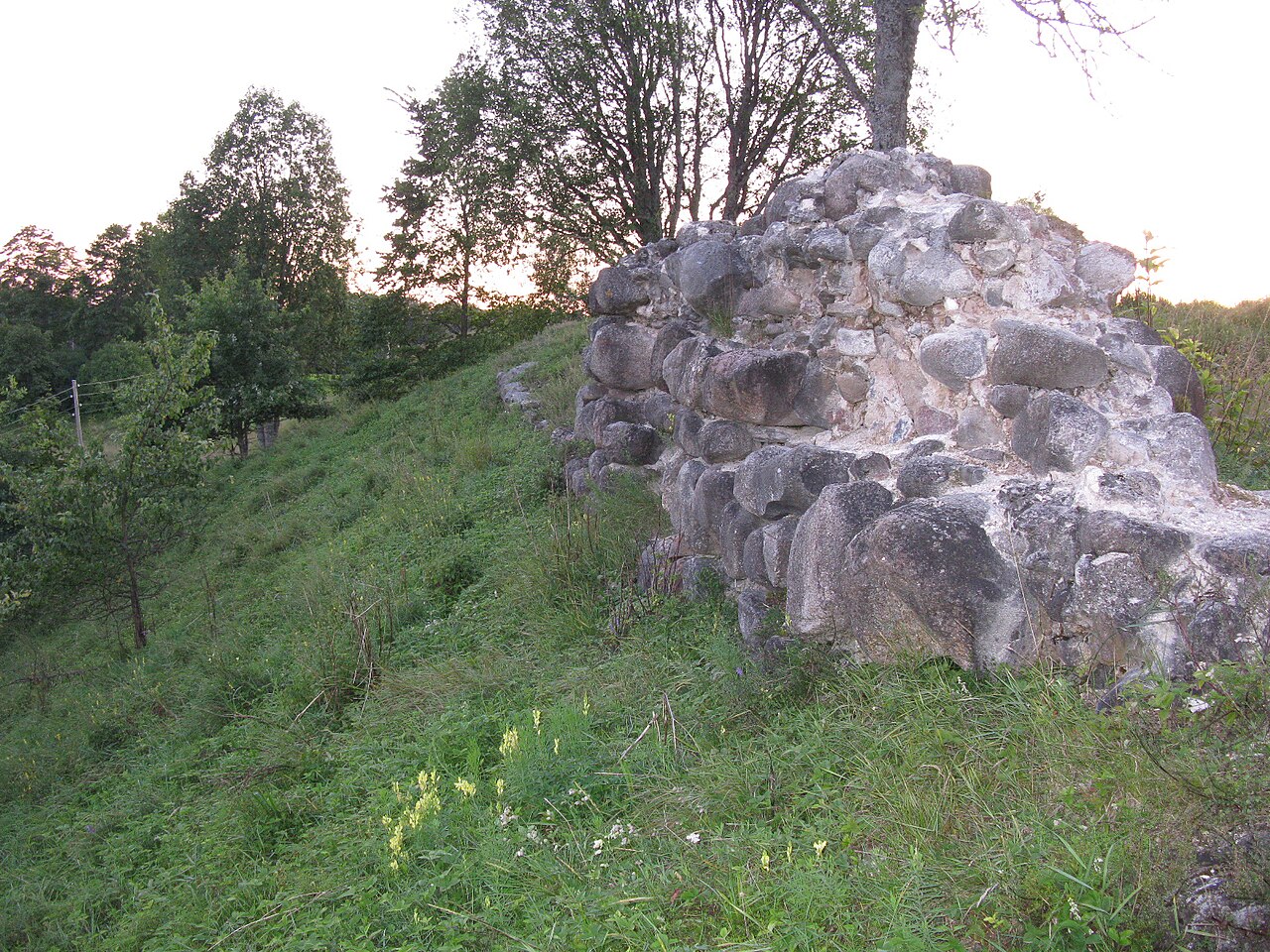
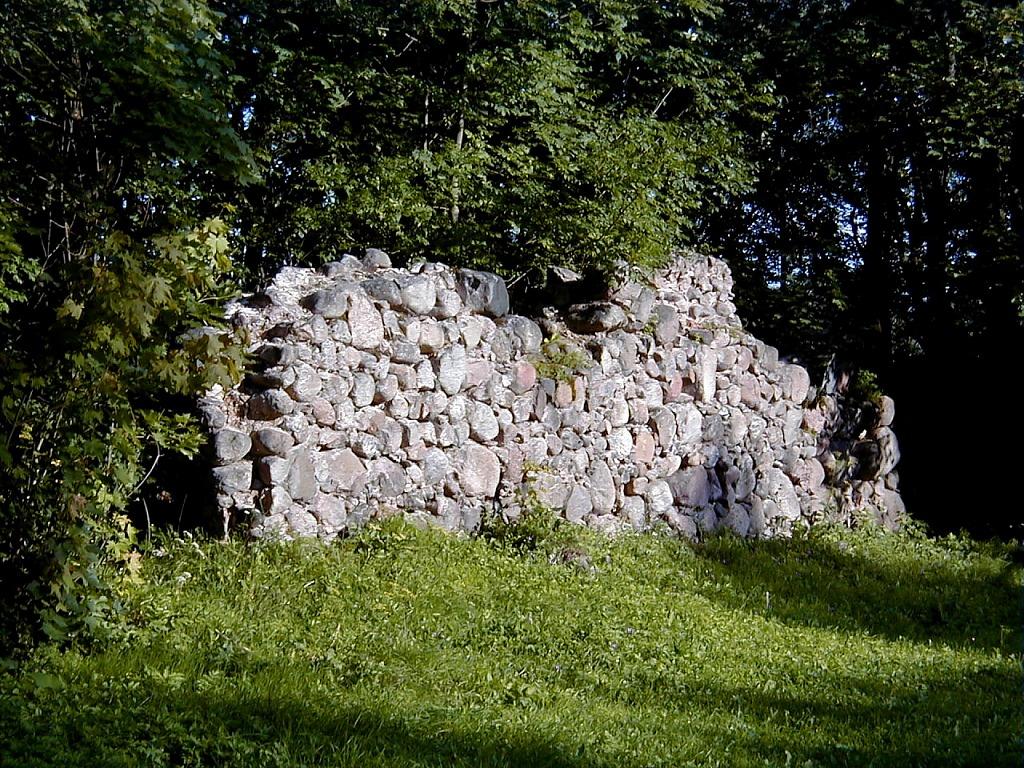
Ergeme castle ruins stand as a significant example of a late-medieval fortress constructed by the Livonian Order to secure the eastern borders of their territory. Built around 1320 under the direction of the Order master Gerhard von Jocke, the castle played a strategic role as a frontline defense and as a support outpost for the nearby Cēsis castle, the seat of the Livonian Order master. Although first mentioned in historical records in 1422, the castle's origins date back to the early 14th century, reflecting the military and administrative needs of the Livonian Order during a period of territorial consolidation.
Architectural design and features
The castle was designed in the typical convent-type layout, characterized by a regular quadrangular stone wall enclosing the complex. This design was common among Livonian Order castles, emphasizing both defensive capabilities and functional space for the Order's operations. The outer walls were fortified with two large towers, including a prominent round corner tower that still rises to a height of two stories today, offering insight into the castle's defensive architecture.
Surrounding the castle was a system of water-filled moats, which added an extra layer of protection against invaders. Access to the castle was controlled by a drawbridge that connected the castle-front with the central courtyard, allowing for controlled entry and exit. The castle's layout and fortifications reflect the military engineering principles of the late-medieval period and the specific needs of the Livonian Order as a military-religious organization.
Historical significance and ownership changes
Throughout the 15th century, Ergeme castle underwent significant rebuilding efforts to reinforce its defenses and adapt to evolving military technologies. It served primarily as a storehouse, a point of support, and a shelter for the knights of the Livonian Order. The castle was part of the Komturei of Cēsis, acting as an ancillary fortress within the district governed by the Livonian Order master.
In 1575, the castle was conquered by the Livonian duke Magnus, who subsequently sold it to the Polish in 1578. The castle changed hands multiple times during the turbulent conflicts of the region. In 1621, it was occupied by the Swedish king Gustavus Adolphus, who loaned it in 1625 to Major-General de la Barre. The de la Barre family maintained ownership until 1795. The castle was again contested, with the Poles capturing it in 1658.
A devastating fire in 1670 damaged the castle severely, and there are no records indicating that it was inhabited afterward. The castle suffered further destruction during the Great Northern War when it was blown up on 5 July 1702. Despite this, the ruins remained in use as a grain storehouse for the local parish until 1853.
Preservation and modern use
Efforts to conserve the Ergeme castle ruins began in 1986, although these conservation works were not fully completed, leading to gradual deterioration of the site. Today, the ruins remain a notable historical and architectural landmark, with the surviving round tower and sections of the fortification walls providing a tangible connection to the castle's medieval past.
During the summer months, the castle ruins serve as a unique venue for cultural events, utilizing the open-air stage established within the site. This use helps to maintain public interest and awareness of the castle's historical importance while providing a picturesque setting for performances and gatherings.
Ergeme castle in the context of Livonian Order fortifications
The castle's location in Ērģeme, Latvia placed it at a strategic point for the Livonian Order's eastern frontier defense system. As an ancillary castle to the more prominent Cēsis castle, Ergeme was part of a network of fortifications designed to control territory and protect against incursions from neighboring powers. Its design reflects the typical features of convent castles built by the Order, emphasizing both military strength and administrative functionality.
The presence of water moats, drawbridges, and fortified towers illustrates the importance placed on defense and control of access. The castle's history of ownership changes and military engagements highlights the contested nature of the Baltic region during the 16th and 17th centuries, involving Swedish, Polish, and Livonian forces.
Frequently asked questions (FAQ)
- What is the historical significance of Ergeme Castle Ruins?
- Ergeme Castle Ruins date back to the 13th century and were built by the Livonian Order. This castle played a crucial role in the region's defense and governance during the Middle Ages, making it an important historical landmark in Latvia.
- When was Ergeme Castle Ruins constructed?
- The castle was constructed in the early 13th century, around 1230, and was intended to solidify the control of the Livonian Order over the area. Its strategic location made it a key fortification in the region.
- Can I visit Ergeme Castle Ruins year-round?
- Yes, visitors can explore the Ergeme Castle Ruins year-round. However, it's advisable to check local weather conditions and any potential seasonal restrictions before planning your visit.
- What are the opening hours for Ergeme Castle Ruins?
- The ruins are generally accessible at all times; however, visitor information may be available from local tourist offices during regular business hours. It is best to visit during daylight for a complete experience.
- Is it possible to access Ergeme Castle Ruins by public transport?
- While there is limited public transportation directly to the ruins, you can reach the town of Ērģeme by bus from major cities. From there, the castle ruins are a short walk away, making it accessible for visitors.
- When is the best time to visit Ergeme Castle Ruins?
- The best time to visit is during late spring to early autumn, when the weather is mild and conducive for outdoor exploration. This period also allows visitors to enjoy the surrounding landscape in full bloom.
- What are some nearby attractions to Ergeme Castle Ruins?
- Nearby attractions include the picturesque Ērģeme village and the scenic views of the Gauja River. Additionally, visitors can explore other historical sites in the region, enhancing their cultural experience.
- Are there any ticket prices for visiting Ergeme Castle Ruins?
- There is no entrance fee to visit the Ergeme Castle Ruins, making it a budget-friendly option for travelers. However, donations to preserve the site are appreciated.
Loading map...
Visitor reviews
No reviews yet. Been here? Write the first review and help other travelers!
Write the first reviewVisited this castle? Share your experience
Your review helps other travelers and adds first-hand knowledge to our encyclopedia.