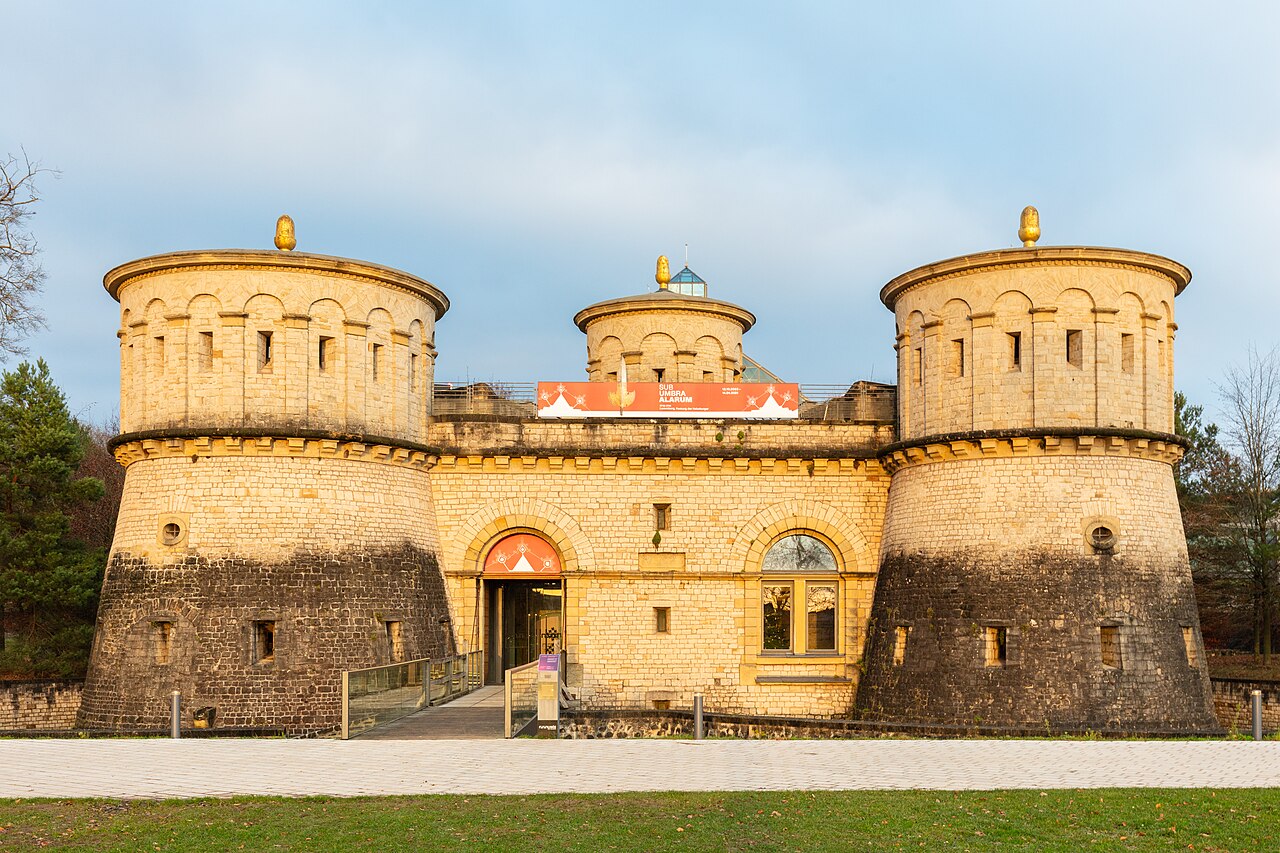
Heisdorf Castle
Heisdorf Castle stands as a remarkable example of 19th-century architecture in Luxembourg, embodying a rich history intertwined with its location and successive uses over the centuries. Originally constructed in 1888 by Baron Lippmann, the castle was designed by the renowned Belgian architect Charles Thirion, whose vision created a stately residence surrounded by an expansive park that remains a key feature of the estate.
The castle is situated on a historically significant site where a previous fortress was built in 1645 by Jean de Beck. While the original structure no longer stands, the dates 1645 and 1888 are prominently displayed above the main entrance, symbolizing the continuity of the location's strategic and residential importance across centuries.
Architectural design and layout
Heisdorf Castle's layout is defined by two wings arranged at a right angle, connected by a square tower that houses the main entrance. This tower serves as a focal point, linking the wings and providing a grand entryway into the estate. At the end of the wing facing the Alzette River, a distinctive round tower capped with a cupola roof and topped by a spire stands out. This tower contains the knights' hall, an important ceremonial space within the castle.
Access to the tower's first floor is marked by a monumental external staircase, enhancing the castle's imposing presence. The combination of the square and round towers, along with the wings, reflects a blend of functional design and aesthetic considerations typical of the period.
Historical transformations and uses
In 1916, the castle transitioned from a private residence to a communal institution when it was acquired by the Sisters of the Christian Doctrine. They repurposed the estate as a convalescent home for members of their community, adapting the castle's interior to meet healthcare needs while preserving its architectural integrity.
Further evolution occurred in 1982 when the castle was opened as an old people's home under the name Maison de retraite Marie-Consolatrice. This phase involved modifications to accommodate senior citizens, reflecting changing social priorities and the adaptive reuse of historic buildings in Luxembourg.
In 2007, the architecture firm Hermann, Valentiny and Partners designed and added a new wing to the castle, enhancing its facilities and ensuring compliance with modern standards for elder care. This expansion was sensitively integrated into the existing structure, maintaining the castle's historic character.
Religious and cultural features
Integral to the castle complex is a chapel constructed in 1924 by the Sisters of the Christian Doctrine. Positioned strategically on the side of the main street where the two wings meet, the chapel serves both spiritual and community functions. It underwent renovation in 2005-2006 to preserve its structure and artistic elements, ensuring its continued use and significance.
Park and natural heritage
The castle is set within a large park that extends along the main road and is enclosed by a high wall, providing privacy and a serene environment. The park was renovated after 1910, carefully preserving the mature trees that contribute to its historic ambiance.
Among these trees are a black pine and an oak tree recognized as notable trees of Luxembourg, highlighting the estate's importance not only architecturally but also environmentally. These trees add to the site's cultural landscape and offer a living connection to the past.
Significance and preservation
Heisdorf Castle represents a modern period castle that bridges historical legacy with contemporary use. Its architectural elements, such as the combination of square and round towers, the cupola roof, and the knights' hall, showcase design trends of the late 19th century in Luxembourg and Belgium.
The castle's adaptive reuse over the 20th century as a convalescent home and later as a senior residence illustrates the evolving social functions of historic estates. The involvement of notable architects in its design and later expansions underscores its architectural value.
Today, Heisdorf Castle remains a well-preserved landmark, reflecting Luxembourg's cultural heritage and commitment to maintaining historical sites while serving community needs. Its park, chapel, and notable trees contribute to its status as a cherished estate in the region.
Frequently asked questions (FAQ)
- What is the historical significance of Heisdorf Castle?
- Heisdorf Castle is a notable example of 19th-century architecture in Luxembourg, representing the romantic style that was popular during that era. The castle not only showcases the region's rich history but also reflects the social and cultural changes of its time, making it a valuable site for understanding Luxembourg's past.
- When was Heisdorf Castle built?
- Heisdorf Castle was constructed in the mid-19th century, with its completion around 1860. The castle was designed to serve as a private residence, and its construction marked an important period of development in the Heisdorf area.
- What are the opening hours for Heisdorf Castle?
- Heisdorf Castle is open to visitors from 10 AM to 5 PM, Wednesday to Sunday. During the winter months, the hours may vary, so it's advisable to check the official website before planning your visit.
- Can I visit Heisdorf Castle with children?
- Yes, Heisdorf Castle is family-friendly and welcomes visitors of all ages. The scenic grounds and interesting architecture provide a great opportunity for children to learn about history while enjoying a day out.
- Is it possible to take guided tours of Heisdorf Castle?
- Yes, guided tours are available at Heisdorf Castle, providing visitors with in-depth knowledge of its history and architecture. It's recommended to book your tour in advance to secure your spot, especially during peak tourist season.
- What is the best time to visit Heisdorf Castle?
- The best time to visit Heisdorf Castle is during the spring and early fall when the weather is pleasant, and the gardens are in full bloom. Additionally, visiting during these seasons allows you to enjoy the surrounding landscape without the summer crowds.
- Are there any nearby attractions to Heisdorf Castle?
- Yes, there are several nearby attractions, including the picturesque village of Heisdorf and the beautiful nature trails in the surrounding area. Visitors can also explore other historic sites and cultural landmarks within a short drive.
- What are the ticket prices for Heisdorf Castle?
- Ticket prices for Heisdorf Castle are generally affordable, with discounts available for children, students, and seniors. It's best to check the official website for the most current pricing and any special promotions that may be offered.
- How do I get to Heisdorf Castle?
- Heisdorf Castle is easily accessible by public transportation, with nearby bus and train stations serving the area. For those driving, there is parking available on-site, making it convenient for visitors traveling by car.
Information
Website
Visit websiteSources & official resources
Verify the information above using these authoritative references.
Loading map...
Visitor reviews
No reviews yet. Been here? Write the first review and help other travelers!
Write the first reviewVisited this castle? Share your experience
Your review helps other travelers and adds first-hand knowledge to our encyclopedia.