Hedingham Castle
Hedingham Castle is a remarkable example of a Norman keep located in the village of Castle Hedingham, Essex, England. This historic fortress stands as one of the best-preserved medieval keeps in the country, showcasing the architectural and feudal legacy of the Norman conquest. The castle's origins date back to the late 11th century when the manor of Hedingham was granted to the Norman baron Aubrey de Vere I by King William the Conqueror following the Norman Conquest of England.
The initial fortification on the site was a motte and bailey castle constructed primarily from timber. This early structure was later replaced by a more durable stone keep during the 1130s and 1140s, likely under the direction of Aubrey de Vere II. The stone keep, which remains the castle's most prominent feature, exemplifies Norman military architecture with its massive walls, strategic design, and imposing height.
Historical significance and lineage
The de Vere family, who became the Earls of Oxford, were among the most influential noble families in medieval England. Their stewardship of Hedingham Castle spanned over five centuries, during which the castle served as their family seat and symbol of power. The de Veres were notable for their roles as Lord Great Chamberlains and for their loyal military and political service to successive English monarchs.
Throughout its history, Hedingham Castle hosted several royal visitors, including King Henry VII, King Henry VIII, and Queen Elizabeth I. The castle also witnessed important historical events, such as the death of Matilda, wife of King Stephen, in 1152.
Sieges and military history
Hedingham Castle endured two notable sieges during the turbulent early 13th century. The first siege occurred in 1216 by King John amid the First Barons' War, while the second in 1217 was conducted by Prince Louis of France, who later became King Louis VIII. Both sieges were brief but successful, reflecting the castle's strategic importance and the volatile political climate of the period.
During the Wars of the Roses in the 15th century, the castle temporarily changed hands when it was confiscated and granted to Richard, Duke of Gloucester, the future King Richard III. It was restored to the de Vere family by Henry VII in 1485, reaffirming their long-standing association with the site.
Architectural features and preservation
The norman keep
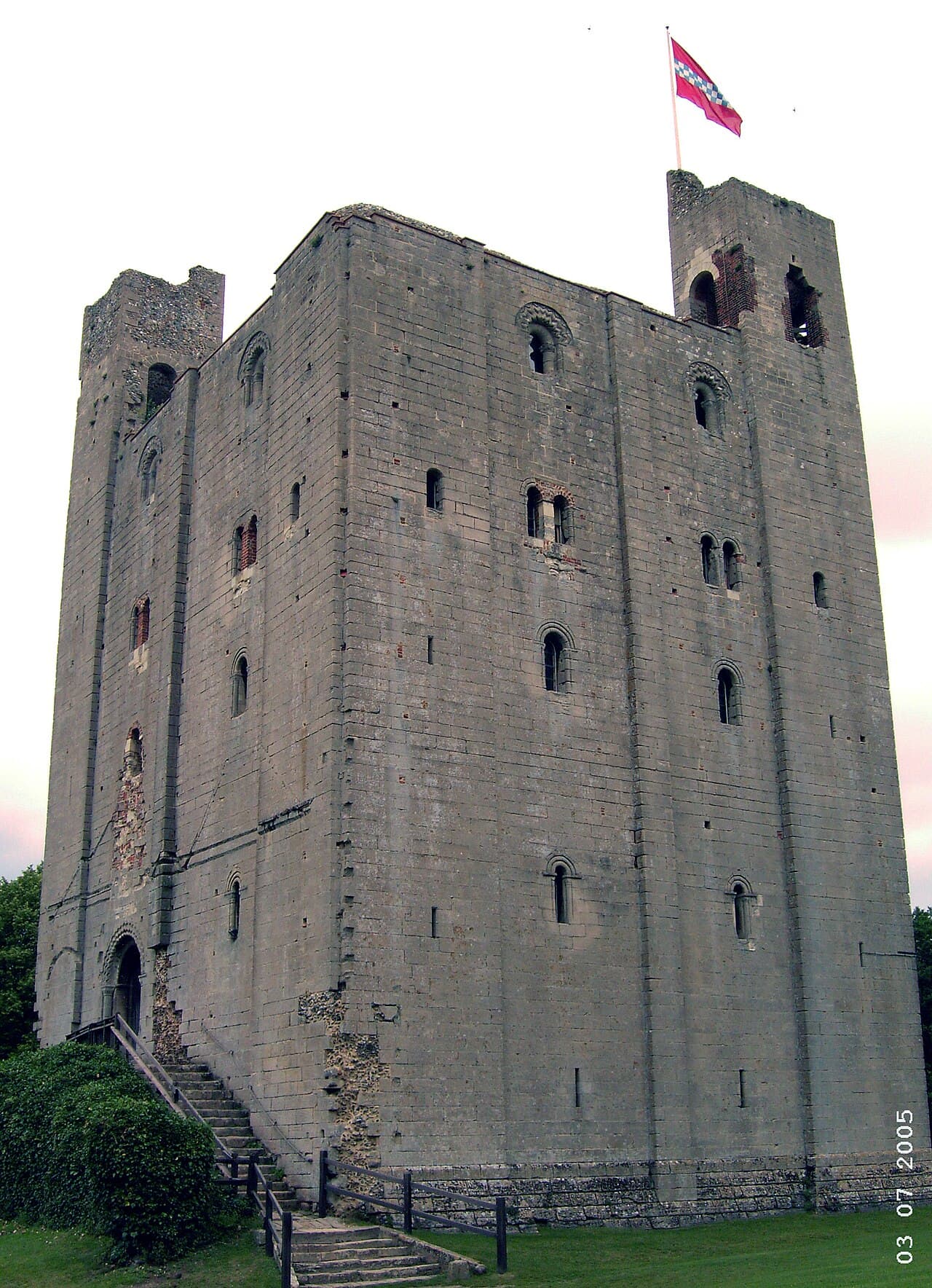
The centerpiece of Hedingham Castle is its Norman stone keep, a nearly square tower approximately 53 feet by 58 feet in dimension and rising over 70 feet high. The keep's walls are exceptionally thick, measuring about 11 feet at the base and tapering slightly to 10 feet near the top. Constructed from flint rubble bound with lime mortar, the exterior is faced with finely cut ashlar stone transported from a quarry in Barnack, Northamptonshire, highlighting the considerable resources invested in its construction.
Originally, the keep was topped by four corner turrets, two of which were removed, likely during the Tudor period when stone was repurposed for other building projects. The interior comprises five floors, including a Great Hall or Banqueting Hall featuring a large fireplace and a distinctive central two-storey arch. The uppermost floor may have been a later addition from the 15th century, replacing an earlier pyramid-shaped roof.
Castle grounds and outbuildings
The keep was originally surrounded by a large ditch carved into a natural spur, forming a ringwork and an inner bailey. Extending southward was an outer bailey reaching into the valley and the area of the modern village. While many Tudor-era structures such as the hall, drawbridge, and outbuildings have not survived, a notable red-brick four-span bridge dating from the late 15th or early 16th century connects the inner and outer baileys. This bridge has been restored multiple times and remains a key feature of the site.
Within the inner bailey, there was once a chapel, indicating the presence of religious facilities within the castle complex. The outer bailey also houses a Queen Anne style mansion built around 1700 by Sir William Ashhurst, a former Lord Mayor of London. This red-brick country house reflects the architectural tastes of the early 18th century and represents the castle's evolution beyond its medieval origins.
Modern use and visitor experience
Today, Hedingham Castle remains in well-preserved condition, with the Norman keep standing as a testament to medieval craftsmanship and feudal power. The castle grounds are open to the public from Easter to October, offering visitors the opportunity to explore the keep and learn about its rich history.
The castle hosts a variety of events throughout the year, including jousting tournaments, archery displays, falconry demonstrations, historical re-enactments, fairs, classic and vintage car shows, music concerts, and theatre productions. Educational school visits are also a significant part of the castle's contemporary role, providing immersive learning experiences about medieval history and architecture.
Hedingham Castle is privately owned by the Lindsay family, descendants of the de Vere lineage, who continue to maintain the estate and its heritage. Visitors should check opening times and ticket prices before planning their visit, as the keep may occasionally be closed for private events or maintenance.
Frequently asked questions (FAQ)
- How do I get to Hedingham Castle?
- Hedingham Castle is located in Castle Hedingham, Essex, and is easily accessible by car, with ample parking available on-site. If you're using public transport, the nearest train station is Halstead, approximately 4 miles away, where taxis can be hired or local bus services can be utilized.
- What is the historical significance of Hedingham Castle?
- Hedingham Castle is one of the best-preserved examples of a Norman castle in England, dating back to the 11th century. It was built by the de Vere family, who played a significant role in English history, and served as a royal residence for many years.
- When was Hedingham Castle last renovated?
- Hedingham Castle underwent significant restoration in the late 20th century, particularly in the 1990s, to preserve its historical architecture and ensure visitor safety. These renovations have allowed the castle to remain a popular tourist attraction while retaining its historical integrity.
- Can I take photographs inside Hedingham Castle?
- Yes, visitors are encouraged to take photographs throughout the castle grounds. However, please be respectful of other guests and the historical artifacts on display, avoiding the use of flash in certain areas.
- Why is Hedingham Castle a popular tourist destination?
- Hedingham Castle attracts visitors due to its rich history, stunning architecture, and picturesque grounds. It often hosts events, exhibitions, and reenactments that bring the castle's history to life, making it an engaging experience for all ages.
- Is it possible to host events at Hedingham Castle?
- Yes, Hedingham Castle offers facilities for hosting a variety of events, including weddings, corporate functions, and private parties. The enchanting surroundings and historical ambiance make it a unique and memorable venue for any occasion.
- What are the opening hours for Hedingham Castle?
- Hedingham Castle is open to the public from March to October, typically from 10 AM to 5 PM. However, it is advisable to check the official website for specific dates and any seasonal variations in opening hours.
- What are the ticket prices for Hedingham Castle?
- Ticket prices for Hedingham Castle vary depending on age and group size, with discounts available for children, students, and seniors. Family tickets are also offered, making it an affordable option for visitors looking to explore this historic site.
- What is the best time to visit Hedingham Castle?
- The best time to visit Hedingham Castle is during the spring and summer months when the grounds are in full bloom and outdoor events are more frequent. Visiting during weekdays can also help you avoid larger crowds and enhance your experience.
- Are there any nearby attractions to visit after Hedingham Castle?
- Yes, there are several nearby attractions, including the charming village of Castle Hedingham, the scenic countryside walks, and other historical sites such as the historic town of Halstead. These nearby locations provide additional opportunities to explore the rich heritage of the region.
Photo gallery

Photo by Agnete•Public domain
Information
Sources & official resources
Verify the information above using these authoritative references.
Loading map...
Visitor reviews
No reviews yet. Been here? Write the first review and help other travelers!
Write the first reviewVisited this castle? Share your experience
Your review helps other travelers and adds first-hand knowledge to our encyclopedia.