Haughton Castle
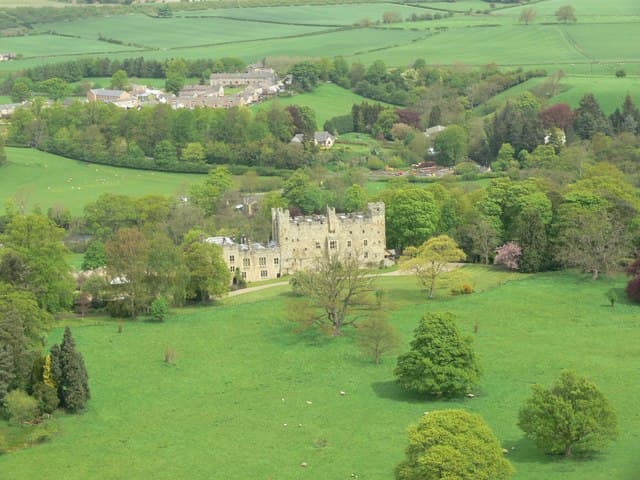
Haughton Castle stands as a remarkable example of a 13th-century hill castle located in Northumberland, England. Situated to the north of the village of Humshaugh on the west bank of the North Tyne River, it lies approximately 5.5 miles (8.9 km) north of the market town of Hexham. The castle's origins trace back to the High Medieval period when it was initially constructed as a fortified tower house, a common defensive residence type for the English-Scottish border region during that era.
Medieval origins and early history
The original structure of Haughton Castle was erected in the 13th century, designed primarily as a tower house to provide both residence and defense. During the 14th century, the castle underwent significant enlargement and fortification, reflecting the turbulent border conflicts of the time. Ownership in this period was held by the Widdrington family, notably Gerald Widdrington, although the Swinburn family were also resident occupants by the early 14th century. This dual occupancy was not uncommon in border castles, where alliances and tenancy arrangements could be complex.
Architectural features of the medieval castle
The medieval castle originally featured a robust stone tower typical of hill castles, with thick defensive walls, narrow windows, and battlements designed for protection against raids. The site’s elevated position on a hill overlooking the river provided a strategic vantage point. The castle likely included a great hall for communal gatherings, private chambers, and defensive features such as a gatehouse and possibly a moat or ditch, although detailed records of these features are limited.
Decline and border reiver attacks
By the 16th century, Haughton Castle had fallen into significant disrepair, a fate common to many border fortifications after the relative pacification of the region. The castle suffered attacks from Border reivers, notorious raiders along the Anglo-Scottish border. A survey conducted in 1541 reported that the castle’s roof and floors were decayed and gone, indicating a state of ruin. Despite its dilapidated condition, the castle remained a notable landmark.
Post-medieval transformations and restoration
In about 1640, the property was acquired by the Smith family. However, by 1715, another survey described the castle as ruinous, reflecting ongoing neglect. The most significant restoration and transformation occurred between 1816 and 1845, when the Smith family commissioned extensive alterations to convert the ruinous tower house into a substantial country mansion. This work was partly carried out by the renowned architect John Dobson, who played a key role in the castle’s 19th-century revival.
19th-century architectural additions
Further enhancements were made after the castle passed into the hands of the Crawshaw family in 1862. In 1876, the celebrated architect Anthony Salvin added a west wing, blending the medieval elements with Victorian country house architecture. Salvin was known for his sensitive restoration of historic buildings, and his work at Haughton Castle helped preserve its medieval character while adapting it for modern use.
20th-century usage and current status
During the Second World War, part of Haughton Castle was repurposed as a hospital, reflecting its continued utility and adaptive reuse through centuries. In the late 19th century, the castle was acquired by the Cruddas family, and today it remains privately owned by the Braithwaite family. The castle is also recognized as a Grade I listed building, marking its importance as a heritage asset.
Cultural associations
Some commentators have suggested that Haughton Castle may be the location referenced in the traditional folk song "Waters of Tyne", linking the site to local cultural history and music traditions of the Northumberland region.
Architectural significance and heritage
Haughton Castle exemplifies the evolution of a medieval defensive structure into a Victorian country mansion, illustrating changes in architectural styles and domestic needs over several centuries. Its origins as a hill castle with a fortified tower house reflect the strategic demands of the Anglo-Scottish border during the High Medieval period. The later 19th-century restorations by John Dobson and Anthony Salvin demonstrate the Victorian interest in preserving and adapting historic buildings, combining medieval fortification elements with elegant residential features.
The castle's location on the west bank of the North Tyne river and its commanding views emphasize its historical role in border defense and control of river crossings. Today, it stands as an important monument within Northumberland's rich collection of castles and historic houses, representing centuries of architectural and social history.
Frequently asked questions (FAQ)
- How do I visit Haughton Castle?
- Haughton Castle is privately owned and not generally open to the public. Visitors should check for any special open days or events before planning a visit.
- What is the historical significance of Haughton Castle?
- Haughton Castle is a prime example of a 13th-century hill castle that evolved from a medieval tower house into a Victorian mansion, reflecting the history of the Anglo-Scottish border region.
- When was Haughton Castle originally built?
- The castle was originally constructed in the 13th century during the High Medieval period as a fortified tower house.
- Can I see medieval architectural features at Haughton Castle?
- Yes, some medieval elements remain visible, including parts of the original tower house structure, though much of the castle was altered in the 19th century.
- Is Haughton Castle associated with any traditional songs?
- Some commentators suggest that Haughton Castle is linked to the traditional folk song "Waters of Tyne," connecting it to local cultural heritage.
Photo gallery

Information
Current owner
Braithwaite family
Loading map...
Visitor reviews
No reviews yet. Been here? Write the first review and help other travelers!
Write the first reviewVisited this castle? Share your experience
Your review helps other travelers and adds first-hand knowledge to our encyclopedia.