Haughley Castle
Haughley Castle is a prominent Norman motte and bailey fortress located in the village of Haughley, Suffolk, England. Established shortly after the Norman Conquest in the late 11th century, it served as a fortified residence and administrative center for the Honour of Haughley. The castle's origins trace back to its founder, Hugh de Montfort, a Norman lord who constructed the stronghold to assert control over the surrounding lands and oversee his feudal obligations.
The castle's strategic importance was underscored by its role as the caput of the Honour of Haughley, a feudal estate responsible for providing soldiers and knights to the constable of Dover Castle under the castle-guard system. This system linked Haughley to the broader military network of the kingdom, emphasizing its significance in medieval England's defensive framework. After Hugh de Montfort renounced his secular life to become a monk in 1088, the castle remained in his family's hands until the mid-12th century.
Ownership of Haughley Castle shifted during the turbulent reign of King Stephen (1135–1154), eventually passing to Henry of Essex, a nobleman noted for his loyalty to the crown. However, Henry's fortunes declined under King Henry II, who ascended the throne in 1154. In 1157, Henry of Essex was convicted of cowardice, leading to the confiscation of his estates, including Haughley Castle. By 1163, the castle was seized by the crown and granted to Ralph de Broc, who maintained a garrison of approximately 30 soldiers to defend the site during a period of political instability.
The siege and destruction in 1173
In 1173, amid the widespread rebellion against King Henry II led by his sons and their allies, Haughley Castle became a focal point of conflict. The castle was besieged by rebel forces under the command of Robert de Beaumont, Earl of Leicester. After a determined defense, the garrison surrendered, and the castle was deliberately set on fire, leaving it in ruins. This event was part of the larger civil unrest known as the Revolt of 1173–1174, which challenged Henry II's authority across England and Normandy.
Reconstruction and architectural evolution
Following its destruction, Haughley Castle underwent a comprehensive rebuilding program. The reconstruction included the addition of a manor house within the inner bailey, signaling a shift toward combining military functionality with residential comfort. This transition reflected broader trends in castle design during the late medieval period, where fortifications increasingly incorporated domestic elements.
Over subsequent centuries, the castle's layout evolved, with the outer bailey gradually being filled in. This change likely corresponded to shifts in defensive needs and the castle's role within the local community. By the 18th century, the castle's keep had largely fallen into disrepair. In 1760, Richard Ray removed the remaining parts of the tower, further altering the site's appearance. Despite these changes, significant foundational remains remain visible, offering insight into the castle's original scale and design.
Architectural features and earthworks
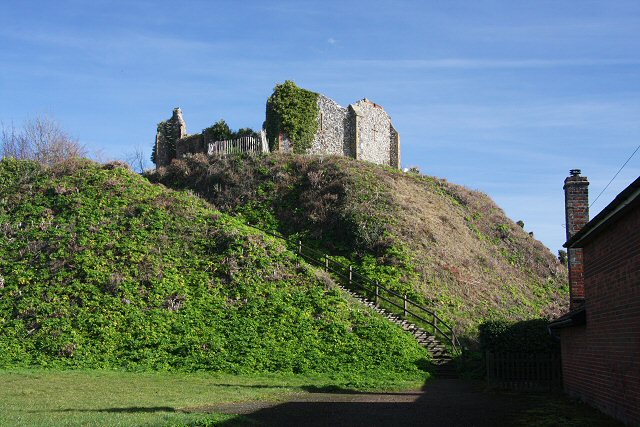
Haughley Castle exemplifies the typical Norman motte and bailey design, characterized by a large artificial mound (the motte) accompanied by an enclosed courtyard (the bailey). The motte is notably substantial, with a base approximately 210 feet (64 meters) wide. While early estimates suggested a height of around 80 feet (24 meters), more recent scholarship proposes a height closer to 40 feet (12 meters), still impressive for earthwork construction.
The bailey itself was rectangular, measuring roughly 390 feet (120 meters) by 300 feet (91 meters). Its main entrance was located on the western side, controlling access to the enclosed area. Both the motte and the bailey were surrounded by a deep ditch, which was filled with water from a nearby stream, creating a wet moat that enhanced the castle's defenses against attackers.
Archaeological evidence suggests that the motte may have supported a stone shell keep, a fortified stone wall enclosing the summit of the mound. Although the foundations of such a structure are no longer clearly visible, excavations have uncovered a separate circular foundation at the site of the keep tower, with walls exceeding eight feet in thickness. These remains testify to the formidable nature of the castle's central defensive tower.
The 2011 archaeological excavations revealed extensive foundational remains and numerous fragments of intricately carved and finely dressed stone. These findings indicate a high level of craftsmanship and suggest that parts of the castle were constructed with considerable attention to both strength and aesthetic detail.
In addition to the primary motte and bailey, there is evidence of an additional outer bailey that once enclosed the existing earthworks and the nearby village church. Over time, this outer bailey was filled in, reflecting changes in the castle's defensive strategy and the surrounding landscape.
Historical significance and preservation
The earthworks and remaining structures of Haughley Castle are regarded as some of the best-preserved examples of Norman military architecture in Suffolk and the wider East Anglia region. The site's large motte and well-defined bailey provide valuable insights into medieval fortification techniques and feudal military organization.
Interest in the castle's history and archaeology has persisted into modern times. The 2011 excavations significantly enhanced understanding of the site's layout and construction methods. In 2023, the local community marked the 850th anniversary of the 1173 siege with commemorative events that highlighted Haughley Castle's enduring historical importance.
Today, Haughley Castle is protected as a scheduled monument, ensuring the preservation of its earthworks and archaeological remains for future generations. Visitors to the site can observe the impressive motte, the outlines of the bailey, and the surviving foundations of the keep, all of which contribute to a tangible connection with England's Norman past.
Frequently asked questions (FAQ)
- When was Haughley Castle built and by whom?
- Haughley Castle was built in the late 11th century by Norman lord Hugh de Montfort shortly after the Norman Conquest of England.
- What type of castle is Haughley Castle?
- Haughley Castle is a Norman motte and bailey castle, featuring a large artificial mound (motte) and an enclosed courtyard (bailey).
- What happened to Haughley Castle during the 1173 rebellion?
- During the 1173 rebellion, Haughley Castle was besieged by rebel forces and deliberately set on fire, leaving it in ruins.
- Are there any visible remains of Haughley Castle today?
- Yes, visitors can see the large motte, outlines of the bailey, and the foundations of the keep tower, which remain visible at the site.
- Is Haughley Castle protected for its historical importance?
- Haughley Castle is a scheduled monument, ensuring its preservation as an important example of Norman military architecture in Suffolk.
Information
Website
Visit websiteSources & official resources
Verify the information above using these authoritative references.
Loading map...
Visitor reviews
No reviews yet. Been here? Write the first review and help other travelers!
Write the first reviewVisited this castle? Share your experience
Your review helps other travelers and adds first-hand knowledge to our encyclopedia.