Framlingham Castle
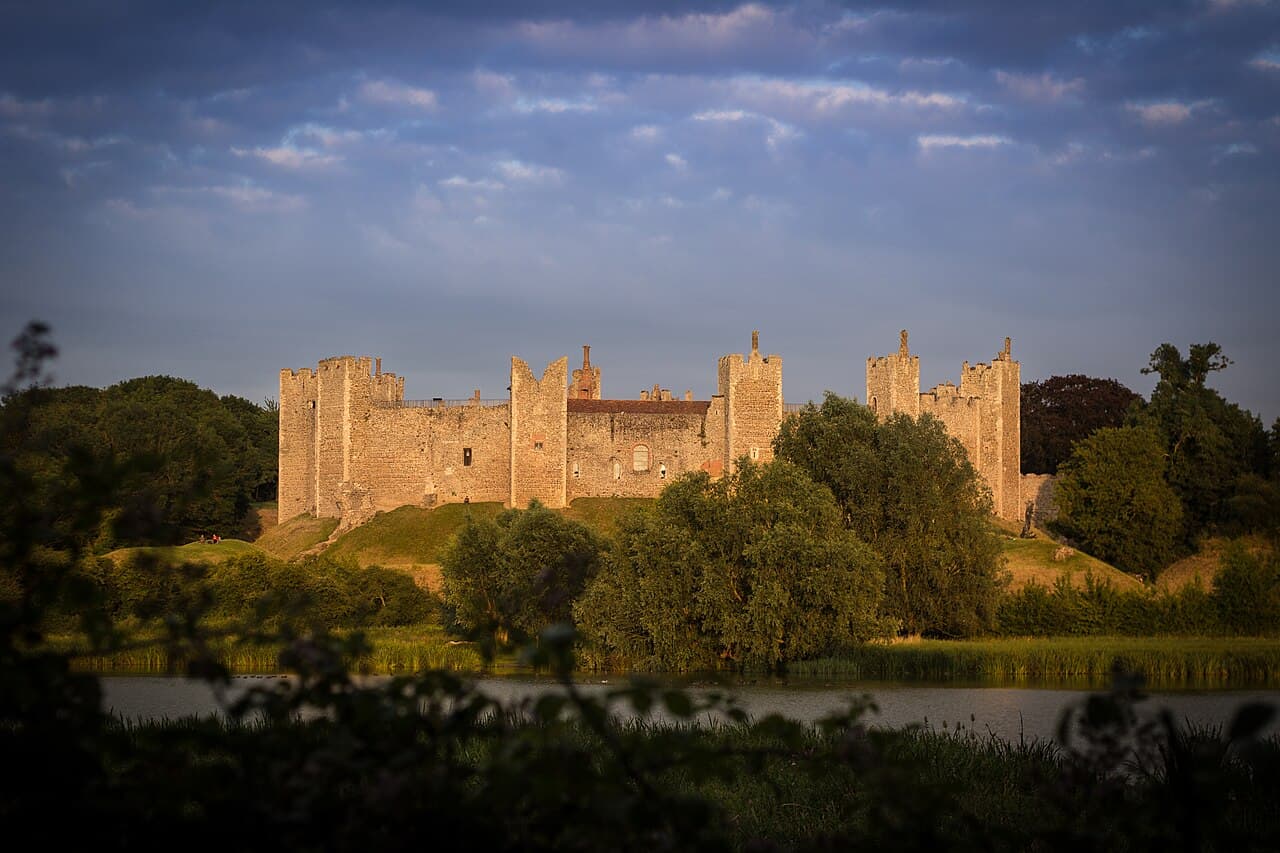
Framlingham Castle stands as an iconic example of a high medieval hill castle in Suffolk, England. Located in the market town of Framlingham, this fortress is renowned for its distinctive curtain wall defense system featuring thirteen tall mural towers and the notable absence of a central keep, a rarity among castles of its era. Built primarily from local flint and septaria stone, the castle's massive walls and towers form a roughly circular enclosure that dominates the surrounding Suffolk countryside.
The castle's origins trace back to a Norman motte and bailey or ringwork structure mentioned in 1148, initially owned by the powerful Bigod family. This early fortification was destroyed in 1174 on the orders of King Henry II after the Bigods' revolt. Subsequently, Roger Bigod, 2nd Earl of Norfolk, rebuilt the castle between 1189 and 1213, introducing the innovative design that replaced the traditional keep with a formidable curtain wall and multiple towers, enhancing its defensive capabilities.
Architectural design and defensive features
Framlingham Castle's design is exceptional for the early 13th century due to its lack of a central keep, instead relying on a strong curtain wall approximately 10.5 meters high and 2.3 meters thick, encircled by thirteen square mural towers standing about 14.3 meters tall. These towers have open backs, facilitating easy movement of defenders along the wall walk that crowns the walls and towers. The Western Tower uniquely projects beyond the curtain wall and protected the postern gate, with its basement later converted into a prison.
Surrounding the castle was a deep ditch, visible today as earthworks, which served as a formidable obstacle to attackers. Although Framlingham Castle never had a water-filled moat, it was strategically positioned adjacent to the Castle Mere, a natural lake and wetland formed approximately 3,000 years ago, adding a natural defensive barrier. The castle's approach was carefully designed to impress visitors, passing through ornamental gardens and the Prison Tower gate, emphasizing its dual role as a military stronghold and a symbol of noble prestige.
A clever defensive feature was the use of wooden bridges spanning gaps in the stone wall walk. These bridges could be removed or destroyed to trap attackers on the walls, leaving them vulnerable to defenders' arrows. This architectural ingenuity highlights the castle's advanced military planning for its time.
Historical significance and ownership timeline
The castle's history is deeply intertwined with the fortunes of the Bigod family, who were Earls of Norfolk. After the destruction of the original Norman castle, Roger Bigod rebuilt Framlingham Castle, which was completed in 1213. During the First Barons' War (1215–1216), the castle was seized by King John after a brief siege but was later returned to the Bigods.
In the late 13th century, the 5th Earl of Norfolk, also named Roger Bigod, undertook extensive renovations, enhancing the castle’s luxury and style. However, due to debts owed to King Edward I, the castle was eventually seized and passed to the Crown upon Roger's death in 1306. Subsequently, the castle changed hands among several noble families, including the Uffords, Mowbrays, and Howards, each contributing to its architectural evolution.
The Howard family modernized the castle in the 15th and 16th centuries, adding fashionable brickwork and decorative chimneys, inspired by grand Tudor architecture such as Hampton Court Palace. The castle served as the main seat for the Dukes of Norfolk and was richly furnished, especially under Thomas Howard, 2nd Duke of Norfolk, who used it as a retirement residence.
Framingham castle and the tudor era
A pivotal moment in Framlingham Castle's history was in 1553, when Mary Tudor gathered her forces at the castle before successfully claiming the English throne. After the death of King Edward VI, Mary’s claim was contested by supporters of Lady Jane Grey. Mary’s refuge in Framlingham and the widespread support she garnered there were crucial in her eventual coronation as Queen of England. This event underscores the castle's political as well as military importance.
Following this period, the castle's military significance waned. By the late 16th century, it was repurposed as a prison, notably holding Catholic recusants. Its decline accelerated in the early 17th century, and by 1613 it was largely derelict.
Post-medieval uses and preservation
In 1636, the castle passed to Pembroke College, Cambridge, with instructions to demolish the internal buildings and establish a poorhouse, which operated intermittently until 1839. Over the centuries, Framlingham Castle served various civic functions, including as a drill hall, county court, and local jail. During World War II, it was incorporated into British defenses against potential invasion, with additions such as a concrete pillbox and temporary huts.
Today, Framlingham Castle is managed by English Heritage and is protected as a Grade I listed building and scheduled monument. Visitors can explore the extensive wall walk, enjoy panoramic views of the surrounding landscape, and learn about the castle’s rich history through the on-site museum housed in the former poorhouse, which stands on the foundations of the medieval Great Hall.
Architectural remains and visitor experience
The castle’s surviving fabric includes the formidable curtain walls and towers, the gatehouse remodeled in the 16th century, and the foundations of the original chapel and stone hall. The Postern Gate leads to the Prison Tower, also known as the Western Tower, which was adapted in Tudor times with larger windows.
The castle’s interior buildings have largely disappeared, but the poorhouse and its associated wings preserve elements of the medieval and post-medieval phases. Notably, the castle features decorative Tudor brick chimneys atop many towers, which served purely ornamental purposes rather than functioning as flues.
Visitors today can enjoy walking the entire circuit of the curtain walls, crossing wooden bridges that span gaps in the stone wall walk, a reminder of the castle’s ingenious defensive design. The adjacent Castle Mere provides a striking natural backdrop, enhancing the castle’s picturesque setting.
The castle’s landscape and water features
The castle is set beside the Castle Mere, a deep lake and wetland that dates back thousands of years. In the 16th century, two larger artificial lakes with wharfs were created, serving both defensive and aesthetic functions. These water features reflected the castle’s image and contributed to its landscape grandeur, offering a scenic contrast to the stone fortress.
Cultural heritage and significance
Framlingham Castle remains a powerful symbol of medieval military architecture and noble power in England. Its unique design without a central keep, extensive curtain walls, and numerous towers demonstrate innovative defensive strategies. The castle’s role in key historical events, such as the First Barons’ War and Mary Tudor’s ascent to the throne, highlight its political importance.
As a well-preserved ruin managed by English Heritage, Framlingham Castle attracts visitors interested in medieval history, architecture, and English heritage. Its panoramic views, rich history, and dramatic setting beside the Castle Mere make it a must-visit site in Suffolk.
Frequently asked questions (FAQ)
- How do I get to Framlingham Castle?
- Framlingham Castle is located on Church Street in Framlingham, United Kingdom. You can reach the castle by car, with parking available nearby, or by taking public transport to the Framlingham bus station, which is a short walk away.
- What is the historical significance of Framlingham Castle?
- Framlingham Castle dates back to the 12th century and played a crucial role in the history of Suffolk, particularly during the English Civil War. It is known for its association with Mary Tudor, who used the castle as a base in her claim to the throne.
- When was Framlingham Castle built?
- Construction of Framlingham Castle began in 1148, with significant developments occurring in the following centuries. The castle was originally built as a defensive fortress and has undergone various modifications throughout its history.
- Can I access all areas of Framlingham Castle?
- While many areas of Framlingham Castle are accessible to visitors, some sections may have restricted access due to preservation efforts. The main exhibits and the castle grounds are open to explore, allowing visitors to appreciate its rich history and stunning architecture.
- Why is Framlingham Castle popular with tourists?
- Framlingham Castle attracts visitors for its impressive architecture, picturesque views, and historical significance. The castle's well-preserved structure and engaging exhibitions make it a fascinating destination for history enthusiasts and families alike.
- Is it possible to visit Framlingham Castle year-round?
- Yes, Framlingham Castle is open to visitors throughout the year, although opening hours may vary seasonally. It is advisable to check the official website for the most current information on visiting times before planning your trip.
- What are the ticket prices for Framlingham Castle?
- Tickets for Framlingham Castle are reasonably priced, with discounts available for children, seniors, and families. It is recommended to purchase tickets online in advance to avoid queues and ensure availability.
- What is the best time to visit Framlingham Castle?
- The best time to visit Framlingham Castle is during the spring and early autumn when the weather is mild and the gardens are in bloom. Weekdays are typically less crowded, allowing for a more enjoyable experience.
- Are there any nearby attractions to visit while at Framlingham Castle?
- Yes, there are several nearby attractions, including the beautiful Framlingham Mere and the charming village of Framlingham itself, which offers cafes, shops, and additional historical sites. Combining your castle visit with these attractions makes for a delightful day out.
Photo gallery

Information
Website
Visit websiteSources & official resources
Verify the information above using these authoritative references.
Loading map...
Visitor reviews
No reviews yet. Been here? Write the first review and help other travelers!
Write the first reviewVisited this castle? Share your experience
Your review helps other travelers and adds first-hand knowledge to our encyclopedia.