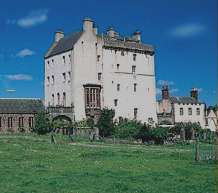
Hatton Castle
Hatton Castle, located near Turriff in Scotland, is a remarkable example of a 16th-century castellated mansion with a complex history spanning several centuries. Originally known as Balquholly Castle, its origins trace back to the early 1500s, with significant construction commissioned in 1575 by Laurence, fourth Lord Oliphant (1527–1593). The castle stands on the lower part of Hatton Hill, south of Newtyle, on lands granted to Sir William Olifard by Robert the Bruce in 1317, indicating the site's longstanding strategic and familial importance.
Historical origins and Oliphant family legacy
The castle's early history is deeply intertwined with the Oliphant family, one of Scotland's notable noble lineages. The original castle built in the late 16th century featured architectural innovations uncommon for its time, such as a scale and platt staircase integrated into the original structure, a feature typically reserved for larger, more grandiose buildings. Following the Jacobite rising of 1715, the castle was de-roofed around 1720, leading to its decline and eventual replacement by the Italian-style Belmont Castle in Meigle, which itself now serves as a Church of Scotland residential home.
19th-century reconstruction and architectural features
In the early 19th century, the estate underwent a significant transformation when Alexander Duff of Hatton acquired the property in 1709. Between 1812 and 1814, the present castellated mansion was constructed, incorporating sections of the ancient building and adopting the name Hatton Castle. This reconstruction embraced a romantic castellated style with defensive features such as round towers at each corner, emphasizing both aesthetic appeal and historical continuity.
The mansion is built of stone and rises to three storeys plus a basement and attic. The basement houses a wine cellar and a gun room, reflecting the estate's historical function and lifestyle of its occupants. The ground floor features a hall with a glass cupola that illuminates a stone staircase leading to the upper floors. Residential accommodations include two bedrooms on the first floor, seven bedrooms on the second floor, and in the attic, four additional bedrooms, a bathroom, and storage space.
Architectural and landscape significance
Hatton Castle's restoration was undertaken with great care to preserve its historical charm, including the use of hand-made glass from Edinburgh in its leaded windows. The castle's gardens are recognized for their exceptional design and historical value, being listed in the Inventory of Gardens and Designed Landscapes in Scotland. These gardens contribute significantly to the estate's cultural heritage, assessed as outstanding for both their historical context and architectural landscaping.
Later history and current status
After falling into disrepair and becoming overgrown with ivy, Hatton Castle was eventually sold by the Kinpurnie Estate and underwent faithful restoration led by members of the Oliphant family, including Roderick Oliphant of Oliphant, yr and his elder brother Richard Oliphant of that Ilk, the 34th chief. Their efforts ensured that the castle retained much of its original 16th-century character while adapting it for modern habitation.
Today, Hatton Castle remains a private family home, with ongoing restoration and maintenance preserving its architectural integrity and historical significance. Its combination of early modern Scottish castle features and 19th-century romantic reconstruction make it a unique monument reflecting centuries of Scottish noble history and architectural evolution.
Architectural details and unique features
Hatton Castle is notable for its round corner towers, which provide a fortified appearance typical of Scottish castles, although primarily decorative in the 19th-century mansion. The integration of the scale and platt staircase from the 16th-century original structure is a rare feature, underscoring the castle's blend of defensive and residential design elements.
The castle's stone construction, multiple floors, and inclusion of specialized rooms such as a gun room and wine cellar reflect the lifestyle and status of its historic occupants. The glass cupola above the main hall is an architectural highlight, allowing natural light to enhance the interior space and the grand stone staircase.
Gardens and landscape design
The gardens surrounding Hatton Castle are an integral part of its heritage. Their inclusion in the Inventory of Gardens and Designed Landscapes in Scotland highlights their historical and architectural importance. The landscaping complements the castle's romantic style, featuring carefully planned layouts that enhance the estate's visual appeal and historical ambiance.
Historical inhabitants and usage
Beyond the Oliphant family, the castle has housed a variety of occupants, including at least one bishop, indicating its significance as a residence of status and influence. The transition from a defensive stronghold to a romantic mansion and family home illustrates the changing functions of Scottish castles over time.
Information
Loading map...
Visitor reviews
No reviews yet. Been here? Write the first review and help other travelers!
Write the first reviewVisited this castle? Share your experience
Your review helps other travelers and adds first-hand knowledge to our encyclopedia.