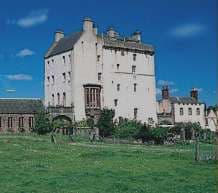
Delgatie Castle
Delgatie Castle stands as a notable historic fortress near Turriff in Aberdeenshire, Scotland. The site has hosted a castle since approximately 1030 AD, though the existing structure mainly dates from the late 16th century. The castle's origins reflect the turbulent medieval history of Scotland, with its ownership passing through important noble families and witnessing key historical events.
Historical background and ownership
The original castle on this site was established in the early medieval period, around 1030 AD. The current main structure was constructed between 1570 and 1579, during the Renaissance period in Scotland, incorporating defensive and domestic architectural elements typical of that era. The castle's ownership shifted notably after the Battle of Bannockburn in 1314, when it was confiscated from Henry de Beaumont, Earl of Buchan, due to his disgrace following the battle. Ownership was then granted to Clan Hay, who later became the Earls of Erroll, a family closely associated with the castle's history and development.
Architectural features and expansions
Delgatie Castle is characterized by its white-harled, five-storey tower, which forms the central keep. This tower house design is typical of Scottish castles from the late medieval to Renaissance periods, combining residential comfort with defensive capabilities. The castle also includes an adjoining house and two additional wings added in the 18th century, specifically in 1743, which expanded the living and ceremonial spaces.
One of the castle's remarkable architectural features is its very wide turnpike stair, a spiral staircase that allowed access to the upper floors while serving as a defensive element. Inside, several rooms retain their 16th-century painted ceilings, which are significant examples of period decoration and craftsmanship. The castle walls and chambers display the Hay family arms, prominently featuring the emblem of three cattle yokes. This symbol commemorates a local legend involving a farmer and his two sons who played a crucial role in defeating a Danish raiding party at nearby Cruden Bay.
The chapel and later additions
The addition of a chapel in 1743 reflects the castle's evolution from a primarily defensive structure to a more comfortable country residence. This chapel provided a private place of worship for the castle's inhabitants, aligning with the period's architectural trends of integrating religious spaces into noble homes.
Notable historical events and guests
Mary, Queen of Scots is one of the castle's most famous visitors. She stayed at Delgatie Castle in 1562 following the Battle of Corrichie, an event that marked a significant moment in Scottish history. The castle's connection to such a prominent figure underscores its importance in the region during the 16th century.
Legends and ghost stories
Delgatie Castle is reputed to be haunted, a common feature among many Scottish castles. During the Second World War, soldiers stationed at the castle reported sightings of a ghostly red-haired figure, believed to be Alexander Hay. According to the castle's information boards, largely written by Captain Hay who restored the castle in the 1950s, the ghost was first seen after the discovery of a body bricked up in a priest hole. These stories contribute to the castle's mystique and attract visitors interested in paranormal history.
Current status and visitor information
Today, Delgatie Castle and its gardens are owned and managed by the Delgatie Castle Trust. The castle, its grounds, and an on-site café are open to the public during the summer months, offering visitors a chance to explore the historic interiors, including the painted ceilings and family heraldry. Additionally, several suites within the castle and estate cottages are available for rent, providing a unique accommodation experience.
The estate also features a popular fishing site along the river that runs through the grounds, adding recreational appeal to the historic setting. The combination of architectural heritage, historical significance, and natural beauty makes Delgatie Castle a valued cultural landmark in Aberdeenshire.
Frequently asked questions (FAQ)
- How do I get to Delgatie Castle?
- Delgatie Castle is located near Turriff in Aberdeenshire, Scotland. You can reach it by car via the A947 road, and there is ample parking available on-site. Public transport options may be limited, so driving is recommended for convenience.
- What is the historical significance of Delgatie Castle?
- Delgatie Castle dates back to the 13th century and is rich in history, having been home to the Seton family for many generations. It showcases elements of Scottish medieval architecture and has played a significant role in local history, including connections to various historical events and figures. Visitors can explore its fascinating past through guided tours.
- When was Delgatie Castle built?
- Delgatie Castle was originally constructed in the early 13th century, making it one of the oldest castles in Scotland. Over the centuries, it has undergone various renovations and extensions, reflecting the architectural styles of different periods. Today, it remains a well-preserved example of medieval fortifications.
- Can I visit Delgatie Castle year-round?
- Yes, Delgatie Castle is open to visitors throughout the year, although opening times may vary by season. It is advisable to check the official website for the latest information on opening hours and any special events that may affect access. Guided tours are available, providing an in-depth look at the castle's history.
- Why is Delgatie Castle considered an architectural gem?
- Delgatie Castle features a unique combination of medieval and 17th-century architecture, including its impressive tower house and surrounding gardens. The structure showcases traditional Scottish building techniques and materials, making it a prime example of the region's architectural heritage. Visitors can admire its intricate stonework and historical features during their tour.
- Is it possible to host events at Delgatie Castle?
- Yes, Delgatie Castle offers the option to host various events, including weddings and private gatherings. The castle provides a stunning backdrop for special occasions, with facilities that can accommodate both small and large groups. Interested parties should contact the castle management for further details and to discuss arrangements.
- What are the ticket prices for visiting Delgatie Castle?
- Ticket prices for Delgatie Castle are generally affordable, with discounts available for children, seniors, and families. Admission fees help support the maintenance and preservation of the castle. Be sure to check the official website for the most current pricing information and any special promotions.
- What is the best time to visit Delgatie Castle?
- The best time to visit Delgatie Castle is during the spring and summer months when the weather is more favorable and the gardens are in full bloom. This is also when many special events and guided tours take place. However, the castle can be visited year-round, with each season offering its own unique charm.
- Are there any nearby attractions to Delgatie Castle?
- Yes, there are several attractions near Delgatie Castle, including beautiful countryside walks and other historical sites. The town of Turriff also offers shops, cafes, and local culture to explore. Visitors can easily spend a day enjoying both the castle and the surrounding area.
Photo gallery

Photo by The photographer was probably (but not definitely) User:Topbanana or a sibling, parent or friend of his.•Public domain
Information
Website
Visit websiteSources & official resources
Verify the information above using these authoritative references.
Loading map...
Visitor reviews
No reviews yet. Been here? Write the first review and help other travelers!
Write the first reviewVisited this castle? Share your experience
Your review helps other travelers and adds first-hand knowledge to our encyclopedia.



