Hasistejn Castle
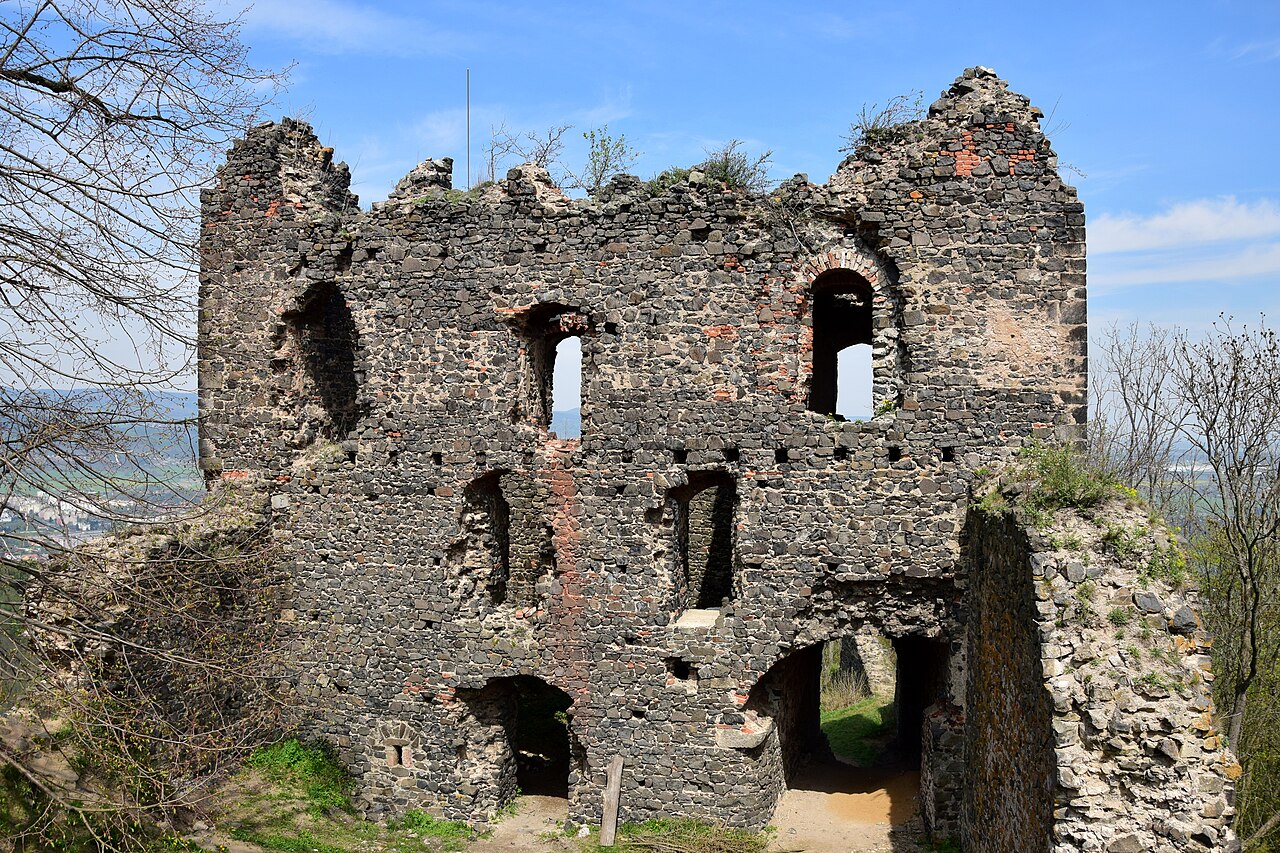
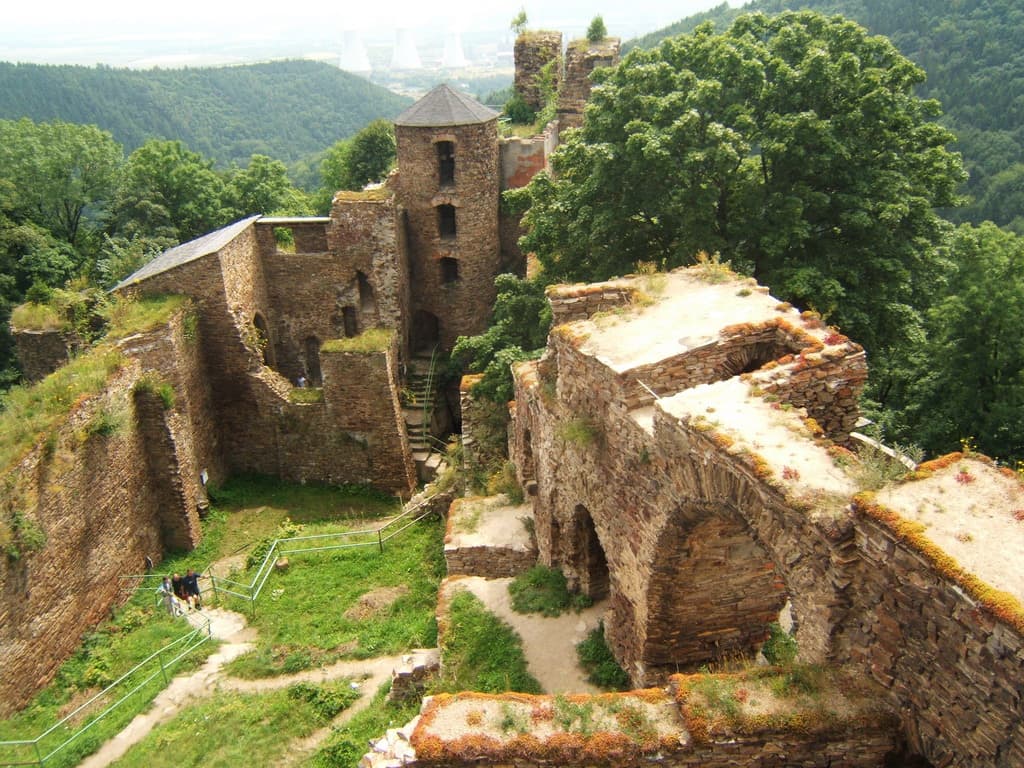
Hasištejn Castle (also known as Burg Hassenstein) stands as a remarkable example of a late medieval hill castle located near the towns of Kadaň, Klášterec nad Ohří, and Chomutov in the Czech Republic. Founded in the 14th century, this castle was strategically built to guard the important trade and military route from Prague to Saxony. Its enduring ruins, including a large bergfried tower and remnants of fortified walls, offer valuable insights into medieval defensive architecture and the cultural history of the region.
The castle's origins are tied to the political and military needs of the Bohemian kingdom during the early 1300s. It was likely constructed between the 1320s and 1330s, possibly initiated by the local Šumburk noble family or directly under the auspices of King John of Bohemia. Documentary evidence first mentions Hasištejn Castle in the 1348 legal code known as the Majestas Carolina, which lists it among royal castles that could be temporarily pledged. This early record underscores the castle's importance as a royal asset and border stronghold in the Ore Mountains region.
Historical significance and ownership
The castle's history is marked by shifting ownership and political upheaval, reflecting the turbulent nature of Bohemia in the late medieval period. Initially controlled by the Šumburk family, the castle was seized by King Wenceslaus IV (Václav IV of Luxembourg) in 1392 amid regional conflicts. Following a siege in 1418, it was granted to Mikuláš Chudý of Lobkowic, marking the beginning of the Lobkowic family's long association with the site.
One of the most notable residents was Bohuslav Hasištejnský z Lobkovic, a Renaissance humanist, poet, and traveler who lived in the castle from 1503 until his death in 1510. Bohuslav transformed the castle into a cultural hub, amassing a vast private library of over 650 volumes. This collection attracted scholars and intellectuals from across Europe, including prominent figures such as Martin Luther and Philipp Melanchthon, emphasizing Hasištejn Castle's role as a center of Renaissance humanism in Bohemia.
After Bohuslav's death, the castle gradually declined. It suffered a damaging fire in 1560, which accelerated its deterioration. Over the following centuries, the castle changed hands multiple times, including ownership by Emperor Rudolf II and the Štampach family. The Bohemian Revolt and subsequent royal confiscations led to its abandonment by the early 17th century, with descriptions from 1622 already referring to it as desolate.
Architectural features and fortifications
Bergfried tower and defensive structures
The centerpiece of Hasištejn Castle is its imposing bergfried tower, a typical feature of Central European medieval castles. Measuring 8.7 meters in diameter with walls up to 3.5 meters thick, the tower was designed as a last refuge and lookout point. Originally, its entrance was elevated about 6.5 meters above ground level, accessible only by ladder, enhancing its defensive capability. The tower's top was modified in the 16th century to include thickened walls with eight embrasures for improved defense against artillery and infantry attacks.
At the bergfried's base lies a carved cistern, hewn directly from bedrock to collect and store water, ensuring the castle's self-sufficiency during sieges. The addition of a spiral oak staircase during 19th-century restorations facilitated visitor access to the tower, which today serves as a lookout platform offering panoramic views of the surrounding landscape.
Castle layout and fortifications
Hasištejn Castle is situated on an oval-shaped plateau overlooking a steep valley formed by the Prunéřovský stream. Its fortifications are primarily constructed from local metamorphic rock, valued for its durability. The castle's defensive system includes reinforced curtain walls, particularly on the northern and eastern flanks, and a barbican featuring a rounded tower. While this tower lacks gun ports, it was defended by a wall-walk allowing defenders to patrol and repel attackers.
Following the 1418 siege, the castle was expanded with a spacious courtyard built above vaulted cellars and protected by a new square gate accessed via a neck ditch. The barbican's western wall was strengthened with two delicate bastions, enhancing the castle's defensive perimeter. Late Gothic modifications introduced an outer wall with a tower gate and a square battery tower, both oriented inward, guarded by an additional ditch. A forward bastion on a nearby hill, with a sharp projecting tip, was constructed to shield the castle from artillery fire, reflecting advancements in military technology during the period.
Palaces and chapel within the castle
Within the castle's core lie the ruins of two palaces. The older medieval Gothic palace features a stair tower and an adjacent chapel dating from the second quarter of the 14th century. This chapel measures approximately 8.2 by 3.9 meters internally and is divided into a nave and chancel by a pointed triumphal arch. Its cross-ribbed vault rests on slender, pyramid-shaped consoles, representing an early example of Gothic architecture in the region.
The younger late Gothic palace is located beneath the bergfried, with portions of its eastern wall and decorative oriels still preserved. The chapel's western wall underwent reconstruction in the 19th century, reusing original Gothic elements. Historically, the chapel contained a gallery or emporium supported by a pointed barrel vault, accessible via a staircase built into the southern wall.
Archaeological findings and preservation efforts
Archaeological excavations at Hasištejn Castle have uncovered fragments of medieval pottery but no ceramics conclusively dated to the 13th century, supporting the castle's 14th-century origins. Remains of two outer bailey buildings were identified, believed to have been destroyed during the 1418 siege by fire.
The castle experienced partial restoration in the late 19th century under Emanuel Karsch, who also added a guesthouse at the site. More recent preservation efforts in the late 20th century included experimental masonry repairs in 1998 and 1999 to stabilize the ruins. Today, the castle is a protected heritage site, with its bergfried tower serving as a lookout and the ruins of palaces and fortifications accessible to visitors. The site retains much of its medieval character despite over five centuries of decline.
Cultural legacy and notable visitors
Hasištejn Castle's cultural significance extends beyond its architectural and military history. The castle's association with Bohuslav Hasištejnský z Lobkovic established it as a beacon of Renaissance humanism in Bohemia. The presence of his extensive library attracted scholars and humanists, including Martin Luther and Philipp Melanchthon, linking the castle to important intellectual movements of the period.
The castle also inspired later cultural figures such as the poet Johann Wolfgang von Goethe, who visited the ruins in 1810. Its evocative ruins have contributed to the romantic imagination of medieval castles in Central Europe, underscoring its enduring place in Czech cultural heritage.
Today, visitors to Hasištejn Castle can explore its dramatic ruins, climb the bergfried tower for expansive views, and appreciate the blend of medieval military architecture and Renaissance cultural history preserved within its walls.
Frequently asked questions (FAQ)
- What is the historical significance of Hasistejn Castle?
- Hasistejn Castle, built in the 13th century, served as a strategic fortification and residence for several noble families throughout its history. It played a crucial role in the region's defense and governance, reflecting the architectural styles and political dynamics of medieval Czechia.
- When was Hasistejn Castle built?
- Hasistejn Castle was originally constructed in the early 13th century, around 1250. Over the centuries, it underwent various renovations and expansions, showcasing a blend of Gothic and Renaissance architectural elements.
- Is it possible to visit Hasistejn Castle?
- Yes, visitors can explore Hasistejn Castle. The site is open to the public, allowing guests to wander through its historic halls and enjoy guided tours that provide insights into its rich history and architectural features.
- What are the opening hours for Hasistejn Castle?
- Hasistejn Castle typically opens from April to October, with visiting hours varying by season. It is advisable to check the official website for the most current opening times and any special events that may affect access.
- Can I purchase tickets in advance for Hasistejn Castle?
- Yes, tickets for Hasistejn Castle can often be purchased in advance through their official website or onsite. Booking in advance is recommended during peak tourist seasons to ensure availability and avoid long waiting times.
- What is the best time to visit Hasistejn Castle?
- The best time to visit Hasistejn Castle is during the late spring and early autumn months when the weather is mild and the surrounding landscape is beautiful. This period also coincides with various cultural events that enhance the visitor experience.
- Are there any nearby attractions to visit while at Hasistejn Castle?
- Yes, visitors to Hasistejn Castle can also explore nearby attractions such as the picturesque town of Chomutov, the beautiful forests of the Ore Mountains, and other historical sites in the region. These locations provide additional opportunities for sightseeing and outdoor activities.
- How accessible is Hasistejn Castle for visitors with disabilities?
- Hasistejn Castle has made efforts to improve accessibility for visitors with disabilities. While some areas may present challenges due to the castle's historical structure, there are designated paths and facilities to accommodate those with mobility issues.

Information
Website
Visit websiteSources & official resources
Verify the information above using these authoritative references.
Loading map...
Visitor reviews
No reviews yet. Been here? Write the first review and help other travelers!
Write the first reviewVisited this castle? Share your experience
Your review helps other travelers and adds first-hand knowledge to our encyclopedia.