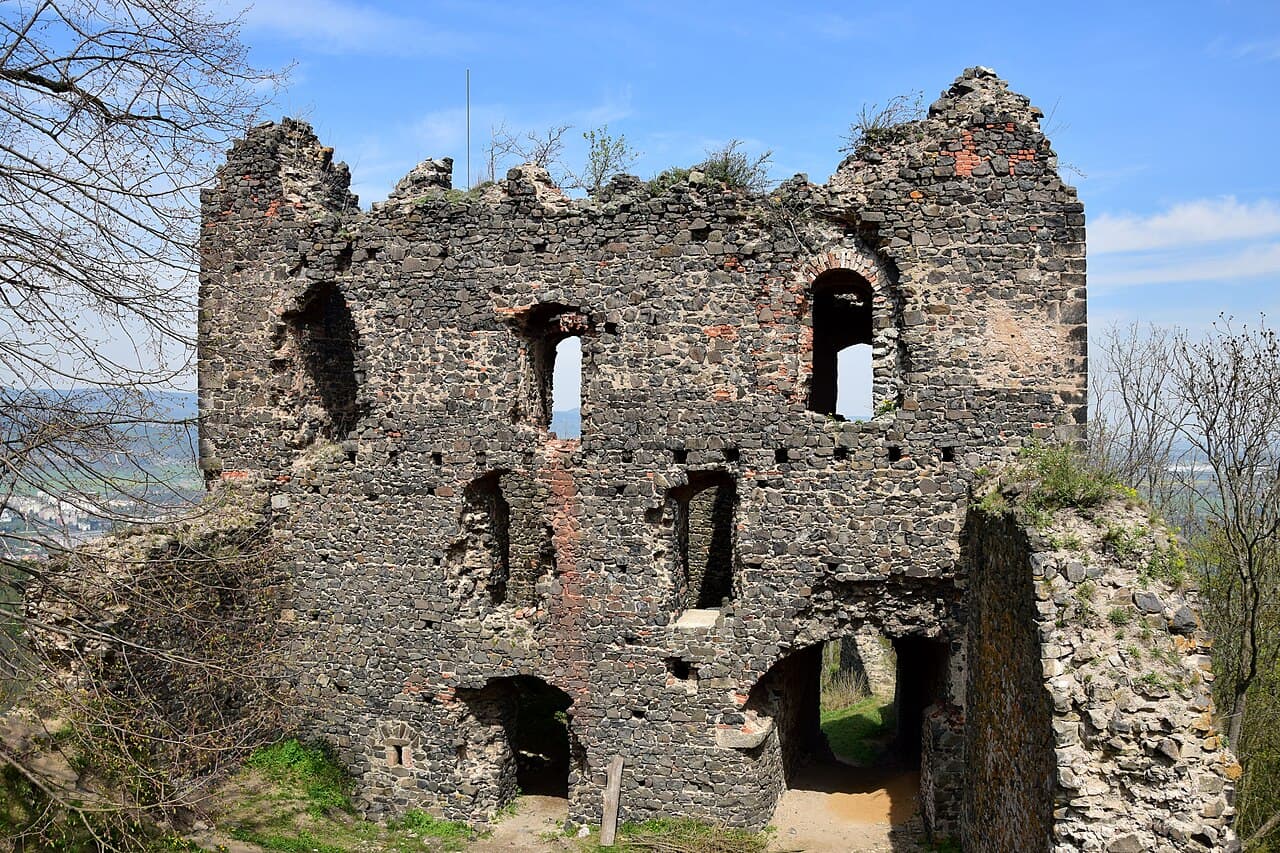
Egerberk Castle Ruins
Egerberk castle ruins stand as a significant historical and architectural monument near Klášterec nad Ohří in the Czech Republic. First documented in 1317, this late medieval Gothic hill castle offers a fascinating glimpse into the medieval noble life and defensive architecture of Bohemia. Built originally as a strategic fortress, it evolved over centuries into a noble residence before falling into gradual decline by the end of the 16th century.
Situated on a rocky spur of the Černý vrch hill, rising approximately 545 to 548 meters above sea level, the castle commands sweeping views over the Doupov Mountains. Its location was chosen for both defense and surveillance, typical of hill castles constructed in the late medieval period. The castle’s layout is characterized by two main palace buildings enclosed within robust defensive walls, reflecting the Gothic architectural emphasis on both fortification and residential comfort.
Early history and ownership
The earliest mention of Egerberk dates to 1317, identifying it as the residence of Vilém of Chýše and Egerberk, who was closely allied with John of Luxembourg. Vilém's association with the Luxembourg king underscores the castle’s importance within the political landscape of medieval Bohemia. Ownership soon passed to the nearby House of Šumburk, who expanded their holdings in the region by acquiring Egerberk.
In 1384, the castle became part of the property of the House of Škopek through Jindřich Škopek of Dubá, who initiated extensive reconstruction efforts. This phase marked a transition from purely military use toward a more comfortable noble residence, incorporating architectural enhancements typical of late Gothic style.
Architectural features and layout
Defensive structures
Egerberk’s defensive design includes a fan-shaped foregate with a small gate tower protecting the main entrance. This foregate was a strategic addition to delay and expose attackers. A bridge spanned a defensive ditch leading to a second gate tower, which was uniquely open on the castle-facing side to facilitate defense. Adjacent to this gate stood a guardhouse for sentries, and a hexagonal turret projected from the core wall, allowing defenders to cover multiple approach angles.
The castle was further protected by a parkán (outer ward) with a moat, parts of which remain visible today. A rock-hewn water reservoir carved into the saddle before the entrance provided a vital resource during sieges, ensuring water supply for inhabitants.
Palace buildings and residential spaces
The castle’s interior centers on two main palace buildings. The larger trapezoidal palace rises to three stone stories, with the ground floor serving as a passage and likely stable space. The first floor featured a large room with a stone window seat, while the second floor contained residential chambers divided by wooden partitions. One chamber included three windows and access to a garderobe (medieval toilet), while another housed a small oratory identified by its rib vaulting and an exterior oriel window.
The third floor held a spacious hall also equipped with a garderobe. The palace was heated by tiled stoves and roofed with wooden shingles, illustrating the blend of comfort and defense typical of late Gothic noble residences.
Next to the main palace, a semicircular palace or tower remains partially preserved. Originally, it featured a wooden gallery supported by beams and thickened walls—up to over four meters in thickness by the late 15th century—to withstand artillery fire. This adaptation reflects the evolving military technologies and the castle’s strategic importance during that era.
Historical significance and decline
Throughout the 15th century, Egerberk was a contested site amid regional power struggles. In 1449, Vilém of Šumburk forcefully occupied the castle, demonstrating its military and political value. Ownership shifted frequently, reflecting the turbulent history of Bohemian nobility and royal influence.
By the late 16th century, under Bohuslav Felix Hasištejnský of Lobkowicz, the castle ceased to function as a noble residence and was relegated to the status of a castellan’s seat. This change marked the beginning of its gradual abandonment and decline as its strategic relevance diminished.
In the 19th century, historian Otto Piper studied the ruins, and conservation efforts supported by the Austrian imperial house helped stabilize the site and improve access, preserving Egerberk as a cultural heritage monument.
Architectural details and surviving elements
Egerberk’s ruins offer valuable insight into Gothic castle architecture and medieval defensive strategies. The absence of a traditional tall bergfried or keep is unusual, with the castle instead relying on its palace buildings and curtain walls for defense.
Noteworthy features include the barrel-vaulted cellar in the economic building, used for storage, and the covered gallery that once circled the second courtyard at the second-floor level. Although much of the courtyard is now filled with collapsed masonry, the structural footprint reveals the castle’s complex spatial organization.
The surviving rib vaulting in the chapel windows and the oriel window on the residential floor highlight the artistic and architectural sophistication of the castle’s builders. The thickened walls of the semicircular tower illustrate adaptations to the introduction of artillery in late medieval warfare.
Visitor experience and cultural importance
Today, Egerberk stands as a well-known ruin attracting visitors interested in medieval history and architecture. Its elevated position offers panoramic views of the surrounding landscape, including the Doupov Mountains, enriching the visitor experience.
The site’s combination of military and residential architectural elements provides a tangible connection to the late medieval period in Bohemia. Preservation efforts ensure that Egerberk remains a valuable cultural and historical landmark, reflecting the region’s noble heritage and medieval fortification techniques.
Frequently asked questions (FAQ)
- How do I get to Egerberk castle ruins from Klášterec nad Ohří?
- Egerberk castle ruins are accessible by local hiking trails starting from Klášterec nad Ohří. The walk offers scenic views and takes approximately 1-2 hours depending on your pace.
- What is the best time of year to visit Egerberk castle ruins?
- The best time to visit Egerberk is during late spring to early autumn when the weather is mild and the trails are clear. Winter visits are possible but can be challenging due to snow and ice.
- Is there an entrance fee to visit Egerberk castle ruins?
- Visiting Egerberk castle ruins is free of charge, making it an accessible destination for history enthusiasts and casual tourists alike.
- What architectural style is Egerberk castle built in?
- Egerberk castle is primarily built in the Gothic architectural style, featuring characteristic elements such as rib vaulting and oriel windows typical of the late medieval period.
- Are the Egerberk castle ruins safe for visitors?
- The ruins are generally safe for visitors, but caution is advised due to uneven terrain and fallen masonry. It is recommended to wear sturdy footwear and follow marked paths.
Photo gallery

Information
Sources & official resources
Verify the information above using these authoritative references.
Loading map...
Visitor reviews
No reviews yet. Been here? Write the first review and help other travelers!
Write the first reviewVisited this castle? Share your experience
Your review helps other travelers and adds first-hand knowledge to our encyclopedia.



