Haselburg Castle
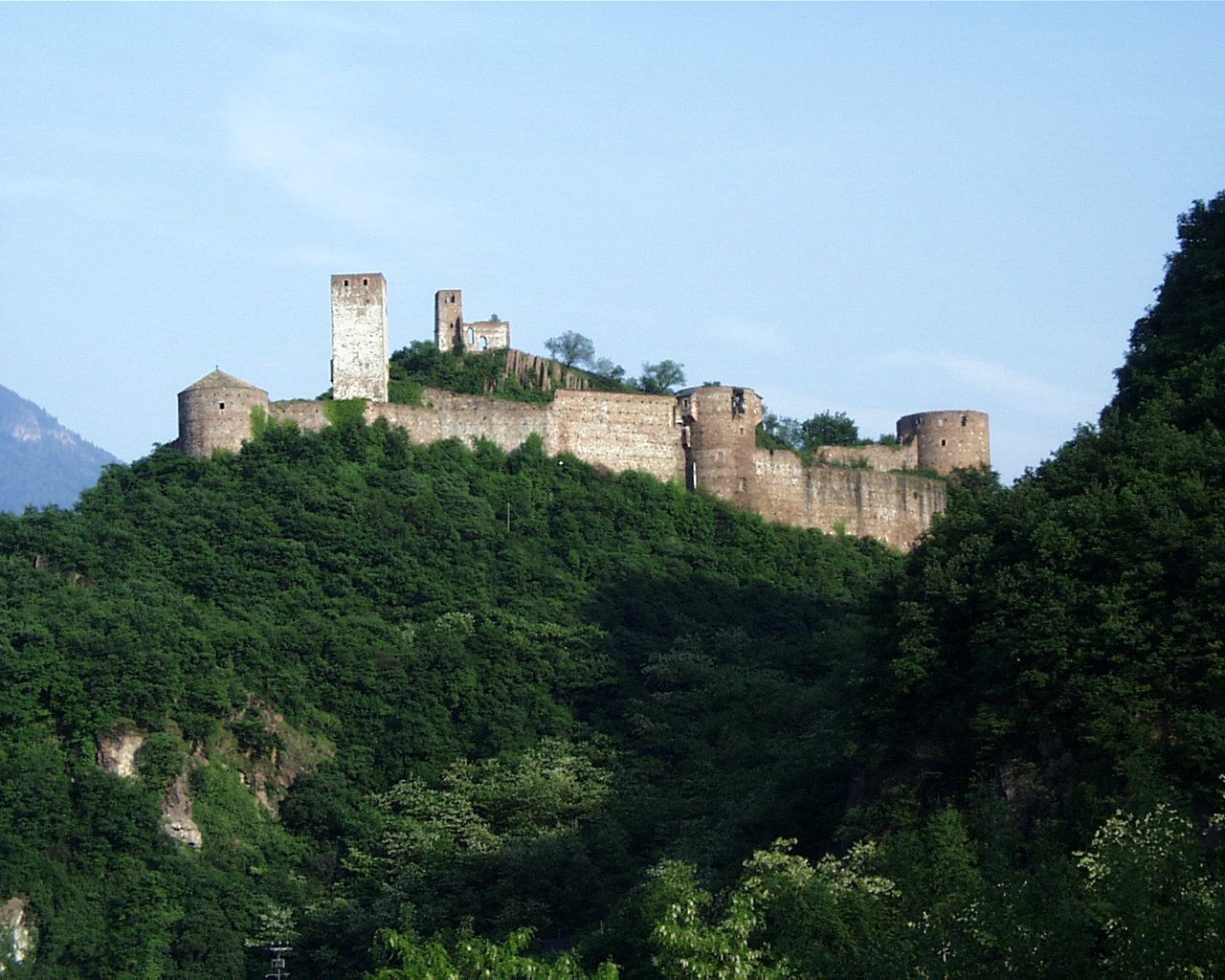
Haselburg Castle, also historically known as Castle Flavon, is a remarkable medieval hill castle perched on a rock spur overlooking the city of Bolzano in northern Italy. Its origins date back to the 12th century, when the noble Lords of Haselberg first established a fortress on this strategic site above the Haslach district. The castle’s position provided commanding views of the surrounding landscape, making it a vital stronghold in the region for centuries.
The initial construction featured a circular defensive wall on the east and south flanks, designed to protect the fortress from assault. The great hall was built directly above the porphyry rock base, highlighting the castle’s integration with the natural terrain. It is believed that a donjon or keep existed even in these early phases, serving as the fortified core of the castle.
Early history and political significance
The castle was originally built by the Lords of Haselberg, a noble family who took their name from the local Haslach area. These lords acted as ministeriales—appointed officials—under the authority of the Bishopric of Trent. They exercised judicial powers and lordship over the nearby Bolzano parish, making Haselburg a center of local governance and control.
In 1259, the Haselberg family sold their extensive rights and holdings to Count Meinhard II of Tyrol-Gorizia, a transaction that underscores the castle’s early importance in regional politics. Around the turn of the 14th century, Haselburg suffered significant destruction, likely due to military conflict or local strife, but was partially rebuilt thereafter.
Renaissance transformation and architectural evolution
The castle’s present form largely reflects the extensive renovations and expansions carried out between 1474 and 1541 under the direction of Leonhard II of Völs, a member of the Lords of Fiè family. These changes transformed Haselburg into a more complex and fortified residence, adapting to the evolving needs of defense and comfort during the Renaissance period.
During this time, Haselburg was remodeled into a three-winged complex, with the addition of a double arcade hall, a new great hall on the northern side, and a reinforced defensive wall. The interiors were richly decorated with Renaissance frescoes painted by the artist Bartlmä Dill Riemenschneider. These frescoes depicted busts of ancient emperors and generals, scenes from their lives, and mythological narratives centered on the myth of Apollo, reflecting the cultural sophistication of the castle’s inhabitants.
An artificial pond was also created on the hill above the castle, enhancing both the fortress’s defensive capabilities and its aesthetic appeal. This water feature is a notable example of Renaissance landscape modification.
Later history and ownership changes
In 1549, the nearby Schloss Ried was acquired by Christoph Küepacher, a councilor to Emperor Ferdinand I and secretary to Emperor Maximilian II. Christoph was ennobled as “von Khuepach,” and his son, Ferdinand von Khuepach, purchased Haselburg in 1590. The Küepacher family retained ownership until 1730.
The castle suffered a damaging fire during the 18th or 19th century, which led to partial ruin of its structure. Subsequent proprietors included the Counts of Sarnthein and later the Toggenburg family, who remain the current owners. Notably, in 1933, Haselburg was the birthplace of the National Socialist “Südtiroler Heimatfront,” later renamed the “Völkischer Kampfring Südtirols.”
Modern restoration and archaeological discoveries
Between 2001 and 2002, the castle underwent significant restoration under the guidance of architect Dietmar Dejori and the stewardship of the Toggenburg family. Restoration efforts focused on removing later overbuildings from the 18th century, exposing the original double arcades, and stabilizing the structure. The northern great hall, which had partially collapsed in 1880, was reconstructed to restore the castle’s original three-winged layout.
Archaeological excavations during this period uncovered 14th-century remains beneath the castle, particularly in an underground hall. These findings have provided valuable insight into the castle’s earlier medieval phases and construction techniques.
Architectural features and cultural significance
Haselburg Castle’s architecture is a blend of High Medieval origins and Renaissance modifications. The hilltop fortress is characterized by its three-winged layout, defensive walls, and the integration of natural rock formations into its design. The presence of a donjon in early phases suggests a traditional medieval keep structure, while the Renaissance era introduced more refined residential halls and artistic decoration.
The castle’s frescoes are among its most significant artistic treasures, illustrating imperial iconography and classical mythology. Although some were lost due to structural collapse and neglect, surviving works demonstrate the cultural aspirations of the castle’s Renaissance inhabitants.
Today, Haselburg serves as a congress center and hosts a restaurant, blending its historic ambiance with modern functionality. Its preservation and adaptive reuse highlight the importance of maintaining cultural heritage sites while allowing contemporary engagement.
Location and views
Situated above the Haslach district of Bolzano, Haselburg commands panoramic views of the city and the surrounding alpine landscape. Its elevated position was strategically chosen for defense and surveillance, typical of hill castles in the region.
Defensive elements
The castle’s original circular walls on vulnerable flanks and the later addition of a new defensive wall during the Renaissance reflect evolving military architecture. The artificial pond on the hilltop also contributed to the castle’s defenses by creating a natural barrier.
Cultural events and accessibility
Haselburg’s current use as a venue for seminars, congresses, and celebrations allows visitors to experience its historical atmosphere firsthand. The restoration has made the site accessible while preserving its architectural integrity.
Frequently asked questions (FAQ)
- How do I visit Haselburg Castle and what are the opening hours?
- Haselburg Castle is primarily used as a congress center and restaurant, with opening hours varying depending on events. Visitors can enjoy the restaurant and attend public events; it is advisable to check ahead for specific visiting times.
- What is the historical significance of Haselburg Castle?
- Haselburg Castle was built in the 12th century by the Lords of Haselberg and played a key role in regional governance under the Bishopric of Trent. It later became a Renaissance residence and witnessed important political changes, including ownership by the Küepacher family.
- What architectural styles are represented in Haselburg Castle?
- The castle exhibits a mix of High Medieval defensive architecture and Renaissance residential and decorative elements, including frescoes and a three-winged layout.
- Are there any notable artworks inside Haselburg Castle?
- Yes, the castle interior features Renaissance frescoes by Bartlmä Dill Riemenschneider depicting emperors, generals, and scenes from the myth of Apollo, although some frescoes were lost due to structural damage.
- Is Haselburg Castle accessible to visitors with mobility issues?
- Due to its hilltop location and historic structure, accessibility may be limited. Visitors with mobility concerns should inquire in advance about accommodations.
- What nearby attractions can I visit when at Haselburg Castle?
- Bolzano offers a rich cultural experience including museums, historic churches, and alpine scenery. Visitors to Haselburg can also explore the surrounding South Tyrol region known for its natural beauty.
Information
Opening hours
Varies; often open for events and restaurant service
Ticket prices
Varies; typically free access to restaurant and event spaces
Architect
Dietmar Dejori
Current owner
Toggenburg family
Website
Visit websiteSources & official resources
Verify the information above using these authoritative references.
Loading map...
Visitor reviews
No reviews yet. Been here? Write the first review and help other travelers!
Write the first reviewVisited this castle? Share your experience
Your review helps other travelers and adds first-hand knowledge to our encyclopedia.