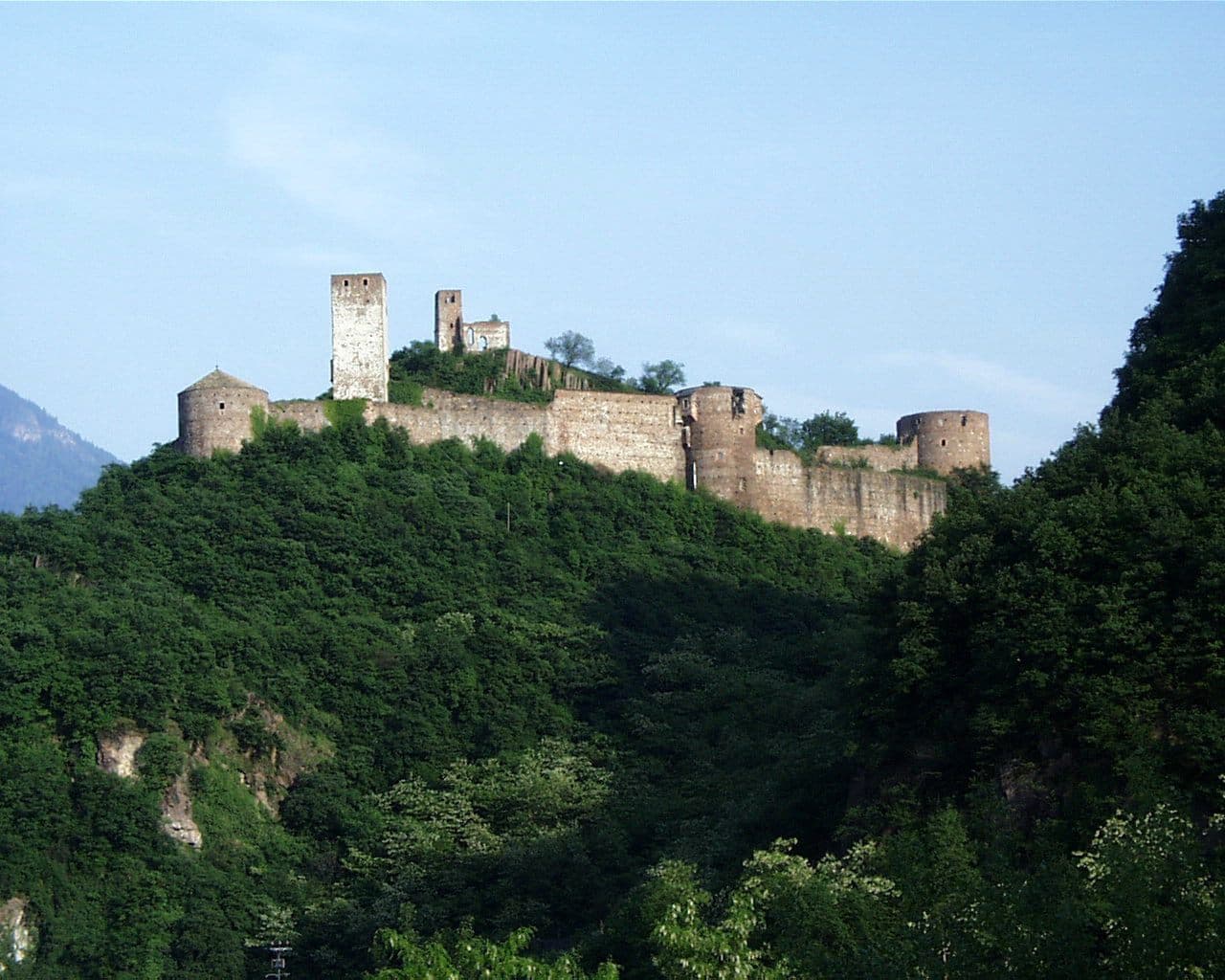
Sigmundskron Castle
Sigmundskron Castle, also known locally as Castel Sigmundskron or Castello Firmiano, is a prominent hill castle situated just south of the city of Bolzano in the South Tyrol province of Italy's Trentino-Alto Adige region. With origins dating back to at least the 10th century, this fortress stands as a testament to the region's complex medieval history and strategic importance.
The site was first documented in 945 AD under the name "Firmian" or "Formigar," serving as the principal stronghold of the Bishops of Trento within the county of Bolzano. Over the centuries, it evolved from a medieval episcopal seat into a formidable fortress, adapting to changing military technologies and political powers. The castle's commanding position on a porphyry rock overlooking the Adige valley allowed it to control key routes and assert dominance in the region.
Early history and medieval origins
The earliest fortifications at Sigmundskron date back to the early medieval period, with the castle initially known as "Formicaria," later shortened to "Formigar." In 1027, Emperor Conrad II transferred the fortress to the Prince-Bishop of Trento, cementing its role as a vital ecclesiastical and military seat. During the 12th century, the castle was granted to various ministerial families who adopted the noble name Firmian, including the Estrich, Hahn (Gallus), Häring, Kastraun, Ripp, and Zungel families, all prominent in the 13th century.
Architectural features from the medieval period
The castle's highest point features the ruins of a Romanesque chapel dedicated to Saints Blaise and Ulrich, which predates much of the fortress and contains traces of frescoes dating from around 1100 to the 14th century. This chapel is a rare surviving element of the early medieval religious architecture within the complex. Nearby stands the remains of the episcopal palace from the 12th century, highlighting the castle's dual role as both a religious and administrative center.
Late medieval transformation under duke sigismund
In 1370, the lower bailey of the castle passed to the Habsburgs, marking a shift in control that would culminate in significant architectural changes. Around 1473, Sigismund, Duke of Tyrol, purchased the entire complex. Recognizing the evolving nature of warfare, particularly the introduction of firearms, he undertook extensive renovations to transform Sigmundskron into a powerful late medieval fortress capable of withstanding artillery attacks.
These renovations included the addition of thick curtain walls, corner towers, and bastions known as rondells, designed to deflect cannon fire. The castle's defensive layout was modernized to reflect the latest military architectural trends of the 15th century. The fortress was renamed Sigmundskron, meaning "Sigismund's crown," a name first recorded in 1474.
Decline and changing ownership
Despite the extensive fortifications, financial difficulties forced Duke Sigismund to pledge the castle soon after its renovation. Over subsequent centuries, the castle gradually fell into disrepair. Ownership passed through several noble families, including the Counts of Wolkenstein in the late 18th century, the Counts of Sarnthein from 1807 to 1870, and the Counts of Toggenburg until 1994.
By the 17th century, much of the castle was already in ruins, with only fragments of the original medieval structure remaining, primarily around the chapel and the highest points of the site.
Political significance and 20th-century history
Sigmundskron Castle holds a prominent place in the modern political history of South Tyrol. In 1957, under the leadership of Silvius Magnago, the castle was the site of the largest protest rally in the region's history. More than 30,000 people gathered to demand autonomy and protest against the delayed implementation of the Paris Agreement, which had promised protections for the German-speaking population of South Tyrol following World War II.
This event cemented the castle's status as a symbol of South Tyrolean identity and resistance, making it a landmark not only of medieval heritage but also of contemporary cultural and political significance.
Modern restoration and the messner mountain museum
In 1976, partial restoration efforts began when a family converted part of the ruins into a restaurant, marking the start of renewed interest in preserving the site. In 1996, ownership of the castle transferred to the Autonomous Province of Bolzano, which initiated further conservation and development plans.
In 2003, the renowned South Tyrolean mountaineer Reinhold Messner was granted permission to establish the Messner Mountain Museum Firmian within the castle. The museum, which opened in 2006, occupies over 1,100 square meters and explores the relationship between humans and mountains through a rich collection of artifacts and exhibits from around the world.
The restoration and adaptation for the museum were overseen by architect Werner Tscholl, who skillfully integrated modern materials such as steel, glass, and iron into the historic fabric without compromising the castle's medieval character. This blend of old and new creates a unique visitor experience that honors both the site's heritage and its contemporary cultural role.
Archaeological discoveries
During the museum's construction in 2006, a Neolithic grave was uncovered beneath the castle, containing the skeletal remains of a woman estimated to be between 6,000 and 7,000 years old. This discovery highlights the site's long-standing human significance, extending far beyond its medieval origins.
Architectural highlights and visitor experience
Sigmundskron Castle is characterized by its expansive layout, perched on a rocky spur with commanding views over the Bolzano basin and the surrounding mountains. The fortress includes two main baileys separated by a large rock outcrop, with remnants of the Romanesque chapel and episcopal palace on the upper bailey.
The castle's defensive structures, including the White Tower (Weißer Turm), now house a museum dedicated to contemporary history. The site also features an arena used for conferences, exhibitions, and concerts, making it a vibrant cultural venue in addition to its historical significance.
Visitors can explore the extensive ruins, enjoy panoramic views, and experience the innovative museum exhibits that blend mountaineering history with the castle's medieval ambiance. Facilities such as parking and shuttle services enhance accessibility, while the nearby Meran–Bolzano highway tunnel underscores the castle's integration into the modern landscape.
Frequently asked questions (FAQ)
- How do I visit Sigmundskron Castle and the Messner Mountain Museum?
- Sigmundskron Castle is open to visitors daily, with the Messner Mountain Museum located within the castle grounds. It is accessible by car or public transport, with parking and shuttle services available nearby.
- What is the historical significance of Sigmundskron Castle?
- Sigmundskron Castle was a major stronghold for the Bishops of Trento and later transformed by Duke Sigismund of Tyrol into a fortress resistant to firearms. It is also a symbol of South Tyrolean autonomy, notably hosting a large protest rally in 1957.
- When was the castle originally built and who owned it?
- The castle dates back to at least 945 AD, initially serving as the seat of the Bishops of Trento. It passed through various noble families, including the Firmian counts and later the Habsburgs and Duke Sigismund of Tyrol.
- Can I see archaeological finds at Sigmundskron Castle?
- Yes, during the construction of the Messner Mountain Museum, a Neolithic grave was discovered on site, highlighting the area's ancient human history. Some artifacts and information are part of the museum exhibits.
- Is the castle suitable for families and cultural events?
- The castle offers a range of cultural events, including exhibitions and concerts in its arena. Its accessible layout and engaging museum exhibits make it suitable for families and visitors of all ages.

Information
Current owner
Autonomous Province of Bolzano
Website
Visit websiteAddress
Via Castel Firmiano 53, Italy
Sources & official resources
Verify the information above using these authoritative references.
Loading map...
Visitor reviews
No reviews yet. Been here? Write the first review and help other travelers!
Write the first reviewVisited this castle? Share your experience
Your review helps other travelers and adds first-hand knowledge to our encyclopedia.


