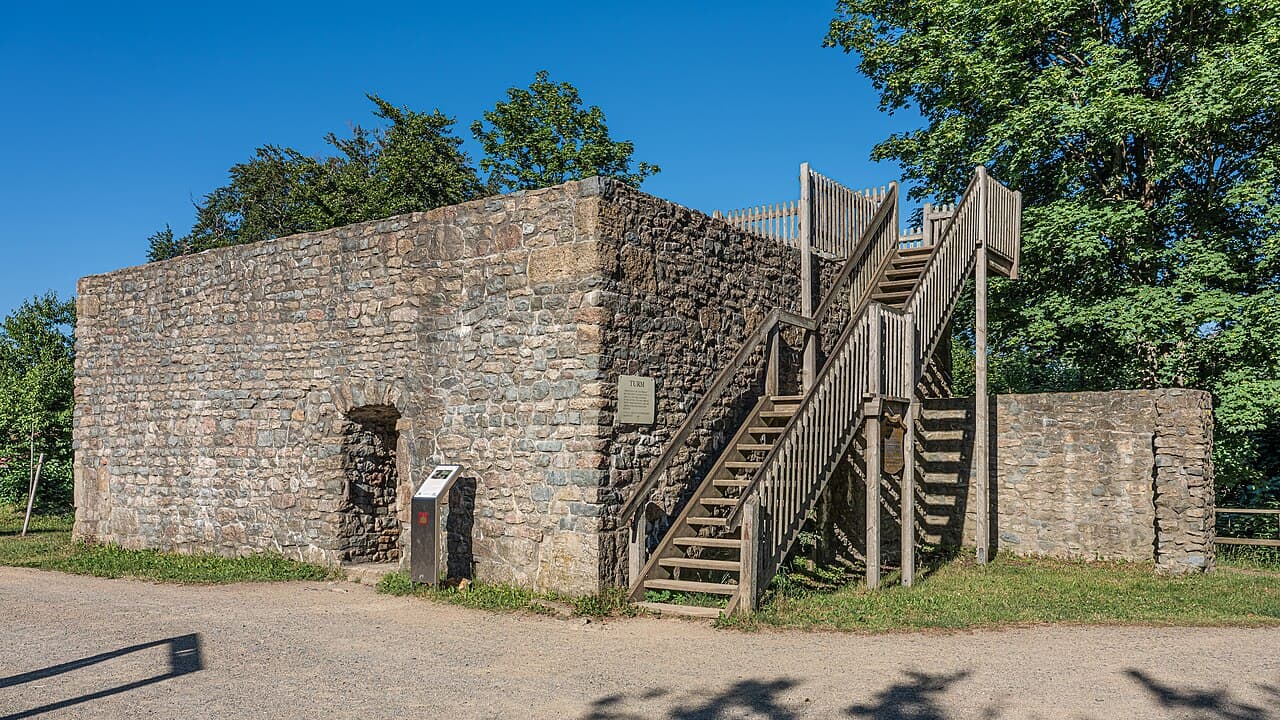
Harzburg
The Harzburg castle, also known as Große Harzburg or "Great Harz Castle," is a significant high medieval fortress located on the northwestern edge of the Harz mountain range, overlooking the spa town of Bad Harzburg in the Goslar District of Lower Saxony, Germany. Constructed between 1065 and 1068 by order of King Henry IV of Germany, the castle was originally intended as an imperial stronghold to assert royal authority in the region and control vital trade routes through the Harz mountains.
Early history and strategic importance
Harzburg was built during the turbulent 11th century, a period marked by power struggles between the German king and the Saxon nobility. The castle's location on a steep hill provided a commanding view over the surrounding landscape, making it a formidable defensive position. However, its prominence also made it a target during the Saxon Rebellion (1073–1075), when rebellious Saxons besieged and ultimately slighted (deliberately damaged) the fortress to weaken imperial control.
Reconstruction and imperial significance
Approximately a century after its initial destruction, the Harzburg was rebuilt under the auspices of Emperor Frederick Barbarossa and later enhanced by his Welf successor, Emperor Otto IV, who died at the castle in 1218. This reconstruction reaffirmed the castle's role as an imperial residence and military base, reflecting the ongoing importance of the Harz region in medieval German politics. The rebuilt castle featured robust stone walls, defensive towers, and a deep well, elements typical of high medieval hill castles.
Architectural features and layout
Though now mostly in ruins, archaeological studies and remaining structures indicate that Harzburg was a classic hill castle with a well-planned defensive layout. The castle was perched on a rocky outcrop, surrounded by steep slopes that acted as natural defenses. The surviving foundations reveal a complex of curtain walls, gatehouses, and towers arranged to maximize protection and surveillance. The presence of a castle well within the inner courtyard was vital for sustaining inhabitants during sieges.
Defensive systems
The castle's defenses included thick stone walls reinforced by multiple towers, which provided vantage points for archers and lookouts. The strategic positioning allowed defenders to monitor the approaches and control access routes through the Harz mountains. The castle's design reflects typical high medieval military architecture, emphasizing both defense and the assertion of imperial power.
Decline and later history
Following its period as an imperial stronghold, Harzburg fell into decline. By the late medieval period, it was reportedly used as a robber baron's lair, a fate common to many castles that lost official military or administrative functions. Over the centuries, the castle gradually deteriorated, and much of its structure was dismantled or collapsed due to neglect and natural decay.
Current condition and preservation
Today, Harzburg exists primarily as an archaeological ruin. Only fragments of the original foundation walls, several towers, and the castle well remain visible. These remnants provide valuable insights into high medieval castle construction and the historical significance of the site. The ruins are accessible to visitors and are an important cultural landmark in Lower Saxony, offering panoramic views of the surrounding Harz region.
Visitor information and cultural significance
Harzburg is a popular destination for history enthusiasts and hikers exploring the Harz mountains. The site allows visitors to experience the atmosphere of a medieval imperial fortress and understand the strategic importance of castle-building in the Middle Ages. Interpretive signage and guided tours help contextualize the ruins within the broader history of the German empire and the Saxon territories.
Despite its ruined state, Harzburg remains a testament to the architectural ingenuity and political complexities of high medieval Germany. Its story reflects the shifting dynamics of power, rebellion, and restoration that shaped the region's history.
Frequently asked questions (FAQ)
- When was Harzburg castle originally built?
- Harzburg castle was originally constructed between 1065 and 1068 by King Henry IV of Germany as an imperial stronghold.
- What caused the castle to fall into ruins?
- The castle was slighted during the Saxon Rebellion in 1073-75 and later fell into decline, eventually becoming a robber baron's lair before deteriorating into ruins.
- What remains of Harzburg castle today?
- Today, only fragments of the foundation walls, several towers, and the castle well remain visible at the site.
- Is Harzburg castle accessible to visitors?
- Yes, the ruins of Harzburg castle are accessible to the public and offer panoramic views of the Harz mountain region.
- What architectural style characterizes Harzburg castle?
- Harzburg castle exemplifies high medieval military architecture, with thick stone walls, defensive towers, and a strategic hilltop location.

Information
Current owner
Municipality
Loading map...
Visitor reviews
No reviews yet. Been here? Write the first review and help other travelers!
Write the first reviewVisited this castle? Share your experience
Your review helps other travelers and adds first-hand knowledge to our encyclopedia.


