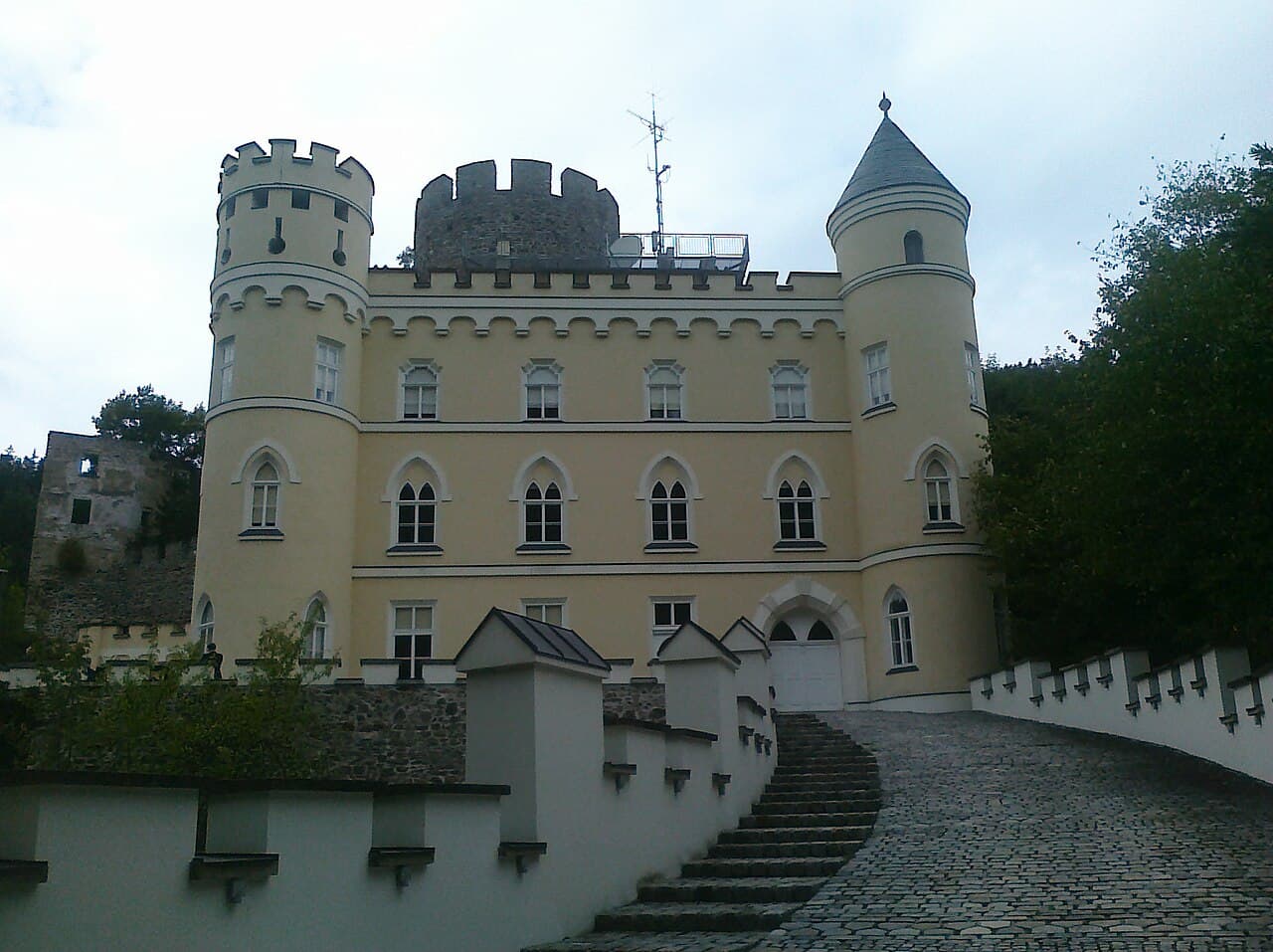
Hartenstein Castle
Hartenstein Castle is a notable hill castle located in Weinzierl am Walde, in the region of Lower Austria. Perched at an elevation of 516 metres (1,693 ft) above sea level, this castle stands as a significant medieval landmark with a history dating back to the 12th century. The castle’s origins are closely linked to the noble Kuenringer family, with records mentioning a possible descendant, Heinricus de Hertinsteine, around the year 1187. This connection situates Hartenstein Castle firmly within the High Medieval period, reflecting the architectural and feudal developments of that era.
Medieval origins and architectural features
Constructed primarily as a defensive fortress, Hartenstein Castle was strategically positioned on a hilltop to oversee the surrounding landscape and control important routes. The castle’s design originally included robust stone walls, a main keep, and fortified towers that provided vantage points for surveillance and defense. Although much of the castle has fallen into ruin, remnants of the two main towers still survive, which were repurposed in the early 19th century as granaries, indicating adaptive reuse over time.
The castle complex also featured an outer fortification, which was partially destroyed during a siege in 1645 by Swedish forces amid the turmoil of the Thirty Years' War. Despite this damage, the main castle withstood the attack, underscoring its solid construction and strategic importance.
Decline and transformation in the early modern period
By the second half of the 17th century, the castle’s role as a noble residence diminished as its lords preferred more comfortable homes, leading to gradual abandonment and decay. In 1726, the estate was granted by Emperor Charles VI to Baron Philipp Ferdinand von Gudenus, whose family maintained ownership until 1927. During the late 18th century, salvageable materials from the castle, such as doors and window frames, were reused by Johann Heinrich von Gudenus to construct a hunting lodge named Els, reflecting a common practice of recycling building materials from older structures.
19th-century adaptations and hydrotherapy facility
In the late 19th century, the castle grounds experienced a revival of sorts when Dr. Otto Pospischil leased the estate in 1892. He converted the outer castle into a hydrotherapy facility, rebuilding it between 1892 and 1896 in a style reminiscent of a castle, which blended historic aesthetics with contemporary health practices of the time. Meanwhile, the original main castle remained largely in ruins, a testament to its long period of neglect.
20th-century uses and cultural significance
During the Nazi era, the site was repurposed as a youth castle, reflecting the regime’s emphasis on youth programs and ideological training. This period added a new layer to the castle’s complex history, intertwining it with 20th-century political and social developments.
Archaeological importance: the Gudenus cave
Below the castle lies the Gudenus Cave, an important archaeological site formed by riverbank erosion. This cave is renowned for containing some of the earliest traces of human settlement in Lower Austria, dating back nearly 100,000 years. Archaeologists have uncovered Neanderthal artifacts here, including hand axes and other stone tools, providing invaluable insight into prehistoric life and human evolution in the region.
Prehistoric findings and their significance
The discoveries in the Gudenus Cave highlight the long-standing human presence in this area well before the medieval construction of Hartenstein Castle. These artifacts contribute to our understanding of early human technology and adaptation during the Stone Age, making the site significant not only for medieval history enthusiasts but also for archaeologists and anthropologists studying prehistoric Europe.
Visitor experience and preservation
Today, Hartenstein Castle exists largely as a ruined hill castle, with parts of its structure still visible amidst the natural landscape. Its historical layers—from medieval fortifications to 19th-century adaptations and prehistoric archaeological sites—offer a multifaceted experience for visitors interested in architecture, history, and archaeology. The site’s elevated position provides panoramic views of the surrounding countryside, enhancing its appeal as a destination for cultural tourism in Lower Austria.
While the castle itself is not fully restored, its ruins and the nearby Gudenus Cave remain protected as cultural heritage sites, preserving both medieval and prehistoric legacies for future generations.
Frequently asked questions (FAQ)
- What is the historical significance of Hartenstein Castle?
- Hartenstein Castle is a significant medieval fortress located in Weinzierl am Walde, Austria. It dates back to the 13th century and has played a crucial role in the region's history, serving as a stronghold during various conflicts and reflecting the architectural styles of its time.
- When was Hartenstein Castle built?
- Hartenstein Castle was constructed in the 13th century, with its earliest records dating back to 1250. Over the centuries, it has undergone numerous renovations and expansions, making it a fascinating representation of medieval architecture.
- Can I visit Hartenstein Castle?
- Yes, Hartenstein Castle is open to visitors, allowing them to explore its rich history and impressive architecture. Guided tours are available, providing insights into the castle's past and its significance in the region.
- What are the opening hours for Hartenstein Castle?
- Hartenstein Castle is typically open from April to October, with varying hours depending on the season. It is advisable to check the official website for the most current opening times and any special events.
- Is it possible to access Hartenstein Castle by public transport?
- Yes, Hartenstein Castle is accessible by public transport. Visitors can take a train to the nearest station and then use local bus services or taxis to reach the castle, making it a convenient destination for tourists.
- What are the ticket prices for entering Hartenstein Castle?
- Ticket prices for Hartenstein Castle are generally affordable, with discounts available for students and seniors. It is best to check the official website for the latest pricing information and any special offers.
- When is the best time to visit Hartenstein Castle?
- The best time to visit Hartenstein Castle is during the spring and early autumn months when the weather is pleasant and the surrounding landscape is beautiful. Visiting during these times also allows guests to enjoy various outdoor activities and events hosted at the castle.
- Are there any nearby attractions to explore while visiting Hartenstein Castle?
- Yes, there are several nearby attractions worth exploring, including the scenic hiking trails and local vineyards. Visitors can also enjoy the charming villages in the vicinity, which offer a glimpse into the traditional Austrian countryside.
Photo gallery

Information
Loading map...
Visitor reviews
No reviews yet. Been here? Write the first review and help other travelers!
Write the first reviewVisited this castle? Share your experience
Your review helps other travelers and adds first-hand knowledge to our encyclopedia.


