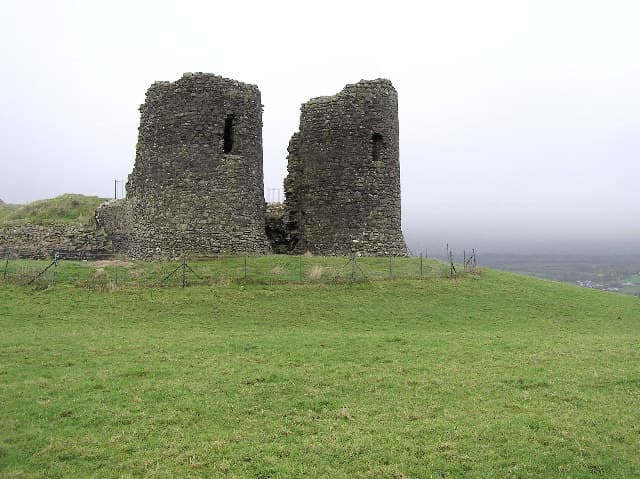
Harry Avery's Castle
Harry Avery's Castle stands as a rare and evocative example of a Gaelic Irish stone castle from the late medieval period, located southwest of Newtownstewart in County Tyrone, Northern Ireland. This fortress, built around 1320, was commissioned by a chieftain of the powerful O’Neill clan, one of the most influential Gaelic families in Irish history. The castle is named after Henry Aimhréidh O'Neill, anglicised as Harry Avery, a local chief who died in 1392. It reflects the transitional architecture of native Irish lords adapting stone fortifications influenced by Norman designs while maintaining Gaelic defensive traditions.
Historical context and significance
The construction of Harry Avery's Castle during the early 14th century marks an important period when Gaelic chieftains began adopting stone castle-building techniques, previously dominated by Norman settlers. The castle's association with the O’Neill clan situates it within the turbulent political landscape of medieval Ulster, where native Irish lords sought to assert their power amid English incursions and inter-clan rivalries. The castle's capture by English forces in 1609 reflects the wider conquest and colonization efforts in Ireland during the early 17th century, which ultimately led to the decline of Gaelic strongholds.
Architectural features and layout
Overall structure and design
Harry Avery's Castle is primarily a two-storey rectangular tower house, a common form of late medieval Irish castles. What distinguishes this fortress are the massive D-shaped twin towers projecting from the south face, resembling a gatehouse but serving as integral parts of the tower house itself rather than a separate entrance complex. These D-towers provided additional defensive strength and internal space, reflecting a sophisticated understanding of castle architecture.
Defensive elements
The castle is situated on an artificially scarped knoll, enhancing its defensibility by elevating it above the surrounding landscape. The knoll's sides are reinforced with a revetted wall forming a polygonal enclosure, which would have supported wooden structures and provided a courtyard space within the castle's perimeter. The vaulted basement was accessed through a large door between the twin D-towers, facilitating secure storage and shelter.
Interior layout
The first floor housed a hall, the main living and reception area, accessed from the courtyard. The southern D-tower contained a spiral staircase connecting the basement and first floor, while both towers included small rooms with single windows, likely used for private chambers or storage. Traces of a mural stair suggest access to an upper parapet level, which would have been used for defensive patrols and observation. A latrine chute indicates sanitary provisions within the upper floors, a feature of advanced medieval castle design.
Architectural influences and comparisons
The design of Harry Avery's Castle demonstrates clear inspiration from Norman castles such as Carrickfergus Castle and Castle Roche, both of which feature true gatehouses flanked by D-shaped towers. However, unlike these Norman fortresses, Harry Avery's Castle integrates these elements into a single tower house structure, reflecting a unique Gaelic adaptation. Similarities have been noted with other native-built castles like Elagh Castle in Inishowen and Seafin Castle in County Down, which also feature D-towers and curtain walls enclosing tower houses, indicating a regional architectural tradition among Gaelic lords.
Later history and current condition
Following its capture by English forces in 1609, Harry Avery's Castle fell into disuse and was subsequently quarried for building materials, a fate common to many medieval Irish castles. Today, only the two-storey tower house with its distinctive D-shaped twin towers remains, standing in a field accessible to the public. The castle's setting offers panoramic views of the surrounding countryside and the valley of the River Derg, enhancing its atmospheric appeal despite its ruined state. Nearby, the better-preserved Newtownstewart Castle provides additional context to the region's rich medieval heritage.
Visiting Harry Avery's Castle
Visitors to Harry Avery's Castle can explore the site freely, though they are advised to respect the grazing livestock that share the surrounding fields. While the remains are modest, the castle's remote and tranquil location offers a unique glimpse into the Gaelic past and the evolution of native Irish fortifications. Its rarity as a Gaelic-built stone castle with Norman architectural influences makes it a valuable site for enthusiasts of medieval Irish history and architecture.
Frequently asked questions (FAQ)
- How do I get to Harry Avery's Castle?
- Harry Avery's Castle is located about half a mile southwest of Newtownstewart in County Tyrone, Northern Ireland. It can be accessed via Old Castle Road, and visitors typically reach it by car or local transport followed by a short walk through fields.
- What is the historical significance of Harry Avery's Castle?
- Harry Avery's Castle is a rare example of a Gaelic Irish stone castle from the 14th century, associated with the O’Neill clan. It reflects the adaptation of Norman architectural features by native Irish chieftains during the late medieval period.
- Can I enter the castle?
- The castle remains are ruins without internal access to upper floors, but visitors can explore the exterior and surrounding grounds freely. Caution is advised due to uneven terrain and grazing livestock.
- When is the best time to visit Harry Avery's Castle?
- The castle is accessible year-round, but the best time to visit is during dry weather in spring or summer when the surrounding countryside is most scenic and the paths are easier to navigate.
- Are there other castles nearby to visit?
- Yes, Newtownstewart Castle is located close to Harry Avery's Castle and offers additional insight into the region's medieval heritage. Visitors often combine both sites in a single trip.
Photo gallery

Information
Current owner
Private owner
Address
Old Castle Road, Newtownstewart, County Tyrone, Northern Ireland
Loading map...
Visitor reviews
No reviews yet. Been here? Write the first review and help other travelers!
Write the first reviewVisited this castle? Share your experience
Your review helps other travelers and adds first-hand knowledge to our encyclopedia.



