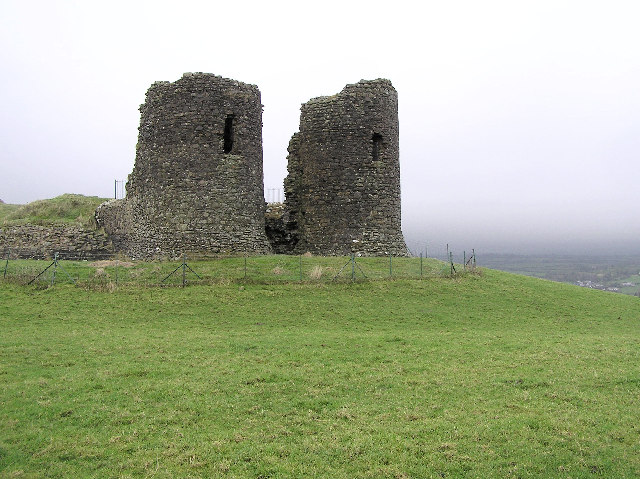
Derg Castle
Derg Castle, also known as Castlederg Castle, is a historic fortress located on the north bank of the River Derg beside the village of Castlederg in County Tyrone, Northern Ireland. This site offers a glimpse into the turbulent history of Ulster, reflecting the shifting control between Gaelic clans and later colonial powers. The castle's story spans from its origins as a late 15th-century Irish tower house to its transformation into a fortified bawn during the early 17th century, and its eventual decline into ruin.
Early history and strategic importance
The first recorded mention of a castle at Castlederg dates to 1497. This original structure was likely a square Irish tower house, a common form of fortified residence in late medieval Ireland. Positioned strategically to command a ford on the River Derg, the castle played a crucial role in controlling access to the surrounding lands. Its location made it a valuable military asset for the Gaelic chieftains who dominated the region.
The castle was initially established by the O'Donnell clan, one of the most powerful Gaelic families in Ulster. However, during the late 15th and early 16th centuries, the castle frequently changed hands amid fierce rivalry with the O'Neill clan. In 1497, the O'Neills captured the stronghold, only for the O'Donnells to retake it in 1505. This back-and-forth control highlights the intense conflict between these clans for dominance in this border region.
The plantation of ulster and architectural transformation
The early 17th century brought significant change with the Plantation of Ulster, a policy initiated by the English Crown to colonize and pacify the region. In 1610, the lands including the castle site were granted to Sir John Davies, the Attorney General for Ireland, who undertook a major reconstruction of the castle.
Davies replaced the original tower house with a fortified enclosure known as a bawn. This structure measured approximately 100 feet by 80 feet and was built from stone and lime mortar, reflecting the construction techniques of the period. The bawn featured three open flankers, defensive towers projecting from the walls to provide enhanced coverage and protection against attackers. The walls themselves stood about five feet high, providing a formidable barrier around the courtyard.
In addition to the bawn, Davies constructed a seven-mile straight causeway connecting Derg Castle to Kirlish Castle, another plantation fortification. This causeway was a significant engineering feat of the time, facilitating rapid communication and troop movement between the two sites, thereby strengthening the English hold on the region.
A 1619 survey by Captain Nicholas Pynnar recorded the status of the castles on Davies's estate, noting that while the stone and lime castles existed, the bawns were still incomplete. By 1622, the bawn at Derg Castle was described as unfinished but structurally substantial, indicating ongoing efforts to consolidate the plantation defenses.
Military significance during 17th-century conflicts
Derg Castle played a critical role during the Irish Rebellion of 1641. The castle served as a refuge for the local settler community, predominantly Scottish and English Protestants, who faced attacks from Irish Catholic rebels. Despite being besieged by a much larger force led by Sir Phelim O'Neill, a prominent rebel leader, the small garrison held out for an extended period. The defenders ultimately surrendered only after their ammunition was exhausted, underscoring the castle's robust defensive design.
Later, during the Williamite War in Ireland in 1689, the castle was again garrisoned by settler forces loyal to William of Orange. It capitulated to the forces of James II after assurances were given that the lives of the defenders would be spared. Following this event, the castle was abandoned and gradually fell into ruin.
Architectural remains and current condition
Today, the original tower house no longer survives above ground. The most prominent remains are those of the 17th-century bawn, particularly the northern wall with its two flankers, which remain the best-preserved elements of the site. The southern walls have largely disappeared, having been eroded over time by the flow of the River Derg.
The bawn's walls, constructed using stone bonded with lime mortar, demonstrate early 17th-century building techniques typical of Ulster Plantation fortifications. The open flankers, designed to provide overlapping fields of fire, are a distinctive feature that highlights the defensive priorities of the period.
Inside the bawn, very little remains of the original internal buildings, which have not survived the centuries of neglect and natural decay. The defensive causeway linking Derg Castle to Kirlish Castle has also vanished from the landscape, leaving only historical records to attest to its existence.
Cultural significance and visitor information
Derg Castle is recognized as a Scheduled Historic Monument, protected for its cultural and historical importance. The site is managed by the Northern Ireland Department for Communities, which ensures its preservation and accessibility for public education and enjoyment.
Located within a village park, the castle ruins are freely accessible to visitors. While the site offers limited architectural detail due to the extent of its ruinous state, it remains a valuable heritage landmark that illustrates the complex history of Ulster's Gaelic and colonial past.
Visitors can explore the surviving walls and flankers, gaining insight into the defensive strategies employed during the Plantation period. The peaceful rural setting adds to the experience, making Derg Castle a noteworthy destination for those interested in Irish history and castle architecture.
Frequently asked questions (FAQ)
- How do I get to Derg Castle?
- Derg Castle is located in the village of Castlederg in County Tyrone, Northern Ireland. It is accessible via Parkview Road and is situated within a public village park, making it easy to visit by car or local transport.
- What is the historical significance of Derg Castle?
- Derg Castle played a key role in the late medieval conflicts between the O'Donnell and O'Neill clans and later served as a fortified plantation bawn during the 17th century. It was involved in major events such as the Irish Rebellion of 1641 and the Williamite War.
- Can I enter the castle ruins?
- Yes, the castle ruins are freely accessible to the public. Visitors can explore the remaining walls and flankers, although the original tower house no longer stands. The site is open year-round and offers a peaceful setting for historical exploration.
- When was Derg Castle built?
- The original castle at Castlederg was first mentioned in 1497 as a square Irish tower house. It was reconstructed into a bawn in the early 17th century during the Plantation of Ulster.
- Is there an entry fee to visit Derg Castle?
- There is no entry fee to visit Derg Castle. The site is located in a public park and is open to visitors free of charge.
- What architectural features remain at Derg Castle?
- The most notable surviving features are the northern bawn walls and two open flankers. The southern walls have mostly been lost to river erosion, and the original tower house no longer exists above ground.
Information
Current owner
Northern Ireland Department for Communities
Website
Visit websiteAddress
Parkview Road, Castlederg, County Tyrone, Northern Ireland
Sources & official resources
Verify the information above using these authoritative references.
Loading map...
Visitor reviews
No reviews yet. Been here? Write the first review and help other travelers!
Write the first reviewVisited this castle? Share your experience
Your review helps other travelers and adds first-hand knowledge to our encyclopedia.