Hardknott Roman Fort
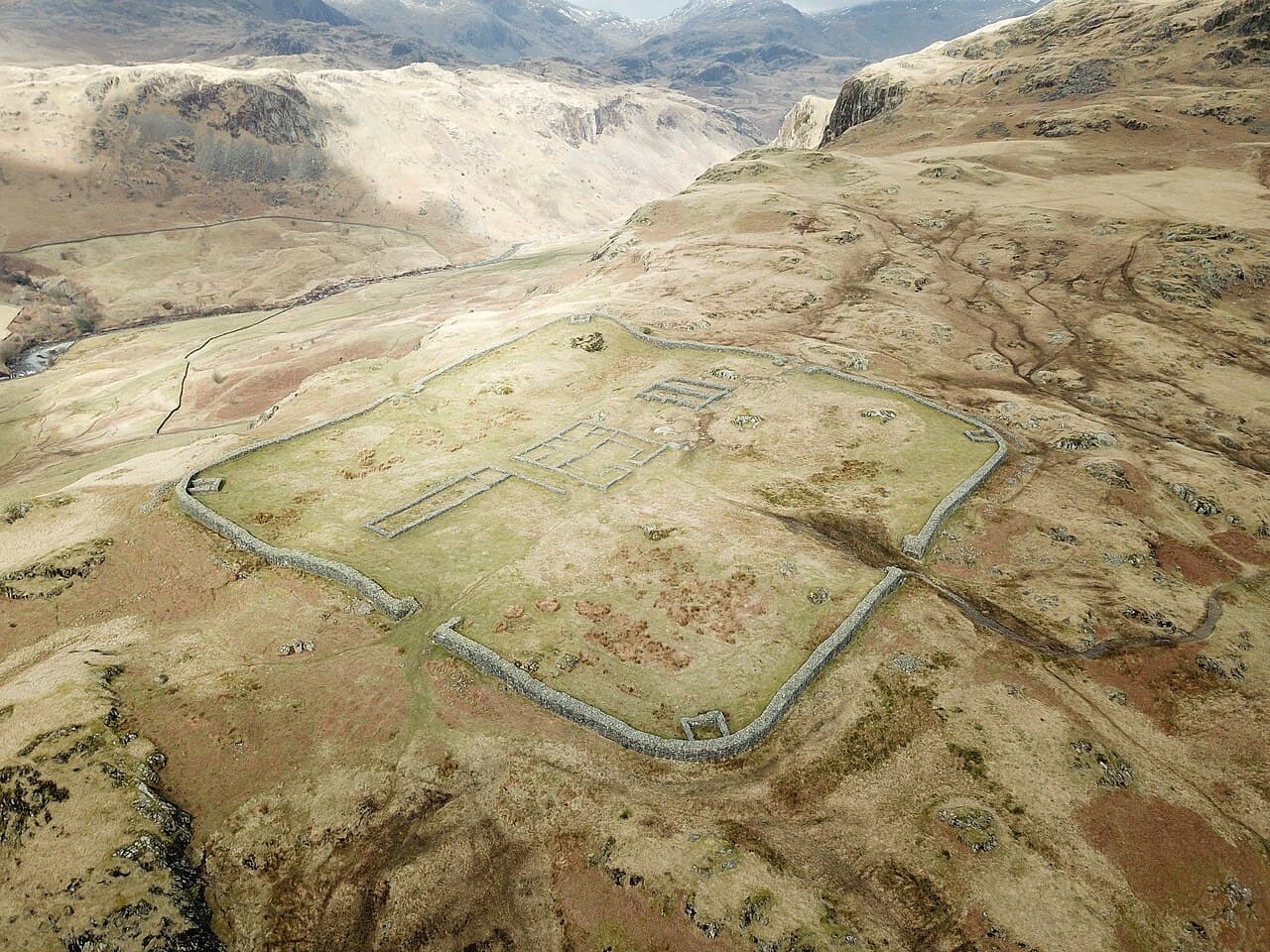
Hardknott Roman Fort, known in antiquity as Mediobogdum, is a significant archaeological site located in the English Lake District, within the modern ceremonial county of Cumbria. This fortification stands on a rocky spur on the western side of the steep and challenging Hardknott Pass, a strategic mountain route connecting the coastal region with the interior valleys. The fort's position reflects Roman military strategy to control key transportation routes and to secure the frontier of the Roman province of Britannia.
Historical background and construction
The construction of Mediobogdum dates back to the early 2nd century AD, specifically between 120 and 138 AD, during the reign of Emperor Hadrian. This period saw significant Roman military activity aimed at consolidating control over northern Britain, including the building of Hadrian's Wall. The fort was built as part of a network of fortifications designed to monitor and control movement through the region.
The fort was originally garrisoned by the Cohors IV Delmatarum, an auxiliary infantry unit recruited from the Dalmatian coast (modern-day Croatia). This unit's presence illustrates the Roman practice of stationing troops far from their homelands to reduce local sympathies and increase loyalty to Rome.
Hardknott Roman Fort was constructed on a naturally defensible rocky spur, which was enhanced by Roman engineering techniques. The fort's layout was roughly rectangular, enclosed by strong defensive walls and towers. Its design included typical Roman military architectural features such as gates, barracks, granaries, and a principia (headquarters building).
Military use and occupation phases
The fort's initial occupation lasted about a decade before it was abandoned, likely due to shifts in military priorities or local conditions. Around 200 AD, the site was reoccupied and remained in use for much of the next two centuries, reflecting its ongoing strategic importance. This second phase of occupation coincided with renewed Roman efforts to maintain frontier defenses and control over northern Britain.
Throughout its use, the fort served as a base for controlling the surrounding territory, overseeing local populations, and securing the vital pass. Its location allowed Roman forces to monitor movements and respond quickly to any threats or incursions.
Architectural features and layout
Although now in ruins, the remains of Hardknott Roman Fort reveal the typical characteristics of a Roman auxiliary fort. The fort was enclosed by a stone wall with bastions at intervals, providing defensive strength against attacks. The bastions allowed defenders to cover the walls with crossfire, enhancing the fort's security.
Inside the walls, the layout followed a standard Roman military plan. The central principia housed administrative offices and a shrine, while barracks accommodated the soldiers. Granaries ensured a stable food supply, and workshops supported maintenance and repairs. Roads within the fort connected the main gates and buildings, facilitating efficient movement.
The fort's elevated position on a rocky spur not only provided natural defense but also commanding views of the surrounding landscape, including the valleys below and the mountain passes. This vantage point was crucial for surveillance and early warning.
Later history and preservation
After the Roman withdrawal from Britain in the early 5th century, Hardknott Roman Fort fell into disuse and gradually became a ruin. Over the centuries, the site was subject to natural decay and occasional stone robbing for local building projects. Despite this, substantial remains of the fort's walls and structures have survived, offering valuable insights into Roman military architecture and presence in northern England.
Today, the fort is located on land owned by the National Trust, within the Trust's Wasdale, Eskdale, and Duddon property holdings. It is maintained and managed by English Heritage, ensuring its protection and accessibility to the public. The site lies within the civil parish of Eskdale in the unitary authority area of Cumberland.
Visitors to Hardknott Roman Fort can explore the ruins and appreciate the challenging terrain that Roman soldiers once guarded. Interpretive signage and pathways help to explain the fort's historical context and architectural features, making it a valuable educational resource.
Significance in Roman Britain
Hardknott Roman Fort represents an important example of Roman military engineering and frontier strategy in northern Britain. Its location on a difficult mountain pass illustrates the Roman emphasis on controlling key routes and maintaining communication lines. The fort's occupation by an auxiliary cohort from Dalmatia highlights the diversity of the Roman army and its deployment across the empire.
As one of the highest Roman forts in Britain, Hardknott offers unique insights into the challenges faced by Roman forces operating in rugged and remote environments. The site's archaeological remains contribute to understanding the broader network of Roman fortifications that supported the empire's northern frontier.
Frequently asked questions (FAQ)
- How do I get to Hardknott Roman Fort?
- Hardknott Roman Fort is located in Eskdale, United Kingdom. The fort is accessible by car, and there is parking available nearby. Public transportation options are limited, so it's best to plan your visit by driving or arranging a taxi.
- What is the historical significance of Hardknott Roman Fort?
- Hardknott Roman Fort, also known as Mediobogdum, was built in the 2nd century AD as part of the Roman defense system in Britain. It served as a key military outpost guarding the important Roman road that traversed the region. The fort provides valuable insight into Roman military life and engineering in a challenging landscape.
- When was Hardknott Roman Fort built?
- Hardknott Roman Fort was constructed around AD 120 during the Roman occupation of Britain. It was strategically positioned to oversee the surrounding area and protect the Roman frontier. The fort underwent several modifications throughout its use, reflecting changes in military tactics and architecture.
- Can I enter the fort and explore the ruins?
- Yes, visitors are welcome to explore the ruins of Hardknott Roman Fort. The site is largely open and allows for self-guided tours, so you can wander through the remnants at your own pace. Be sure to take care while navigating the grounds, as some areas may be uneven.
- Why is Hardknott Roman Fort important for archaeological studies?
- The fort is important for archaeological studies as it provides a well-preserved example of Roman military architecture and settlement patterns in Britain. Excavations have uncovered various artifacts, including pottery and coins, which help historians understand the daily lives of Roman soldiers and local interactions. The site contributes significantly to our knowledge of Roman Britain.
- Is it possible to visit Hardknott Roman Fort year-round?
- Yes, Hardknott Roman Fort is open to visitors year-round, but it's best to check local conditions and weather before your visit. The site can be less accessible during winter months due to snow or heavy rain. Always consult local resources for the most current information regarding access and conditions.
- What are the opening hours for Hardknott Roman Fort?
- The opening hours for Hardknott Roman Fort can vary seasonally, so it's advisable to check the official website or local tourist information for the latest updates. Generally, the site is open during daylight hours, allowing visitors ample time to explore the fort and its surroundings. Ensure you plan your visit accordingly to enjoy the site fully.
- What are the ticket prices for visiting Hardknott Roman Fort?
- There is no admission fee to visit Hardknott Roman Fort, making it an accessible destination for all visitors. However, donations are appreciated to help maintain the site and support ongoing preservation efforts. Be sure to check for any special events that might have associated costs.
- What is the best time to visit Hardknott Roman Fort?
- The best time to visit Hardknott Roman Fort is during the late spring to early autumn months, when the weather is generally milder and more conducive to outdoor exploration. This period offers the best visibility for the stunning views surrounding the fort. However, each season has its own unique charm, so choose a time that suits your preference for weather and landscape.
- Are there any nearby attractions to visit after exploring Hardknott Roman Fort?
- Yes, the Eskdale area offers several nearby attractions, including the scenic Ravenglass and Eskdale Railway, which provides beautiful views of the Lake District. You might also consider visiting the picturesque village of Eskdale or exploring other Roman sites in the vicinity. The area's natural beauty makes it an ideal location for hiking and outdoor activities as well.
Photo gallery

Information
Loading map...
Visitor reviews
No reviews yet. Been here? Write the first review and help other travelers!
Write the first reviewVisited this castle? Share your experience
Your review helps other travelers and adds first-hand knowledge to our encyclopedia.