Edlingham Castle
Edlingham Castle stands as a remarkable example of a fortified manor house in the village of Edlingham, Northumberland, England. Established in the late 12th century, the castle reflects the turbulent history of the Anglo-Scottish border region, where defense and domestic comfort were carefully balanced. Originally held by John of Edlingham by 1174, the site began as a feudal manor before evolving into a defensible stronghold that witnessed centuries of conflict and architectural development.
Historical development and ownership
The castle's history is closely tied to the families who owned and fortified it. In 1294, Walter of Edlingham sold the manor to William de Felton, who initiated significant fortifications to protect the estate against frequent border raids. De Felton's enhancements included strengthening the main hall, constructing a fortified gatehouse, and enclosing the site with ramparts to create a defensible courtyard. These improvements were typical of the late 13th-century response to escalating border tensions between England and Scotland.
Later, in 1396, Elizabeth de Felton brought Edlingham into the possession of the Hastings family through marriage to Sir Edmund Hastings. Sir Edmund further fortified the castle by adding a substantial solar tower, a private chamber that served both residential and defensive purposes. The Hastings family maintained the castle for over a century, up until 1514, overseeing its role as a fortified residence in a volatile borderland.
Following the Hastings era, the castle passed to George Swinburne, constable of Prudhoe, whose family retained ownership until the 18th century. During this period, the strategic importance of Edlingham Castle diminished, and the site gradually fell into disrepair. In the 1660s, much of the castle's stone was repurposed for local farmhouses, accelerating its decline. Despite this, the solar tower survived relatively intact, standing as a testament to the castle's former strength.
Architectural features and layout
Edlingham Castle is classified as a hill castle, positioned at an elevation of approximately 87 meters above sea level in a valley west of Alnwick. The castle's layout is typical of a fortified manor house from the medieval border regions, featuring an enclosed courtyard surrounded by defensive walls and ancillary buildings.
The solar tower
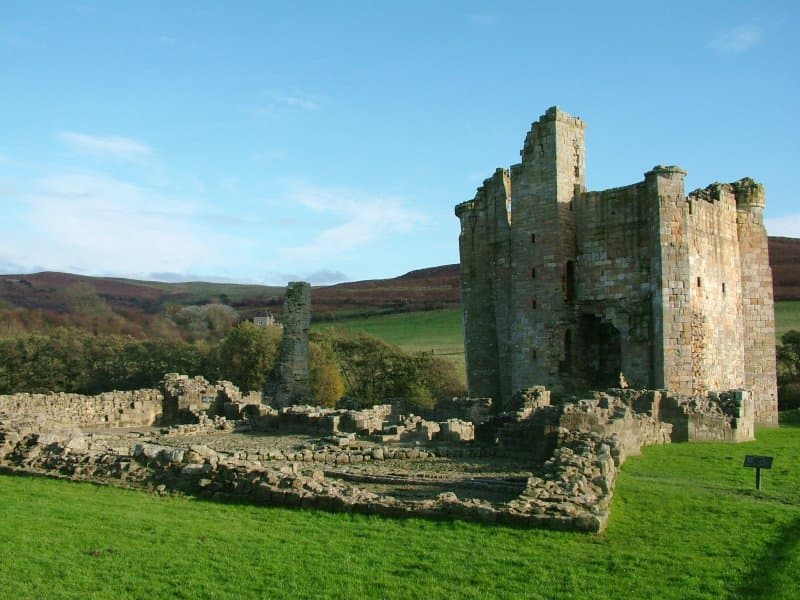
The most prominent surviving structure is the solar tower, dating from the late 14th century and attributed to Sir Edmund Hastings. This tower functioned as a private living space for the lord of the manor and also provided a defensible refuge during attacks. The tower's vertical form dominates the ruins, despite a significant vertical crack extending several storeys down its façade. The solar tower exemplifies the dual residential and military functions of fortified manor houses during this period.
Gatehouse and barbican
The gatehouse and barbican are key defensive features dating mainly from the 16th century. The gatehouse controlled access to the castle, while the barbican served as an outer defensive work protecting the entrance approach. Both were constructed using local stone and typical masonry techniques of the time, highlighting the continued adaptation of the castle's defenses over the centuries.
Hall house and courtyard buildings
Within the courtyard, the remains of the hall house and various subsidiary buildings provide insight into the castle's domestic arrangements. These structures, mostly reduced to low walls and foundations, indicate the presence of living quarters, service areas, and storage facilities essential for the castle's operation as a manorial center.
Role in border conflicts and strategic importance
Edlingham Castle's location was strategically significant as it guarded one of the few western routes to the important settlement of Alnwick. From the 13th to the 16th centuries, the castle played a defensive role during the frequent Anglo-Scottish conflicts that characterized this border region. Its fortifications reflect the need to protect the manor and surrounding lands from raids and incursions.
The castle's evolution from a manor house to a fortified residence illustrates the broader historical context of border warfare and the social status of the local gentry. The presence of defensive features such as ramparts, a gatehouse, and a solar tower underscores the castle's function as both a home and a military stronghold.
Preservation, archaeology, and heritage significance
By the 18th century, Edlingham Castle had largely fallen into ruin, with many buildings dismantled for building materials. However, the solar tower remained a striking feature of the landscape. Archaeological interest resumed in the late 20th century, notably with excavations conducted by the Department for the Environment in 1978. These efforts uncovered buried parts of the solar tower and clarified the castle's layout and construction phases.
Today, Edlingham Castle is a scheduled monument and Grade I listed building, recognized for its historical and architectural significance. The site is located near the church of St John the Baptist, where William de Felton is buried, linking the castle to the local religious heritage. Interpretive materials at the site help visitors understand the castle's history, architecture, and role in the border conflicts.
The ruins, including the standing solar tower and low remains of walls and foundations, offer valuable insights into medieval fortified manor houses in northern England. Edlingham Castle exemplifies the adaptation of domestic architecture to meet defensive needs in a contested frontier zone, making it a significant cultural landmark in Northumberland.
Frequently asked questions (FAQ)
- How do I visit Edlingham Castle?
- Edlingham Castle is accessible to the public year-round as an open-air ruin. Visitors can explore the site at their own pace, with interpretive signage providing historical context. There are no entrance fees, making it an affordable destination for history enthusiasts.
- What is the historical significance of Edlingham Castle?
- Edlingham Castle is significant as a fortified manor house reflecting the turbulent Anglo-Scottish border conflicts from the 13th to 16th centuries. Its surviving solar tower and defensive structures illustrate medieval defensive architecture adapted for domestic use.
- When was Edlingham Castle built?
- The castle's origins date to the late 12th century, with major fortifications added in the late 13th and 14th centuries. Key construction phases include the initial manor house, William de Felton's 1294 fortifications, and Sir Edmund Hastings' 14th-century solar tower.
- Can I see the solar tower at Edlingham Castle?
- Yes, the solar tower is the most prominent surviving feature at Edlingham Castle. It remains standing despite damage and offers a striking example of a medieval private chamber combined with defensive capabilities.
- Is Edlingham Castle suitable for families and children?
- The castle ruins are suitable for families, offering open spaces for exploration and educational signage. However, visitors should exercise caution around uneven ground and standing ruins, especially with young children.
Photo gallery

Information
Website
Visit websiteSources & official resources
Verify the information above using these authoritative references.
Loading map...
Visitor reviews
No reviews yet. Been here? Write the first review and help other travelers!
Write the first reviewVisited this castle? Share your experience
Your review helps other travelers and adds first-hand knowledge to our encyclopedia.